
Your needs, this model
Does it fit your priorities?
What does the MPK Road 88's DIN operating plan actually require?
Akai's v1.1 manual documents 88 notes across A0-C8 and a five-pin MIDI Out; for a computer-free external-instrument route, it specifies a separate 6 V DC, 1 A, center-positive adapter. A sound module and audio-monitoring route are still required. This recalled reference is not a buying match.
Explore this need in the finder →Will the MPK Road 88 clear a 56-inch shelf or stage footprint?
The manual prints a 55.0-inch body width and 1399.2 mm, which converts to 55.09 inches; this review uses the slightly larger converted figure. At a 56-inch body-only cap it clears by less than an inch before plugs, stand support or playing clearance. Its separate 28.3 kg/62.1 lb weight figures conflict, and the published owner notice blocks any buying match.
Explore this need in the finder →Does an MPK Road 88 listing qualify for the earlier-model shortlist?
No. Akai's exact product route carried an owner notice linking to a recall/information page that now returns 404, so this assessment cannot verify an affected serial range or remedy. The matcher excludes the model; ask Akai about the exact serial rather than treating a different seller's description or a former product listing as clearance.
Explore this need in the finder →Reference first: the owner notice takes priority
This is a document-based assessment, not a hands-on review. Akai's exact MPK Road 88 product route showed an important notice for all owners and linked to the manufacturer's recall/information page. Both routes now return unavailable pages, and the archived notice could not be retrieved during this check. That leaves the exact affected serial range and any remedy unverified. For that reason the entire MPK Road 88 is kept as a reference-only model and excluded from the buying finder. A used listing, a seller's claim that it works, or an attractive price is not evidence that a particular unit has been cleared by Akai.
The official v1.1 guide is still useful for identifying the controller and understanding its documented connections. It does not clear a unit's owner-notice status, certify repair, or establish the current availability of software support. Anyone who already owns one should ask Akai about the exact serial number and follow the manufacturer's current safety guidance before use.
An 88-note controller, not a sound module
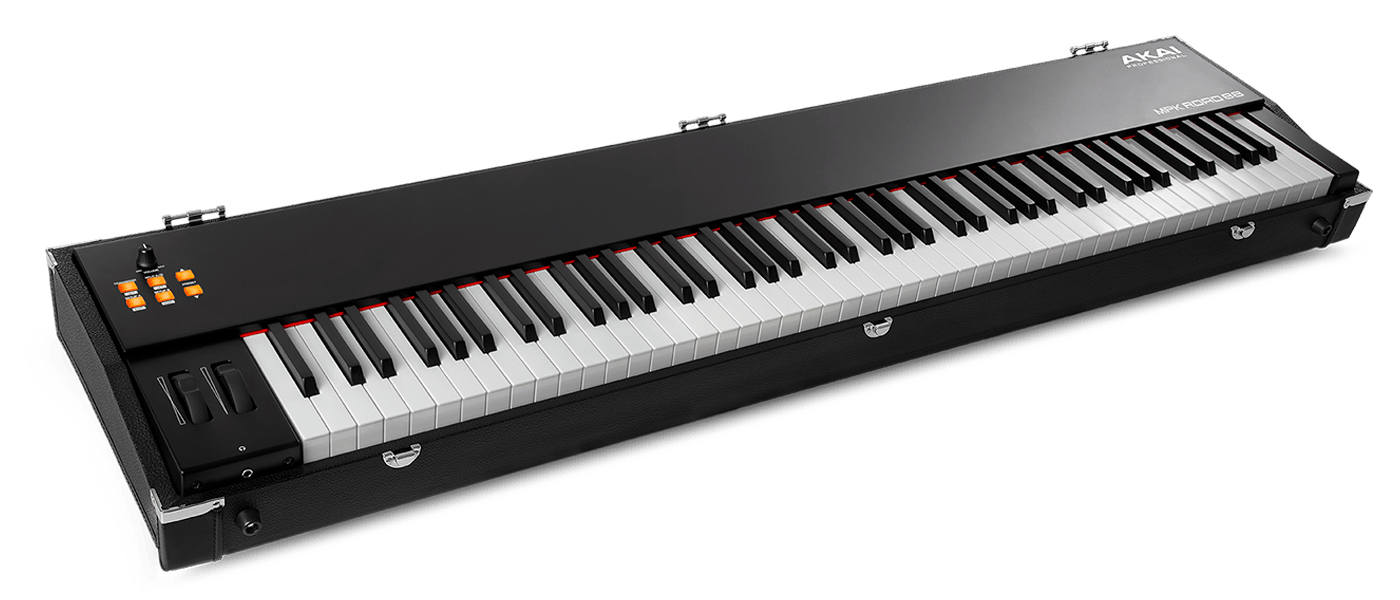
Akai's product-page title described the MPK Road 88 as a hammer-action 88-key controller. The manual confirms MIDI note output and uses A0-C8 as its split-range example, but it does not specify graded weighting, key width, measured action, or keyboard aftertouch. Those finer claims should not be borrowed from the separately named MPK88 or from third-party listings. The large physical span can matter when an external or software instrument needs a wide register without repeated octave shifts; it also consumes far more stage or desk space than a compact controller.
The control surface is oriented toward performance routing rather than a large pad grid. Akai documents pitch and modulation wheels, a master-volume knob, transpose and split functions, two setup/edit buttons and preset up/down. The rear panel adds two continuous expression-pedal inputs and a sustain socket. The guide does not describe a drum-pad bank, so the MPK Road 88 should not be treated as a pad controller simply because it belongs to Akai's broader production-controller family.
USB and DIN are different operating plans
For a computer setup, the guide specifies a USB 2.0 Type-B port and says to connect the keyboard to a computer to trigger a software synth or MIDI sequencer. The manual allows USB power from a powered computer port or powered hub. This is the clearest documented route for a software instrument: MIDI notes leave the keyboard, while the computer and software provide the sound.
For hardware without a computer, the manual describes a different chain: power on the controller and external MIDI device, connect the MPK Road 88's five-pin MIDI Out to the instrument's MIDI In, then play. In that mode the guide specifies a separate 6 V DC, 1 A, center-positive adapter, sold separately. The external instrument must generate audio and have its own monitoring route. MIDI Out carries control messages; it does not turn the receiving instrument on or guarantee an audible signal.
The product-data record calls the unit a four-output USB soundcard, and the manual lists two 1/4-inch main outputs and two 1/4-inch auxiliary outputs. Its front headphone output duplicates Main 1/2. But the manual does not explain how the USB audio device appears to a computer, its routing or supported sample formats. The presence of analog outputs and a marketing description is not enough to certify an interface workflow, so this assessment does not promise that a particular DAW can use it as expected.
Size and package checks are unusually important
Akai's guide gives a body size of 1399.2 x 369 x 171 mm and prints 55.0 x 14.5 x 6.7 inches. The metric width converts to about 55.09 inches; the finder uses that slightly more conservative conversion. It is a body measurement only, not room for cable bends, hands, a stand or safe access to the controls. The manual prints weight as both 28.3 kg and 62.1 lb, which do not agree exactly; no single weight is selected here.
The included-items list names the keyboard, USB cable, software download card, guide and safety/warranty manual. It does not list the optional power adapter, expression/sustain pedals, an external sound module or speakers. A present used or open-box offer may also be missing listed items. The current condition and exact box contents of any seller's unit have not been checked.
Bottom line: keep it out of the purchase shortlist
On documented features alone, the MPK Road 88 represents a distinctive large-format controller: an 88-note range, hammer-action designation, DIN I/O, three pedal sockets and several audio outputs. Its unresolved owner notice changes the practical decision. This page is an identification and connection reference only—not a positive recommendation, a statement that any unit is safe, or a substitute for Akai's serial-specific advice. Do not buy or use an offer on the assumption that another owner's outcome applies to it. For a current comparison, build a fresh shortlist in the MIDI keyboard finder and verify each exact model independently.
Key specifications
Key details at a glance
| Keys | 88 |
|---|---|
| Manufacturer's keybed description | Hammer action |
| Width | 55.09 in |
| Pads | 0 |
| Velocity-sensitive pads | No |
| Pressure-sensitive pads | No |
| 5-pin MIDI Out | Yes |
| Computer connection | USB Type-B |
| USB bus-powered | Yes |
| Assignable pedal input | Yes |
| 5-pin MIDI In | Yes |
| Depth | 14.53 in |
Use the exact model’s instructions for operating limits, supplied equipment and version differences.
Sources for this review
Sources for this assessment
- Akai Professional current builder-data query: exact MPK Road 88 legacy record and image
- Akai Professional MPK Road 88 exact US-coded product route; page presently unavailable
- Akai Professional MPK Road 88 product-page owner notice; recall destination presently unavailable
- Akai Professional MPK Road 88 official legacy downloads entry
- Akai Professional MPK Road 88 User Guide, version 1.1
Start with your setup, not a headline feature
Use the finder to combine key-count, connection, control and desk-fit requirements. Unverified specifications are never treated as a match.