
Your needs, this model
Does it fit your priorities?
Does the Q Mini meet a 25-key minimum, and does octave shifting make it a 37-key keyboard?
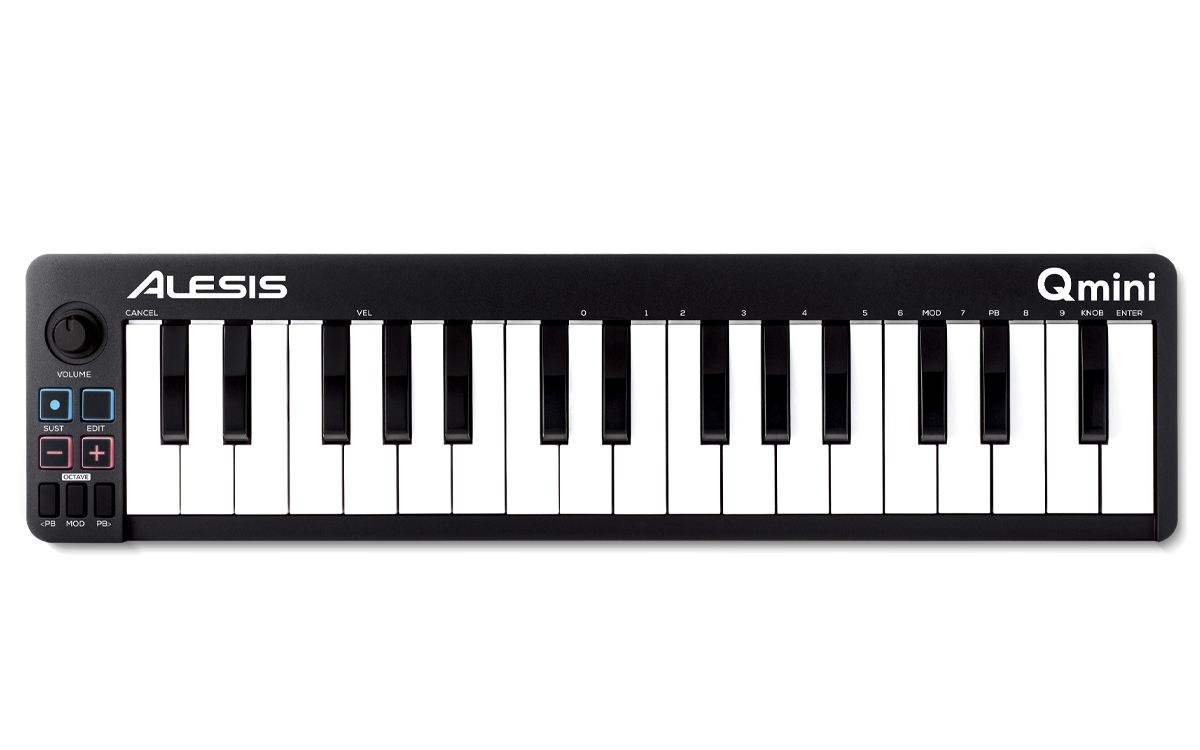
It has 32 physical velocity-sensitive compact keys, so it clears a 25-key floor but not a 37-key minimum. The guide documents octave shifts that reach notes outside the physical span; those shifted notes cannot be played at the same time as notes in a different octave.
Explore this need in the finder →Can I connect the Q Mini to a host that requires USB-C at the controller?
Alesis documents USB MIDI and bus power through the supplied cable, but the reviewed page and guide do not name the Q Mini's device-end connector shape. Do not treat the USB data standard or the host port as proof of a USB-C socket; confirm the exact unit and cable if USB-C is essential.
Explore this need in the finder →Can the Q Mini connect directly to an external sound module's five-pin MIDI input?
No five-pin MIDI output is documented for the Q Mini. Its reviewed connection plan is USB MIDI to a computer, which then needs software that produces sound and its own audio-monitoring path; the Q Mini's pitch/modulation buttons and toggle sustain control do not add a DIN socket.
Explore this need in the finder →The Alesis Q Mini is a 32-key compact controller built around a particularly direct travel setup: octave and transpose buttons, pitch-bend and modulation buttons, an assignable volume knob, and a toggle sustain control. Its exact product page and matching v1.0 guide support that small but useful control set. The evidence does not provide a chassis measurement, USB plug shape, or direct five-pin MIDI connection, so those details should remain open rather than be guessed from a photo.
Thirty-two notes change the useful range
Alesis calls this a compact 32-key keyboard with velocity-sensitive synth-action keys. The guide describes two and a half playable octaves and explains that the octave buttons move the current span up or down by an octave, with a range of four octaves in either direction. That is handy for laying down separate bass and melody takes or reaching notes beyond the keys, but it does not create more simultaneous reach. The Q Mini clears a 25-key floor and misses a 37-key floor; those are materially different answers when a chord, bass note and melody need to remain under the hands together.
The keys are described as compact, not full-size. The inspected sources do not give a numerical key width, name a weighted mechanism, or document aftertouch. Velocity sensitivity means the controller can vary note-on intensity; it should not be read as proof of a particular key feel or piano-style action. A buyer choosing it for serious two-hand practice should compare the actual key spacing with a full-size board, rather than relying on the generic word “keyboard.”
Small controls instead of a large production surface
The top panel gives the player a single reassignable volume knob, pitch-bend buttons, a modulation button, octave/data buttons, edit access and sustain. The guide explains that the modulation control behaves like a button in place of the more familiar wheel and can send an assignable MIDI message; the pitch buttons can also be reassigned. This keeps the unit visually simple and avoids a wider pad or fader bank. It also means expression is more stepped than a hand-operated wheel: a player who expects a smooth wheel gesture should compare another design before settling on the Q Mini.
The sustain control is a button that toggles sustain on or off. It can hold notes without keeping fingers on the keys, but it is not the same workflow as a foot pedal while both hands continue to play. No physical pedal socket appears in Alesis's listed features or the reviewed connection guide. If hands-free pedal use matters, do not assume that an adapter can turn the button into a pedal input.
USB MIDI is a host route, not a sound engine
The matching guide says the included USB cable both powers the keyboard and carries MIDI data to and from a computer. It recommends an externally powered hub when a hub is needed, warns that a passive hub may not supply enough power, and discourages putting an audio interface on the same hub. Alesis says the model can control music software or supported tablet apps, but the reviewed page does not specify the controller-side plug shape. A USB data connection does not prove USB-C, so verify the exact port and cable if a particular connector is a hard requirement.
The guide also makes clear that pressing a key sends MIDI rather than producing sound by itself. A compatible software instrument or an external MIDI sound source must make the audio, and that sound source needs its own headphones, speakers or interface. The Q Mini page lists USB, not five-pin MIDI DIN, as its documented connection. Treat a direct DIN requirement as unmet unless the exact configuration is verified; adding a computer or MIDI host may bridge equipment, but also changes the setup and does not create an audio output on the controller.
What the bundle and portability claims do not settle
Alesis advertises MPC Beats and a Melodics trial, and the box list names a software download card. That can make a compact controller easier to start using, but the reviewed sources do not guarantee that a used unit's registration code is unused, transferable or still eligible. Confirm the exact seller's package and present software terms rather than valuing a code as if it were a permanent license.
The manufacturer calls the Q Mini lightweight and portable but publishes no width, depth, height or weight in the exact page and guide sections reviewed here. The slim visual profile is not a measurement of a bag pocket or a desk shelf. Check the actual body and allow room for the attached cable; do not use octave range or a product photo as a proxy for physical fit.
Bottom line
The Q Mini is a focused choice for compact software control when 32 compact velocity-sensitive keys and button-based performance gestures are enough. It offers octave/transpose reach, MIDI-assignable pitch and modulation buttons, a volume knob, a toggle sustain button and a USB-powered computer route. Its key span, port shape, dimensions and direct hardware MIDI path should not be inferred from larger Q models. This assessment uses Alesis's exact product page and user guide, not hands-on testing; verify the model label, cable and any software-code terms before purchase.
Primary sources: Alesis Q Mini product page; Q mini User Guide v1.0; Alesis MIDI Controllers category.
Key specifications
Key details at a glance
| Keys | 32 |
|---|---|
| Manufacturer's keybed description | Velocity sensitive compact synth action keys |
| Pads | 0 |
| Velocity-sensitive pads | No |
| Pressure-sensitive pads | No |
| 5-pin MIDI Out | No |
| USB bus-powered | Yes |
| Assignable pedal input | No |
| 5-pin MIDI In | No |
| 5-pin MIDI outputs | 0 |
Use the exact model’s instructions for operating limits, supplied equipment and version differences.
Sources for this review
Sources for this assessment
Start with your setup, not a headline feature
Use the finder to combine key-count, connection, control and desk-fit requirements. Unverified specifications are never treated as a match.