
Your needs, this model
Does it fit your priorities?
Does the V49 MKII meet a 49-key minimum for ordinary two-hand parts?
Yes. Alesis identifies this exact model as a 49-key full-size synth-action controller. It provides more physical reach than the V25 MKII, though broad two-handed piano passages may still need octave changes or a larger instrument.
Explore this need in the finder →Can the V49 MKII connect to a computer that requires USB-C at the controller?
The maker documents USB 2.0 MIDI and USB bus power, but the reviewed product-page text and guide do not identify the controller-side socket shape as USB-C. Treat that connector need as unverified and check the exact unit and cable rather than equating a USB data standard with a connector type.
Explore this need in the finder →Can the V49 MKII send directly to a five-pin MIDI sound module?
The model-specific rear-panel guide lists USB, a sustain input, power switch and security connector, with no five-pin MIDI output. The documented setup sends MIDI to a computer; a separate host/interface bridge would add equipment, and the module still needs its own audio connection.
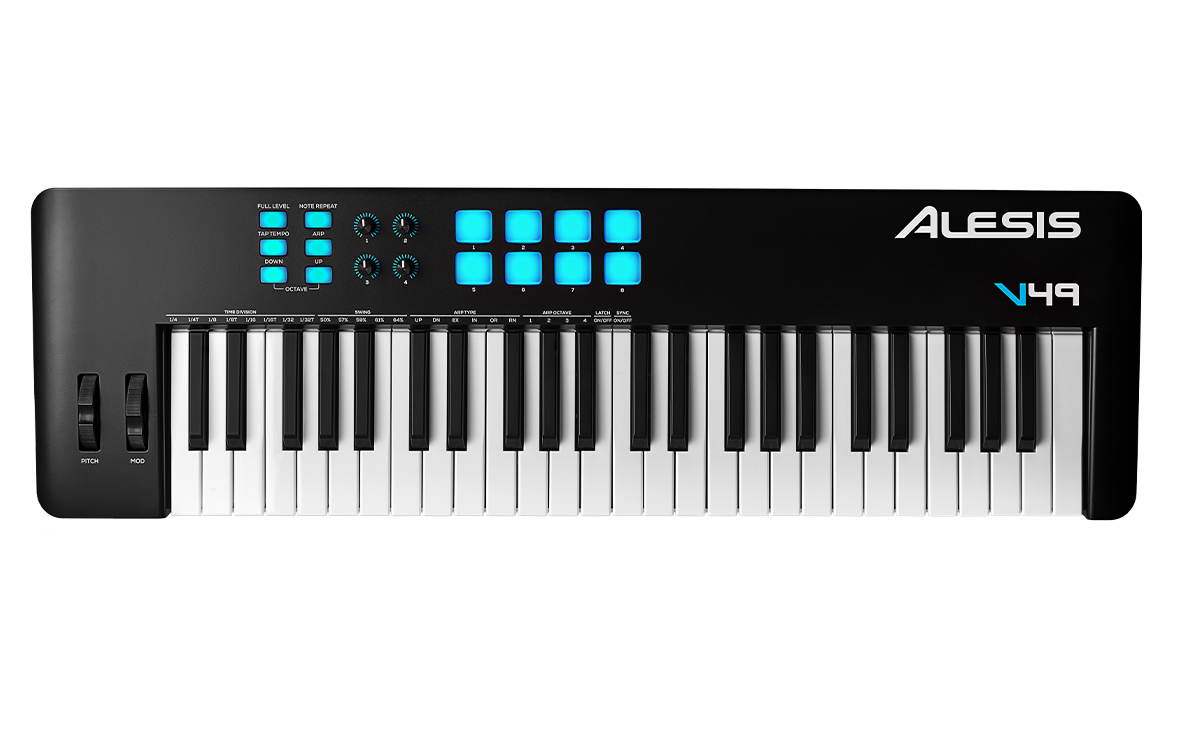
Explore this need in the finder →The Alesis V49 MKII takes the same concise V-series control layout into a 49-key, full-size synth-action format. That middle span can suit parts that feel cramped on a 25-note board while keeping the panel focused on playing, beat triggering and a handful of MIDI assignments. The exact model page and v1.3 guide substantiate its key count and controls; they leave several fit and connection details open.
What the extra keys change
Compared with the V25 MKII, the V49 MKII gives the player 24 more physical notes before any octave buttons are used. That makes it easier to keep a bass register and a melody or chord voicing within one reach, and it reduces the need to shift octaves while sketching. It is still a 49-key controller, not an 88-key piano substitute; broad piano parts can exceed its span. The octave controls remain useful for moving through the wider MIDI note range, but they do not add simultaneous physical reach.
Alesis describes this exact configuration as 49 full-size, velocity-sensitive synth-action keys. The source set does not quantify key width, describe a weighted action, or document key aftertouch. Those are separate questions from note count. The V49 MKII should therefore be considered on the basis of its documented keybed category and practical range, not a numerical measurement or an assumed piano-like mechanism.
A performance layout with a small mapping bank
The V49 MKII keeps eight velocity-sensitive, backlit pads and four assignable knobs beside the keys, plus pitch and modulation wheels. The octave controls also share surface space with tap tempo, arpeggiator, Full Level and Note Repeat functions. This mix gives a software setup several kinds of hands-on input without filling the panel with faders or a large encoder bank. The knobs are assignable MIDI controls, so the owner has to set them up for the software task rather than assume each application has a universal factory layout.
The manual describes the pads as velocity-sensitive and explains that they can trigger drum hits or samples, be reassigned in the V Series editor, use Full Level and retrigger with Note Repeat. It does not document a pressure-sensing pad mode. That distinction matters when choosing between a simple beat trigger and pads expected to transmit ongoing pressure data. No separate display or pad-aftertouch function is specified in the reviewed materials.
A built-in arpeggiator supplies multiple note directions, latch, one-to-four-octave range, swing, time division, tempo sync and gate control. It is a helpful sketching feature when composing with software, but it is not a complete DAW mixer or a multitrack pattern sequencer. The V49 MKII is most coherent for a player who wants a moderate keyboard span and a few performance controls rather than a densely mapped production surface.
Computer MIDI, power and the missing DIN route
Alesis documents USB 2.0 for the computer link and says it powers the keyboard while transferring MIDI. The English guide advises using a powered computer connection or powered hub and explains that the controller exposes separate data paths for the instrument and its editor. The product page calls it USB-MIDI, but the reviewed text does not identify the device-side connector as USB-C. A USB 2.0 claim does not establish a USB-C socket; check the exact unit and cable if that plug shape matters to your workstation.
The rear-panel diagram lists USB, the sustain input, a power switch and a security-lock connector, rather than five-pin MIDI sockets. This matters if the goal is direct control of a hardware instrument with a DIN input: the documented path runs through a computer, and the instrument will need a separate interface or host arrangement to bridge MIDI. The V49 MKII itself is not documented as an audio source. A software instrument or external module produces the sound and needs its own headphone, speaker or interface connection.
Desk fit and package checks are not optional details
Although 49 keys offer more reach than the V25, the manufacturer sources reviewed for this assessment do not give a chassis width, depth, height or weight. Do not infer that a 49-key board fits a particular pull-out tray from its product image. Measure the exact support surface and leave room for the USB cable, hand movement and any stand edges. The guide also warns that an unpowered USB hub may not provide a suitable supply; the cable and a software download card are listed, while a sustain pedal is sold separately.
The product page advertises MPC Beats and other software benefits, and the manual points to a downloadable V Series editor for MIDI mappings and response settings. These are useful setup routes, not a guarantee that every offer includes a redeemable code or that old operating-system requirements remain current. Verify account eligibility, transferability and present Alesis support guidance for the exact computer and seller package.
Bottom line
The V49 MKII is the size to consider when 25 keys feel too restrictive but a full 61-key panel is more than the routine needs. Its documented essentials are a 49-note synth-action bed, eight velocity-sensitive pads, four knobs, wheels, octave controls and USB-powered MIDI to a computer. It does not answer a firm numeric-width question from the reviewed sources, and it should not be matched to USB-C, pressure-sensitive pads or direct DIN without better evidence. This review is based on maker pages and the model-specific guide, not hands-on testing; confirm the model suffix, cable and separate pedal/software terms.
Primary sources: Alesis V49 MKII product page; V49 MKII User Guide v1.3; Alesis MIDI Controllers category.
Key specifications
Key details at a glance
| Keys | 49 |
|---|---|
| Manufacturer's keybed description | Velocity sensitive synth action full size keys |
| Pads | 8 |
| Velocity-sensitive pads | Yes |
| 5-pin MIDI Out | No |
| USB bus-powered | Yes |
| Assignable pedal input | Yes |
| 5-pin MIDI In | No |
| 5-pin MIDI outputs | 0 |
Use the exact model’s instructions for operating limits, supplied equipment and version differences.
Sources for this review
Sources for this assessment
Start with your setup, not a headline feature
Use the finder to combine key-count, connection, control and desk-fit requirements. Unverified specifications are never treated as a match.