
Your needs, this model
Does it fit your priorities?
Does the V61 MKII meet a 61-key minimum without octave shifting?
Yes. Its exact model page and user guide specify a physical 61-note, full-size, velocity-sensitive synth-action keybed. Octave controls add note-range access, but the 61 keys are already present physically.
Explore this need in the finder →Can the V61 MKII connect to a computer that requires USB-C at the controller?
The maker documents USB 2.0 MIDI and USB bus power, but the reviewed product-page text and guide do not identify the controller-side socket shape as USB-C. Treat that connector need as unverified and check the exact unit and cable rather than equating a USB data standard with a connector type.
Explore this need in the finder →Can the V61 MKII send directly to a five-pin MIDI sound module?
The model-specific rear-panel guide lists USB, a sustain input, power switch and security connector, with no five-pin MIDI output. The documented setup sends MIDI to a computer; a separate host/interface bridge would add equipment, and the module still needs its own audio connection.
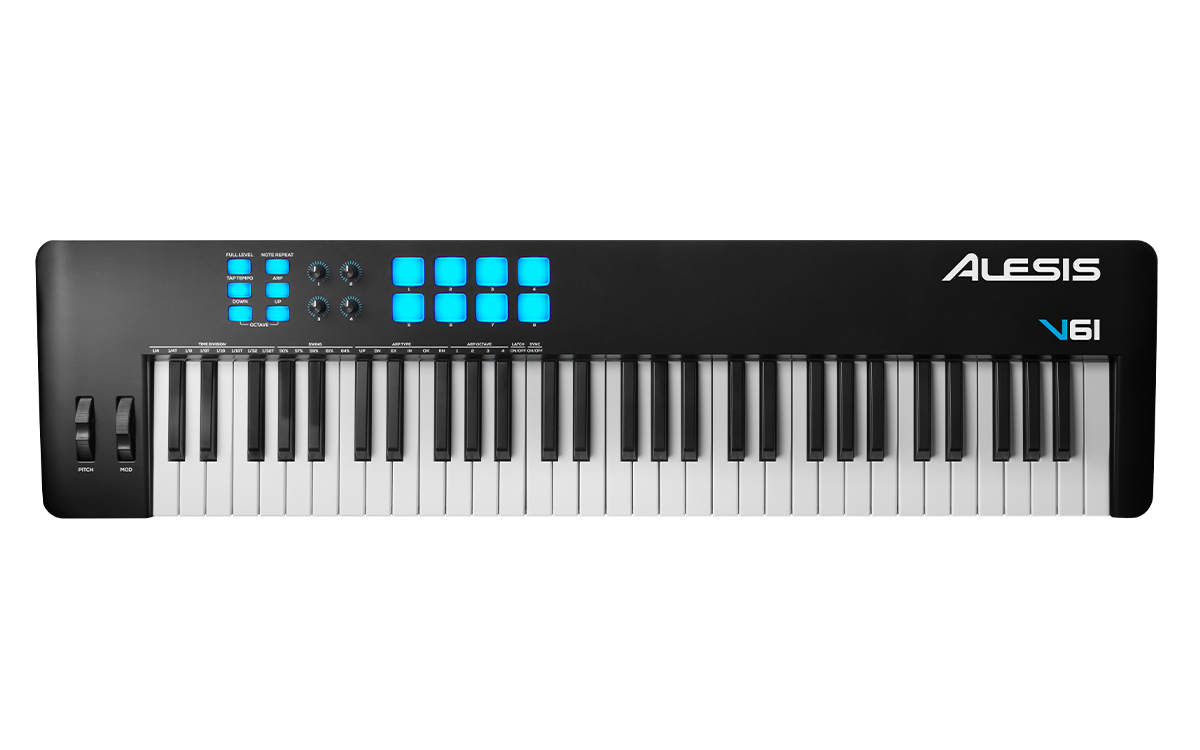
Explore this need in the finder →The Alesis V61 MKII moves the V-series controls to a 61-key, full-size synth-action board. Its central decision is range: 61 physical notes support more continuous two-hand playing than a 25- or 49-key span, while the panel remains simpler than a controller designed around a large DAW mixer surface. Alesis documents the keybed, pads, wheels, arpeggiator and USB-computer setup, but the reviewed material does not provide a chassis measurement.
61 keys add physical reach, not piano weighting
The 61-note bed offers materially more room than the V25 MKII and V49 MKII. That is useful for chords with a separate bass line, longer melodic phrases and arranging that would otherwise require repeated octave shifts. The octave buttons still let the V61 reach across the MIDI note range, but with 61 keys already present they are more of an extension than a substitute for the physical span. An 88-key player or anyone who needs a documented weighted action should compare other models rather than infer those qualities from the longer shell.
Alesis calls the keys full-size, velocity-sensitive and synth-action. The sources reviewed do not publish a key-width measurement, keybed weight, chassis width, depth, height or mass, and they do not state that the keys send channel aftertouch. Those omissions matter for a fixed furniture fit or a specific playing technique. The official 61-key photograph identifies the correct V61 MKII panel and size, but it cannot be used as a scale reference.
Enough built-in control for sketches and software mapping
The documented surface includes eight backlit velocity-sensitive pads, four assignable knobs, pitch and modulation wheels, octave buttons, arpeggiator controls, Full Level and Note Repeat. That is a useful set for entering notes, triggering samples and adjusting a few mapped parameters without reaching for the mouse. It is not a dense desk of sliders, displays and transport controls, so a producer who expects a dedicated fader for every software channel may prefer a different design.
The guide describes the pads as velocity-sensitive triggers for software sounds and explains how Full Level forces a maximum hit and Note Repeat retriggers notes according to timing settings. It does not characterize them as pressure-sensitive pads. The four knobs send assignable MIDI CC messages through the V Series editor; their value depends on configuring useful targets for the chosen software. Alesis also provides an onboard arpeggiator with several note directions, latch, octave range, swing, tempo and gate adjustments. These are practical performance tools, but do not turn the V61 into a multitrack sequencer or a sound module.
USB carries MIDI and power, not audio
The product page and user guide describe USB 2.0 as the computer MIDI and power connection. Alesis recommends a powered USB port and specifically warns that a hub should be powered. The rear-panel illustration shows the USB connection along with sustain, power and a security connector; it does not show five-pin MIDI sockets. For a DIN-only hardware synth, the V61 requires an added computer/interface or a compatible USB-host arrangement rather than a direct keyboard-to-synth DIN cable.
Do not mistake USB 2.0 for a USB-C connection. The written sources inspected do not name the keyboard-side socket shape, so a USB-C requirement is not verified here. Check the exact unit and the cable end before buying if a particular plug is mandatory. In any case, this is a controller: the computer running a software instrument, or an external sound module, must generate audio and connect to its own monitoring equipment.
Measure the actual support and verify the package
The reviewed manufacturer page and guide do not state a physical width, so the site's width matcher cannot make a confirmed tray-fit claim for this exact V61. Measure a real chassis against the usable support area and allow for the USB cable, hand movement and any stand lip. A product image is not a dependable measuring tool, and one should not borrow a number from a V49 or from an unrelated listing.
The guide's box list names the V61 MKII, USB cable, quick-start and safety/warranty documents, and a software download card. The sustain pedal is not included in that list and Alesis says it is sold separately. The maker advertises MPC Beats and the V Series editor, but software entitlements and present computer compatibility need checking for the exact package and registration status. A page's old minimum operating-system line should not be treated as current support advice.
Bottom line
The V61 MKII makes sense when a 61-note physical range is the priority and a simple group of pads, knobs, wheels and arpeggiator controls is enough. Its documented computer route is USB MIDI with bus power; no direct five-pin MIDI, verified USB-C socket or pressure-sensitive pad behavior is established by the reviewed sources. The maker also leaves body measurements unpublished, so there is no evidence-based numeric desk-fit answer yet. This is a research-based assessment, not hands-on testing; verify the precise suffix, fit, cable and software package before choosing a seller.
Primary sources: Alesis V61 MKII product page; V61 MKII User Guide v1.3; Alesis MIDI Controllers category.
Key specifications
Key details at a glance
| Keys | 61 |
|---|---|
| Manufacturer's keybed description | Velocity sensitive synth action full size keys |
| Pads | 8 |
| Velocity-sensitive pads | Yes |
| 5-pin MIDI Out | No |
| USB bus-powered | Yes |
| Assignable pedal input | Yes |
| 5-pin MIDI In | No |
| 5-pin MIDI outputs | 0 |
Use the exact model’s instructions for operating limits, supplied equipment and version differences.
Sources for this review
Sources for this assessment
Start with your setup, not a headline feature
Use the finder to combine key-count, connection, control and desk-fit requirements. Unverified specifications are never treated as a match.