
Your needs, this model
Does it fit your priorities?
Does octave shifting make the Vmini a full-range 127-key keyboard?
No. It has 25 physical mini keys. Octave Up/Down shifts their MIDI note range so the controller can address 127 notes over time, but only the 25-note span is physically available at once.
Explore this need in the finder →Is there a direct five-pin MIDI output on the Vmini?
The exact product page describes a single USB computer connection, and the matching manual's connection callout identifies USB only. A direct five-pin DIN output is not documented; a DIN-only sound module needs a separate computer or suitable USB-MIDI host/interface.
Explore this need in the finder →Do the Vmini's four pads support pressure sensing or key aftertouch?
The official page and v1.1 guide identify the pads as velocity-sensitive but do not specify pressure sensing or keyboard aftertouch. A knob can be assigned to channel-aftertouch messages; that is a different control and does not prove pressure response from a pad or key.
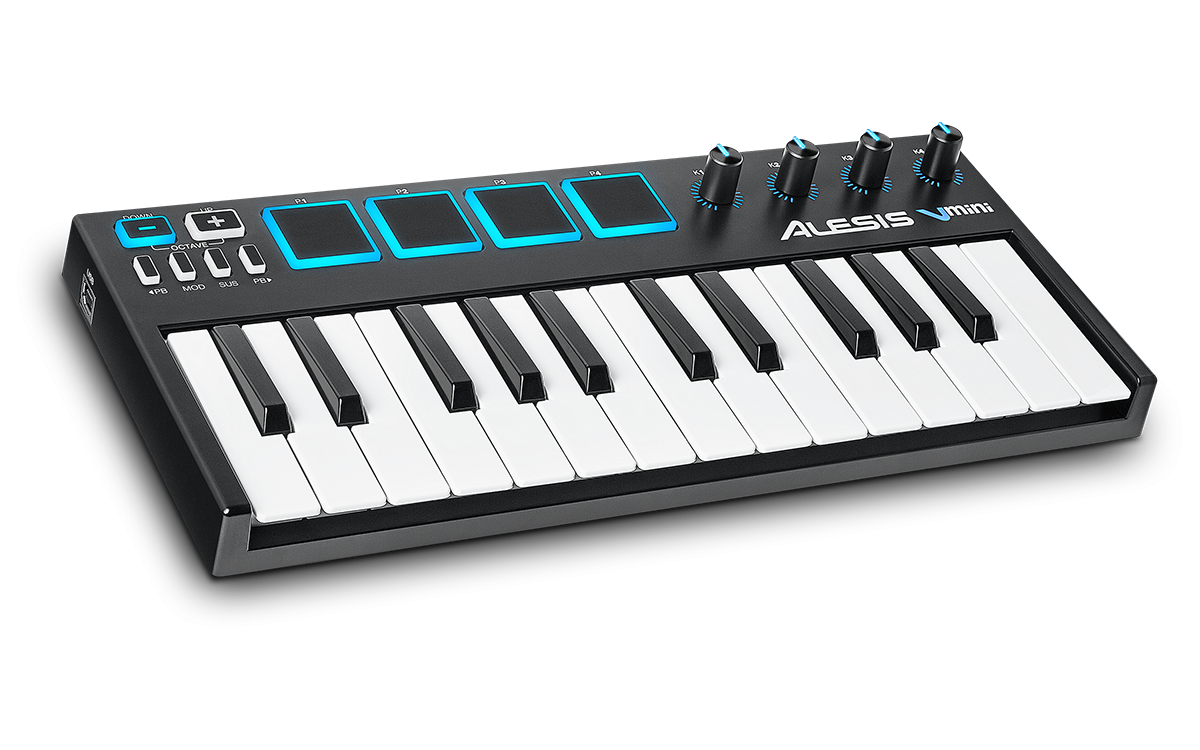
Explore this need in the finder →The Alesis Vmini is a compact 25-key USB-MIDI controller with mini-size velocity-sensitive keys, four pads and four assignable knobs. Its small physical range can shift across the MIDI note span, but octave buttons do not create extra keys. The exact guide documents a computer USB connection and USB power; it does not document five-pin MIDI Out, an onboard sound engine or audio output.
Small physical range with octave shifting
Vmini has 25 mini keys with velocity response. Octave Up/Down can move the playing range so the controller addresses all 127 MIDI notes, but only 25 keys remain under the hands at a time. That works for entering a short melody, bass phrase or chord part one register at a time. It is less convenient when a passage needs a wide two-handed span or distant bass and treble notes simultaneously. The manufacturer calls the action synth-action and mini-size; this is not a full-size or piano-weighted bed.
Neither the exact product page nor the v1.1 manual publishes the chassis width, depth, height or weight, so the official image cannot answer whether it fits a particular tray. Measure the actual unit if a rigid support limit matters, and leave space for the cable and hands. The manual describes a keyboard and octave controls, but does not specify keyboard aftertouch. Its separate assignable knobs may be configured for channel aftertouch messages; that is a knob assignment, not proof that pressing a key sends aftertouch.
Four pads and knobs cover basic mapped tasks
The four illuminated pads are velocity-sensitive and can be assigned to note, control-change or program-change messages using V Mini Editor. Four 270-degree knobs send MIDI CC messages by default, and the manual says they can instead send channel-aftertouch messages. Pitch-bend, modulation, sustain and octave buttons add a few immediate performance actions. These controls can trigger clips, shape a virtual instrument or send mapped commands, but four pads and four knobs are a modest surface compared with controllers that provide a larger pad bank, faders, transport controls or displays.
The official page and matching guide describe the pads as velocity-sensitive, not pressure-sensitive. If pressure on the pads is essential, do not treat velocity response or the knobs' channel-aftertouch assignment as a substitute. The distinction is useful: pad strike velocity, key aftertouch and a knob transmitting channel aftertouch are different input behaviors.
USB to a computer is the documented operating path
The v1.1 guide describes a standard USB cable to a computer; that one connection sends and receives MIDI and supplies power to the Vmini. The source does not identify the controller-side plug as USB-C. The exact product page and manual do not list a five-pin DIN MIDI output or an external power supply, and the rear connection callout is USB. For a DIN-only hardware synthesizer, plan on a separate computer or compatible USB-MIDI host/interface; the controller cannot be treated as a direct DIN keyboard from the evidence reviewed here.
USB MIDI is data, not sound. The controller needs a computer instrument or another compatible host to produce audio, then a separate audio route to speakers or headphones. The product page lists AIR Xpand!2 software, while its guide lists the V Mini Editor and a software download card. That does not prove that a particular used unit includes a valid or transferable license. Verify the included cable, registration status and current operating-system compatibility before assigning value to a software bundle.
What the product page does and does not establish
Alesis's official MIDI Controllers category links to Vmini and its exact product page calls it a portable 25-key USB-MIDI controller. This assessment therefore keeps the exact Vmini identity rather than substituting the 32-key Q Mini or another V-series model. The current category route and the retained product page do not establish a live retailer offer, stock, condition or package. No numeric chassis measurement, USB-C socket, DIN output, pressure-sensitive pad specification, key aftertouch or self-contained audio is claimed.
Who should consider it?
On the documented facts, Vmini suits someone who wants a small, bus-powered controller for a computer-based setup and can work within 25 mini keys, four pads and four knobs. It is not the right evidence-backed pick for a direct five-pin hardware connection, a USB-C-only requirement, pressure-sensitive pads or a fixed width ceiling: the inspected manufacturer sources do not verify those needs. Buyers should also account for the limited simultaneous range and the uncertainty around old software downloads. This is a research-based reading of Alesis's exact page and Vmini v1.1 guide, not a personal-use report or claim that any seller has a complete unit.
Primary sources: Alesis Vmini product page; Alesis V Mini User Guide v1.1; Alesis MIDI Controllers category.
Key specifications
Key details at a glance
| Keys | 25 |
|---|---|
| Manufacturer's keybed description | Velocity sensitive synth action mini keys |
| Pads | 4 |
| Velocity-sensitive pads | Yes |
| 5-pin MIDI Out | No |
| USB bus-powered | Yes |
| Assignable pedal input | No |
| 5-pin MIDI In | No |
| 5-pin MIDI outputs | 0 |
Use the exact model’s instructions for operating limits, supplied equipment and version differences.
Sources for this review
Sources for this assessment
Start with your setup, not a headline feature
Use the finder to combine key-count, connection, control and desk-fit requirements. Unverified specifications are never treated as a match.