
Your needs, this model
Does it fit your priorities?
Can KeyStep mk2 run a sequence without a computer?
Yes, Arturia's manual documents operation from a standard USB mobile charger without a computer and specifies at least 5 V and 100 mA. The exact package lists the controller and USB cable, not a charger, so confirm the power supply yourself. A separate powered MIDI/CV instrument still has to create sound; the controller has no documented audio output.
Explore this need in the finder →What do the KeyStep mk2 sequencer limits mean in practice?
The manual documents 64 stored patterns arranged in four banks, with each pattern up to 64 steps and up to eight notes at a step. Those are onboard sequencing limits, not a promise that every DAW or external device will map its controls automatically. Confirm synchronization, MIDI channels and the receiving instrument's settings for your rig.
Explore this need in the finder →Does keyboard aftertouch make KeyStep mk2 a pressure-pad controller?
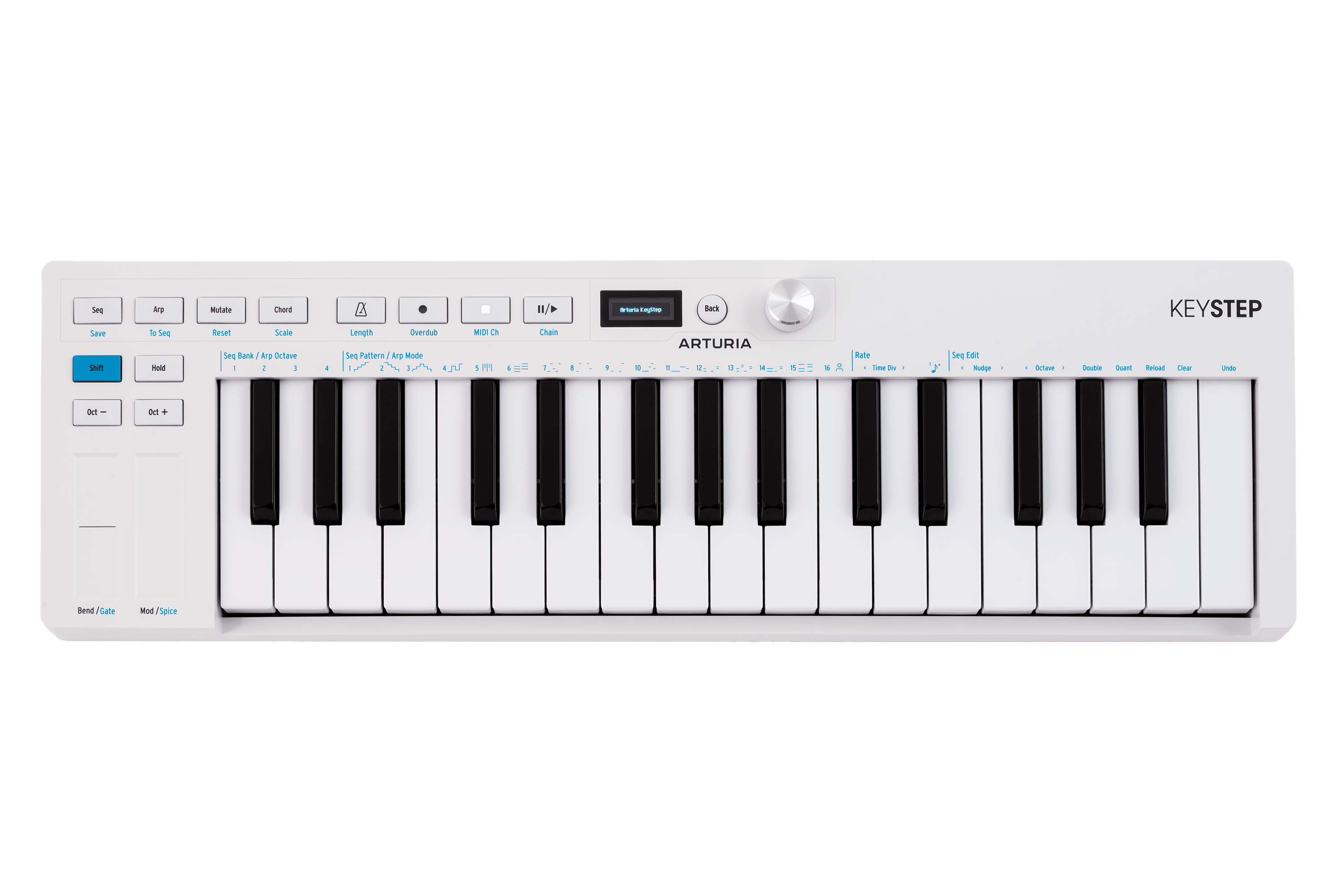
No. The product has aftertouch on the Slimkey keyboard, but the official front view and control list show no physical drum-pad bank. A required pressure-sensitive pad feature therefore does not match this model; key aftertouch and pressure on a separate pad are different controls.
Explore this need in the finder →The Arturia KeyStep mk2 is a 32-key Slimkey MIDI controller with its own sequencer, arpeggiator and several routes for connecting external gear. Its appeal is not simply that it saves desk space: the hardware can store and play musical patterns, shape them with its arpeggiator and send data over USB, MIDI DIN and CV/Gate. The important trade is the short key range. This assessment is based on the current Arturia product pages and its English manual, not hands-on use.
A 32-key range is a specific compromise
Thirty-two keys let you play a compact phrase, chord, bass figure or melodic line without taking up the width of a conventional 49-key board. They do not give the same simultaneous reach as 37, 49 or 61 keys, so a passage with both a broad left-hand part and distant right-hand notes may force octave shifts, separate takes or a different controller. The keybed is described as Slimkey; Arturia's manual says the keys are smaller than standard piano keys and documents velocity and keyboard aftertouch. That is useful information for screening, but it does not establish a measured key width, a force curve or a feel preference. If key size determines your decision, inspect the exact model before choosing it.
The onboard sequencer is more than a demo feature
Arturia documents 64 stored patterns in four banks, with each pattern reaching 64 steps and eight notes at a step. A 16-mode arpeggiator, chord and scale functions, transport controls and mutation tools give the controller a role in generating and editing ideas, not just entering notes into a DAW. These capacities describe the unit's own documented sequence workflow; they are not a promise that its controls will automatically map to every DAW or hardware synth. Read the current manual for how to store, select, synchronize and route patterns in the setup you plan to use.
The small front panel uses an OLED display and a clickable encoder for many edits. This keeps the layout comparatively simple, but means some changes are menu- or shift-driven rather than assigned to a bank of dedicated knobs. If you expect to twist several parameters while a pattern is running, compare that workflow with KeyStep 37 mk2, which adds four mode-aware encoders and dedicated direct-control buttons. The larger version shares the documented pattern limits; its advantage is a different playing span and surface, not a larger sequencer memory.
USB-C, DIN and CV make a flexible control path
The reviewed configuration has USB-C for class-compliant MIDI and power, full-size 5-pin MIDI In and Out, 3.5 mm Sync I/O, a pedal input and four assignable CV/Gate connections. A computer-centered arrangement can use USB-C for host MIDI and power while the DIN output sends control to a hardware instrument. The CV/Gate sockets can address compatible modular equipment. Keep each part of that plan distinct: MIDI and CV are control signals, not audio, and the controller does not document its own sound engine or audio output. A receiving synthesizer still needs its own power and an audio route to headphones, speakers, a mixer or an interface.
The manual also documents computer-free operation from a standard USB mobile charger, with at least 5 V and 100 mA recommended. That is a useful way to run the sequencer or send DIN/CV control without a computer, but the charger is not in the listed box. Check its electrical rating, the external instrument's own supply and your monitoring route instead of assuming that a MIDI cable completes the rig.
Width and pads are not confirmed substitutes
The official store, overview and manual reviewed here do not state the 32-key body's width, depth, height or weight. It is described as compact, but that word cannot clear a numeric desk-width limit. The finder therefore withholds this model from any maximum-width answer rather than borrowing the KeyStep 37 mk2's published 21.7-inch dimension. Treat the exact width as a seller/manufacturer check before planning a fixed desk or stand.
The front-panel image and control list show no physical drum-pad bank. The keyboard does have aftertouch, but that is pressure detected by a key, not pressure measured on a pad. If you need pressure-sensitive pads for finger drumming or a mapped pad gesture, this model does not satisfy that requirement. Likewise, the software names in the store package are computer software and licenses; they should not be mistaken for a sound engine inside the controller or assumed to transfer with every used unit.
Who should keep it on the shortlist?
KeyStep mk2 makes sense to investigate when an intentionally short keybed, internal sequence/arpeggiator functions and broad control connections are more important than a long piano-style range. Its small layout can be relevant for a synth desk or hardware-rig controller, but exact desktop clearance remains an unknown in the source set. Someone who needs more reach and immediate knob access should compare the 37-key sibling; someone who wants a pad surface should look for a model that documents one. Before ordering, confirm the exact 32-key SKU keystep-mk2,0, package cable, software-license eligibility, required USB charger and the external instrument's power/audio route. No universal DAW compatibility, product ranking or sound-quality claim follows from the listed feature set.
Key specifications
Key details at a glance
| Keys | 32 |
|---|---|
| Manufacturer's keybed description | Velocity-sensitive slim keys (manufacturer description) |
| Pads | 0 |
| Velocity-sensitive pads | No |
| Pressure-sensitive pads | No |
| 5-pin MIDI Out | Yes |
| Computer connection | USB-C |
| USB bus-powered | Yes |
| Assignable pedal input | Yes |
| Keyboard channel aftertouch | Yes |
| 5-pin MIDI In | Yes |
| Maximum steps per pattern | 64 |
| Maximum notes per step | 8 |
| CV/Gate/Mod voice outputs | 4 |
Use the exact model’s instructions for operating limits, supplied equipment and version differences.
Sources for this review
Sources for this assessment
Start with your setup, not a headline feature
Use the finder to combine key-count, connection, control and desk-fit requirements. Unverified specifications are never treated as a match.