
Your needs, this model
Does it fit your priorities?
Does the original LPK25 suit a short-part setup where octave shifting is acceptable?
Akai documents 25 velocity-sensitive mini keys and octave controls with access to a wider MIDI range. The 25 physical keys still limit how many notes are under both hands at once; the guide also distinguishes the original hinged keybed from the MK2.
Explore this need in the finder →Does the original LPK25 clear a 16-inch body-width screen?
Its original English guide lists 339 mm width, which converts to 13.35 inches; the product-data snippet says less than 13 inches, so the sources conflict. The manual’s explicit metric figure is the conservative screen value. Both figures are below 16 inches, but neither describes room for hands or cable clearance.
Explore this need in the finder →Can the original LPK25 drive a software arpeggiator and MIDI track without a DIN port?
The manual documents USB MIDI, USB bus power, Tap Tempo and a four-program arpeggiator. It lists no DIN output or onboard sound engine, so a compatible computer/host and separate audio path are part of the plan.
Explore this need in the finder →The original Akai Professional LPK25 is a very small, USB-powered 25-key MIDI keyboard whose feature set is unusually concentrated on octave shifting and a built-in arpeggiator. It is not the later LPK25 MK2: Akai’s comparison FAQ identifies a different hinged keybed, a Mini-USB connection and four stored programs on the original. The assessment below is based on Akai’s legacy product record, original quickstart guide and model-family comparison—not on ownership or a playing test.
A compact note range, with an important dimension discrepancy
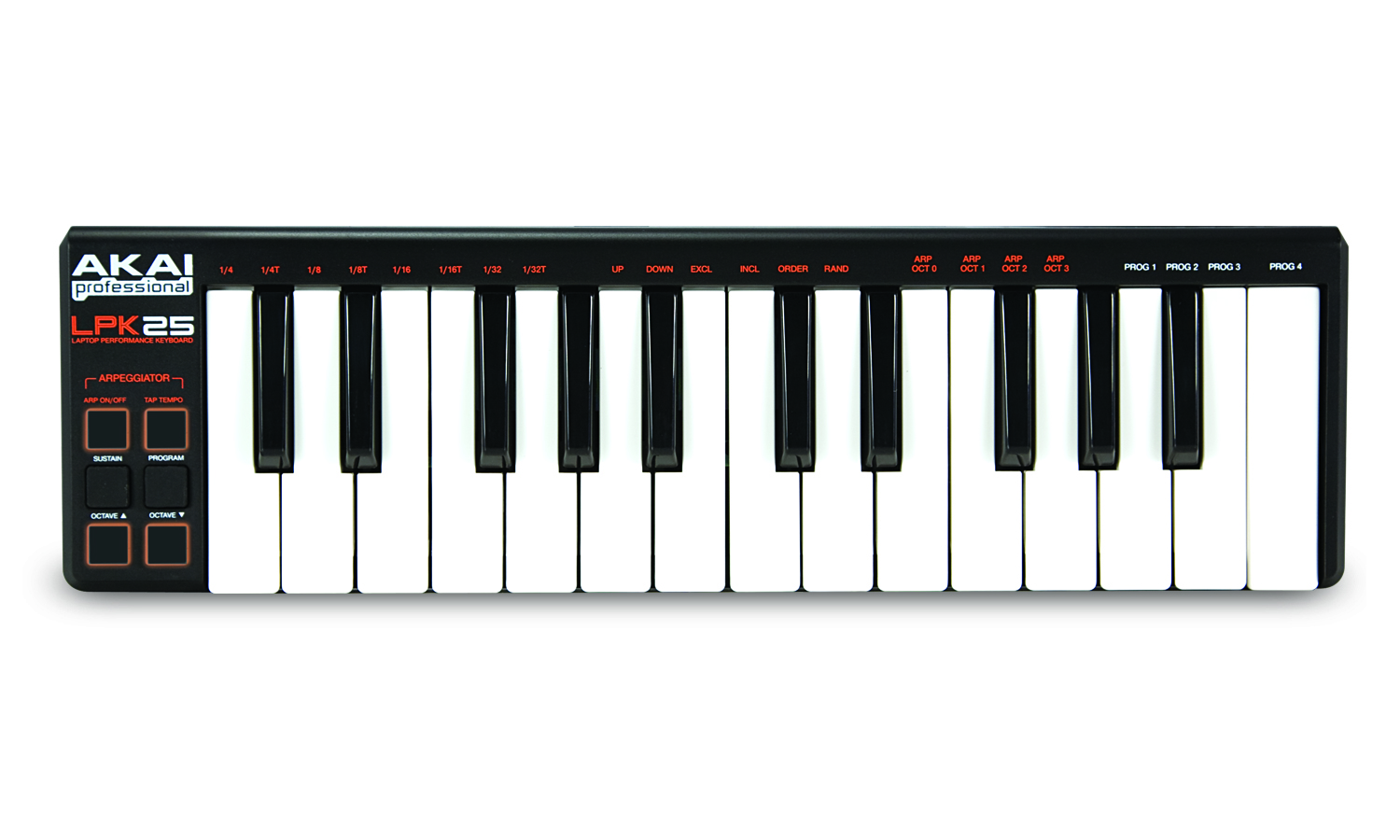
The original has 25 velocity-sensitive mini keys. Octave buttons shift the playable span, and Akai’s guide describes access to a nine-octave range, but only two octaves are physically under the hands at one time. That suits entering a bass line, a short melody, or a chord shape in passes; it is a different proposition from playing wider two-handed parts without moving the keyboard range. The manual’s MIDI implementation chart does not document keyboard aftertouch.
For the body, Akai’s English quickstart guide gives 339 × 97 × 33 mm (width × depth × height). The exact 339 mm width converts to about 13.35 inches. The current legacy product-data snippet instead says the keyboard measures “less than 13 inches across.” Because those manufacturer statements conflict, the manual’s explicit metric figure is the conservative value used for a width screen here; a 16-inch body cap still leaves nominal room, but cable bends, hands and surrounding equipment need separate clearance. The guide’s stated weight of 40 g is implausible for this device and is not repeated as a dependable weight.
Original hinge and controls are not the MK2 design
Akai’s LPK25 FAQ distinguishes the original’s plastic friction hinge and lack of support foam from the MK2’s spring-and-joint action and added foam. Those are manufacturer descriptions, not a measured feel comparison. The sources do not give key width, force curves or a tactile assessment, so anyone who is particular about mini-key spacing or response should treat the design wording as a prompt to check the exact used unit, not a promise about feel.
The small top panel is built around octave buttons, tap tempo, sustain/latch and arpeggiator controls rather than pads or a bank of assignable knobs. Akai documents four stored programs. Arpeggio mode, note division and octave span are selected through labeled keyboard combinations, while the editor provides the deeper setup; the guide lists up, down, inclusive, exclusive, order and random modes, plus zero-to-three-octave settings. Tap Tempo sets the internal rate, but the guide says it is disabled when an external clock is driving the arpeggiator. The Sustain button is a held control, not evidence of a pedal socket.
USB MIDI and power share one Mini-USB route
The original guide identifies one USB-mini port, USB bus power, a maximum draw below 100 mA at 5 V, and 16 MIDI output channels over USB. It does not document a five-pin DIN output. For a computer-based setup, the connection carries MIDI and power; the receiving DAW or instrument must create sound and provide an audio-monitoring path. A DIN-only hardware synthesizer therefore needs a separate compatible host or interface between the keyboard and the synth. Do not confuse that MIDI path with audio.
The Mini-USB socket is a generation-specific check. Akai describes the later LPK25 MK2 as having a full-sized USB connector, whereas the original uses Mini-USB. Akai does not name the MK2 connector standard more narrowly in the FAQ, so neither description should be silently translated into USB-C. Check the exact cable, host adapter and condition of the connector when evaluating an older unit.
Where this original model fits
The original LPK25 is most relevant when a small, bus-powered key input and its own arpeggiator matter more than pads, knobs or direct hardware MIDI. It is not interchangeable with the MPK Mini Classic or MKII: the official guides for those products document eight pads and eight knobs, and the MKII adds a four-axis joystick and a separate sustain-pedal input. Those are different operating layouts, not accessories that can be inferred from the LPK family name.
Before considering any legacy offer, verify that it is the original 25-key LPK25 rather than the MK2 or LPK25 Wireless, inspect the hinge and Mini-USB socket, and confirm what cable and editor access the seller actually supplies. The official material reviewed here establishes no current stock, price, seller condition or software-license availability. Choose a different configuration if you need a pressure-sensitive pad bank, documented USB-C or direct five-pin output, or a broader physical key range.
Akai LPK25 legacy product record · Akai LPK25 / LPK25 MK2 comparison FAQ · Akai legacy LPK25 downloads.
Key specifications
Key details at a glance
| Keys | 25 |
|---|---|
| Manufacturer's keybed description | Velocity sensitive mini keys |
| Width | 13.35 in |
| Pads | 0 |
| Velocity-sensitive pads | No |
| Pressure-sensitive pads | No |
| 5-pin MIDI Out | No |
| Computer connection | Mini-usb |
| USB bus-powered | Yes |
| Assignable pedal input | No |
| Keyboard channel aftertouch | No |
| 5-pin MIDI In | No |
| Depth | 3.82 in |
Use the exact model’s instructions for operating limits, supplied equipment and version differences.
Sources for this review
Sources for this assessment
- Akai Professional current product data query: exact LPK25 legacy record
- Akai Professional LPK25 legacy product page (redirects to official legacy downloads)
- Akai Professional LPK25 Quickstart Guide, English, revision B
- Akai Professional LPK25 Editor User Guide, version 1.0
- Akai Pro LPK25 MK2 FAQ with original-versus-MK2 differences
- Akai Professional LPK25 official media archive
Start with your setup, not a headline feature
Use the finder to combine key-count, connection, control and desk-fit requirements. Unverified specifications are never treated as a match.