
Your needs, this model
Does it fit your priorities?
Can the MPK Mini Plus II cover a compact 37-key USB-C-to-DIN setup?
Akai documents 37 velocity-sensitive keys, USB-C MIDI and power, and a separate five-pin MIDI Out. At 19.4 inches, its published body clears a 20-inch screen by only 0.6 inches; allow more room for cables, hands and nearby controls. Akai describes both USB-host MIDI forwarded to DIN and an internal-MIDI arrangement powered from USB-C. Neither arrangement generates documented audio, so plan the receiving instrument and monitoring separately.
Explore this need in the finder →Does the MPK Mini Plus II's DIN socket also provide five-pin MIDI In?
The technical specification lists one physical MIDI DIN Out, not a DIN In. USB-C carries MIDI In and Out to a connected host, but it is a different port and route. Confirm the receiving device's direction, MIDI channel, power and audio path before planning a hardware connection.
Explore this need in the finder →Does pressure sensing mean the Plus II has sixteen pads or keyboard aftertouch?
No such conclusion is supported. Akai's product specification and model-specific FAQ identify eight physical pads; the product page specifies pressure and velocity response on those pads. Its Control Voltage support discussion also uses '16 drum pads' while explaining a source/channel route, but that wording does not establish sixteen physical pads. The reviewed sources do not confirm pressure response on the keys, so treat keyboard aftertouch as unknown and check the current manual if it is essential.
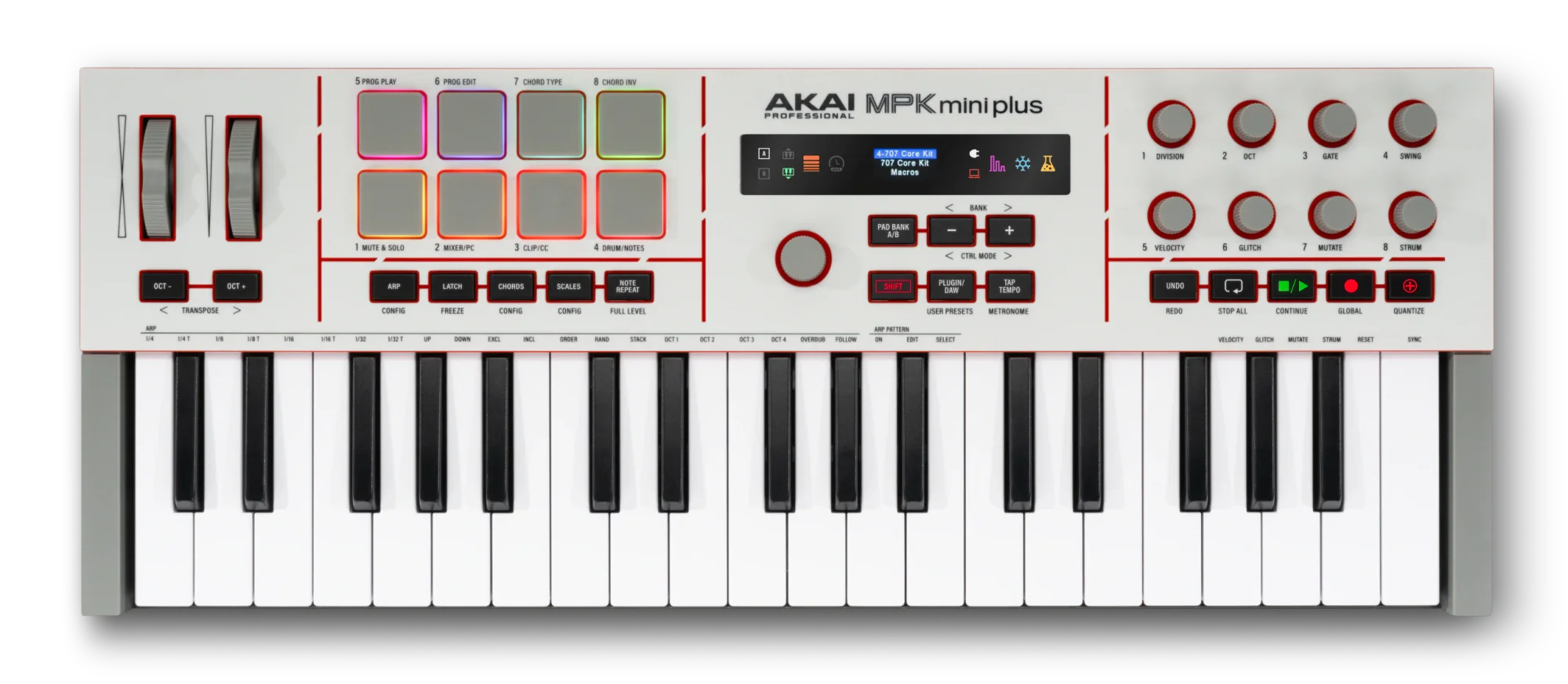
Explore this need in the finder →The Akai Professional MPK Mini Plus II is a compact 37-key controller that pairs USB-C host control with five-pin MIDI Out and three analog CV/Gate outputs. That combination gives it a broader hardware-routing role than a computer-only keyboard, but its short mini-key range, 19.4-inch body, and requirement for compatible external sound sources still shape who should consider it. This is a source-based assessment of Akai's current product page, product-specific FAQ and control-voltage guidance—not a hands-on test.
Thirty-seven velocity-sensitive keys in a compact format
The Plus II provides 37 velocity-sensitive keys, a useful three-octave working span for bass, melody and compact two-handed material. That is a meaningful step beyond a 25-key controller when frequent octave changes interrupt a part, but it is not a piano-range bed: passages that need a wider simultaneous reach still call for more keys. The manufacturer positions it as a compact MIDI keyboard; it does not publish a measured key width or a key-action test in the material reviewed here.
Akai documents velocity response on the keys, but the reviewed specification does not establish keyboard aftertouch. The model's pressure-sensitive pads are a separate surface. Do not treat pad pressure as proof that a held keyboard note can send aftertouch, and try a keybed in person if key spacing or touch is decisive. No ownership or playing evaluation is claimed here.
Eight pressure-sensitive pads and a detailed control surface
The specification lists eight RGB pads with velocity and pressure sensitivity, eight assignable encoders, one push encoder, pitch and modulation wheels, transport buttons and a 160-by-80 full-color display. Those controls provide more direct input than a bare keybed when their mappings line up with the software or hardware you use. Akai's support FAQ confirms eight drum pads. A separate Control Voltage article refers to “16 drum pads” in its routing discussion; that phrasing does not establish sixteen physical pads, so this assessment retains the technical page's eight-pad count and leaves the deeper bank/source interpretation unresolved.
The page advertises MPC integration, DAW maps and current software offers. The FAQ describes the Studio Instrument Collection and Ableton Live Lite 12, with registration through an Akai account. These are computer-software and partner offers, not sounds generated by the keyboard itself. Bundle contents, eligibility, licensing and supported software versions can change, so check the current model-specific offer and your exact host requirements instead of treating every promotional tile as a permanent package feature.
USB-C, DIN and CV are different control routes
USB-C carries MIDI to and from a compatible host and supplies bus power. A separate physical five-pin DIN socket is MIDI Out; Akai's FAQ describes using it either to forward USB-host data or to send the controller's internal performance data. The physical I/O list does not show a DIN input. If a computer-free DIN arrangement matters, the FAQ and product page describe separate USB-C power from an adapter or power bank. The exact supply is not assumed to be in a seller's package.
Three 1/8-inch TS CV/Gate outputs provide another connection family, identified in Akai's support article as Pitch, Gate and Mod. CV is not five-pin MIDI, USB audio or power for the receiving module. Confirm the voltage range, input type, patch cable and receiving device before relying on that route; compatible analog gear must still be powered and connected to an audio-monitoring system. For a computer-based session, verify the class-compliant USB MIDI path, software setup and any DAW mapping you need.
Check the actual desk limit, not only the note count
Akai lists the body at 19.4 inches wide, 7.6 inches deep and 2.1 inches high, with a stated weight of 3.2 pounds. A 20-inch body cap admits it on paper, but leaves only 0.6 inch of nominal width before connector bends, nearby equipment and hand room. Treat published chassis dimensions as a first screen rather than a complete ergonomic or stand-fit measurement. If a strict 19-inch limit is real, this model does not clear it; a narrower board may fit but could differ in key count, direct DIN or pads.
Where it sits among Akai's compact options
Compared with the 25-key MPK Mini IV, the Plus II provides twelve more keys and adds three documented CV/Gate outputs, at a larger 19.4-inch width versus the Mini IV's 13.68 inches. Both are documented with USB-C, pressure-sensitive pads and five-pin MIDI Out, but their key ranges and footprints answer different constraints. The original MPK Mini Plus is a distinct earlier model: Akai's FAQ contrasts its USB Type-B connection and lack of a color display with the Plus II's USB-C and full-color screen. Do not substitute one generation's port list or package for the other.
The Plus II is a reasonable current-reference candidate when the three-octave range, direct DIN path and analog control outputs will all be used. It is less compelling if 37 compact keys are still too short, a physical DIN input or confirmed keyboard aftertouch is essential, or a 19.4-inch body will crowd the desk. Check the exact Plus II suffix, current documentation, seller condition and included package; neither a product page nor a successful matching result establishes stock, price, compatibility with every host, or suitability for your hands.
Akai Professional MPK Mini Plus II product page · Akai MPK Mini Plus II FAQ · Akai MPK Mini Plus II Control Voltage support article.
Key specifications
Key details at a glance
| Keys | 37 |
|---|---|
| Manufacturer's keybed description | Velocity sensitive mini keys |
| Width | 19.4 in |
| Pads | 8 |
| Velocity-sensitive pads | Yes |
| Pressure-sensitive pads | Yes |
| 5-pin MIDI Out | Yes |
| Computer connection | USB-C |
| USB bus-powered | Yes |
| Assignable pedal input | Yes |
| 5-pin MIDI In | No |
| Depth | 7.6 in |
| 5-pin MIDI outputs | 1 |
| CV/Gate/Mod voice outputs | 3 |
Use the exact model’s instructions for operating limits, supplied equipment and version differences.
Sources for this review
Sources for this assessment
Start with your setup, not a headline feature
Use the finder to combine key-count, connection, control and desk-fit requirements. Unverified specifications are never treated as a match.