
Your needs, this model
Does it fit your priorities?
Can it provide 88 physical notes, USB-C, DIN Out and pressure-sensitive pads together?
Arturia's overview documents the 88-note Fatar TP/110 keybed, USB-C connection, 5-pin DIN output and twelve velocity- and pressure-sensitive pads. These capabilities appear in the USB-C host arrangement, but DIN sends MIDI data rather than audio and the external instrument needs its own power and monitoring route.
Explore this need in the finder →Will it fit a 51-inch support surface?
The official body width is 50.98 inches, so it passes a 51-inch finder cap by only 0.02 inches. The published width excludes connection clearance and does not establish the stand's strength or support points; check width, depth, the 34.61-pound load and the complete playing setup.
Explore this need in the finder →How is it different from the Essential 88?
The KeyLab 88 mk3 has a fully weighted Fatar hammer-action keybed, twelve pads in four banks, a 3.5-inch display and a 50.98-inch, 34.61-pound body. Arturia lists the Essential 88 with a semi-weighted mechanism, eight pads, a 2.5-inch display and a 49.53-inch, 18.08-pound body. Both are 88-key USB-C/DIN controllers; the comparison is about meaningful tier, action, control and support-space differences.
Explore this need in the finder →The White KeyLab 88 mk3 is not an 88-key version of the Essential controller. Arturia specifies a fully weighted Fatar TP/110 hammer-action keybed, a larger control surface, a 3.5-inch display and a substantial 50.98-inch chassis. Those differences make the exact tier and the support surface central purchase checks.
Full range, with a different action and footprint
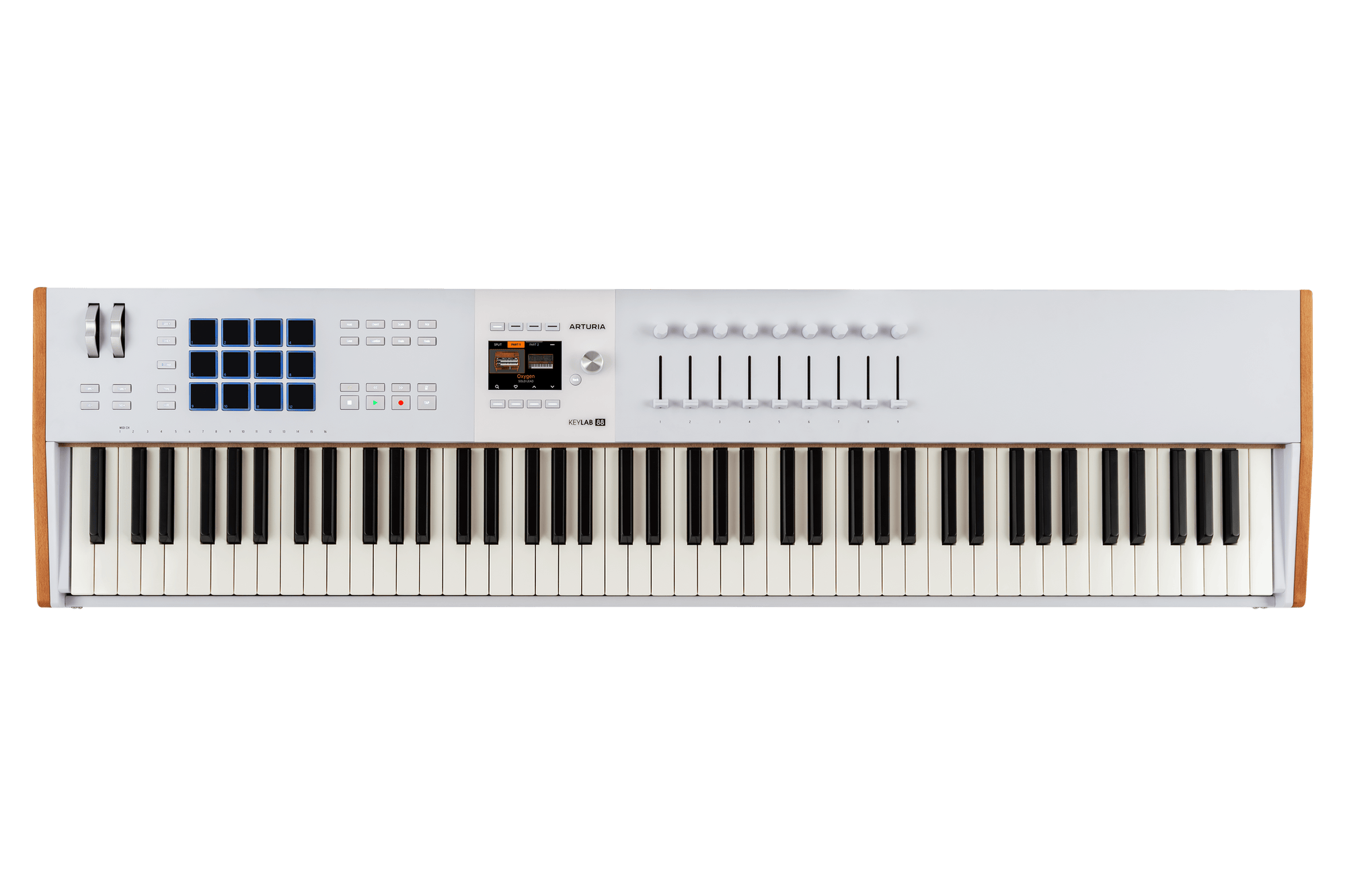
The exact White KeyLab 88 mk3 is listed separately from the KeyLab Essential 88 mk3 in Arturia's US store and product family. Its product overview specifies 88 fully weighted keys on a Fatar TP/110 hammer-action mechanism, with velocity and aftertouch. This is a genuine functional distinction from the Essential 88's semi-weighted keybed. The overview does not identify the aftertouch type, so this assessment does not label it channel or polyphonic aftertouch, and it does not claim a personal appraisal of the action.
The note range is also the longest available in the current reviewed library. That can matter for parts that need piano-length reach without octave changes, but extra notes do not make a controller a piano sound source. KeyLab 88 mk3 has no documented internal audio engine or audio output; its included software instruments require installation, activation and a computer/audio-monitoring path. Hardware connected by MIDI DIN must likewise generate its own sound.
Arturia lists dimensions of 50.98 by 12.72 by 4.45 inches and a weight of 34.61 pounds. This is not a casual desk accessory. Confirm the stand's width, depth, load rating and support points, then leave room for the USB, MIDI and pedal connectors and for a usable playing position. At a nominal 51-inch cap it passes the published-body screen by only 0.02 inches; that arithmetic is not a real-world clearance promise.
Controls for a workstation, not a minimal keybed
The surface adds twelve touch- and pressure-sensitive pads in four banks, nine rotary encoders, nine 50 mm faders, eight transport switches and four command switches. A full-color 3.5-inch, 320-by-480 display and eight contextual buttons provide a different information and navigation layer from the Essential 88's smaller display and eight-pad layout. The manufacturer also lists pitch and modulation wheels, chord and scale modes, a multi-mode arpeggiator and a Hold function. These features are useful only if the controls align with your DAW, instruments and hardware workflow; a control count is not evidence that a particular mapping has been tried.
Arturia lists custom integration for major DAWs plus NKS and MCU/HUI. Check the current script and host operating system; a published integration claim is not a guarantee for every software version. Decide whether the larger display and pad surface justify this tier over the simpler Essential model.
Connection and power paths
The manufacturer documents USB-C for computer connection and bus power, plus 5-pin MIDI DIN input and output for external instruments. One useful arrangement is therefore USB-C to a powered computer running the DAW, with DIN MIDI sent from the controller to a hardware sound module. The MIDI connection carries control data, not audio, and the external module needs its own power and audio route. The exact overview names MIDI DIN I/O; check its manual for the port directions and routing details needed in your particular chain.
There is no separately documented computer-free standalone power plan in the reviewed product sources. Do not assume that DIN routing alone powers the keyboard or the external instrument. The default box lists a USB-C-to-USB-A cable, registration card and QuickStart, as well as a laptop plate and sheet-music holder; verify the current package and any required computer power arrangement. Pedal inputs support sustain, modulation and expression use, including an additional Aux input according to the overview, but confirm the exact pedal type and assignments before adding accessories.
Package and software are not the same as hardware capability
Arturia lists Analog Lab Pro, Ableton Live Lite, several instruments and effects, a Loopcloud offer and Melodics; the store record also shows a Native Instruments license. These are software entitlements, not built-in sounds. Verify current versions, registration and operating-system terms before assigning them value.
The package includes a sheet-music holder and laptop plate, but these do not reduce the chassis footprint. Confirm the seller's current contents and whether your stand can safely support this long, heavy controller; a product photo cannot establish third-party stand suitability.
How it compares with the Essential 88
Both reviewed 88-key tiers offer USB-C, DIN MIDI Out, pressure-sensitive pads and hands-on controls, so both can meet a broad DAW-to-hardware brief when the body-width limit allows. The Essential 88 is the smaller, lighter proposition at 49.53 inches and 18.08 pounds, with a semi-weighted keybed, eight pads and a 2.5-inch display. The non-Essential KeyLab 88 is 50.98 inches and 34.61 pounds, with the fully weighted Fatar action, twelve pads and a 3.5-inch screen. The mechanism, mass and added control surface are meaningful choices, not a finish difference.
At a 50.75-inch maximum, only the Essential 88 fits the documented body measurement. At 51 inches, both configurations enter the finder result, but the KeyLab's additional 1.45 inches of nominal room and 16.53 pounds of mass still need a suitable placement and support. If a full 88-note range is optional, compare the 61-key models before accepting this footprint. If hammer action is essential, verify the exact White KeyLab 88 mk3 SKU and current manual rather than substituting an Essential model with a similar name.
Assessment
KeyLab 88 mk3 is a strong candidate on paper for a player who needs full-range reach, a fully weighted hammer-action mechanism, deep DAW controls and direct MIDI output, and who has a stable space for a roughly 51-inch, 35-pound controller. Its trade-offs are equally concrete: it is heavy, wide, dependent on an external sound source, and more involved than a compact controller. Choose it because those documented differences solve the actual setup—not because a higher tier or longer feature list is automatically better.
This is a research-based assessment of Arturia's current US White listing and product documentation. It is not a hands-on test, measurement, ownership report or claim of present third-party stock.
Primary sources: Arturia KeyLab 88 mk3 White store listing, product overview and technical specifications, product resources, and downloads, manual and DAW resources.
Key specifications
Key details at a glance
| Keys | 88 |
|---|---|
| Manufacturer's keybed description | Fully weighted hammer action (Fatar TP/110) |
| Width | 50.98 in |
| Pads | 12 |
| Velocity-sensitive pads | Yes |
| Pressure-sensitive pads | Yes |
| 5-pin MIDI Out | Yes |
| Computer connection | USB-C |
| USB bus-powered | Yes |
| Assignable pedal input | Yes |
| Keyboard channel aftertouch | Yes |
| 5-pin MIDI In | Yes |
| Display size | 3.5 in |
| Fader length | 50 mm |
| Depth | 12.72 in |
Use the exact model’s instructions for operating limits, supplied equipment and version differences.
Sources for this review
Sources for this assessment
- Arturia US KeyLab 88 mk3 White store listing
- Arturia KeyLab 88 mk3 overview, keybed, controls, connectivity and exact dimensions
- Arturia KeyLab 88 mk3 resources and manual listing
- Arturia KeyLab 88 mk3 downloads, English manual and DAW integration guides
- Arturia KeyLab Essential 88 mk3 overview, used only to distinguish the separate product tier
- Arturia KeyLab Essential 88 mk3 US store listing and body configuration
- Arturia Keyboard Controllers category, original KeyLab 88 mk3 identity observation
Start with your setup, not a headline feature
Use the finder to combine key-count, connection, control and desk-fit requirements. Unverified specifications are never treated as a match.