
Your needs, this model
Does it fit your priorities?
Do 61 keys provide more room than the Essential 49 without requiring the full 88-key span?
This exact White model has 61 velocity-sensitive notes, compared with the Essential 49's 49-note range and Essential 88's 88. Whether that span is enough depends on your parts; it does not establish a particular action or playing comfort.
Explore this need in the finder →Will the body fit a desk limit around 35 inches?
Arturia lists a 35-inch body width. A 35.5-inch ceiling passes that published body measurement, but cable clearance and space to reach the controls still need to be added to your actual layout.
Explore this need in the finder →Can it control a computer and send MIDI data to external gear?
Arturia documents USB-C computer connection and bus power alongside a separate 5-pin MIDI Out. Its eight pads are also specified as velocity- and pressure-sensitive; the external instrument must generate audio and the controller still needs USB power.
Explore this need in the finder →The White KeyLab Essential 61 mk3 is the middle member of Arturia’s current Essential keyboard range: more physical note range than the 49-key version, without taking up the span of its 88-key sibling. Its case is straightforward if your setup calls for a USB-C controller with tactile DAW controls and a five-pin MIDI output. The published specifications support that assessment; they do not tell us whether the action, mappings or layout will feel right to a particular player.
What the extra keys change
This exact configuration is the White 61-note model, not the similarly named KeyLab 61 mk3 from Arturia’s higher tier. The extra range over the Essential 49 can reduce octave-shifting for parts that move between lower accompaniment and upper melody, while 61 keys remain shorter than the Essential 88’s full-length layout. That distinction matters more than the shared “Essential mk3” family name. If your parts routinely need the full span, consider the 88-key version; if your usable desk is tight, compare the actual widths before treating the 61 as a compact option.
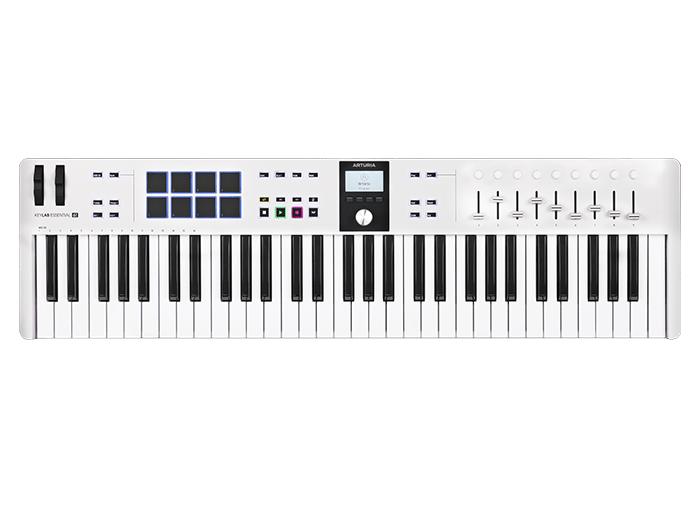
Arturia lists the controller at about 35 inches wide, 9.45 inches deep and 2.76 inches high, with a weight of 6.8 pounds. Those are body dimensions rather than a complete desk-fit measurement. Allow additional space for the USB cable, MIDI lead and pedal connection, and check that the controls and keybed remain accessible on the actual shelf or stand.
Hands-on control for a software session
The manufacturer lists nine rotary encoders, nine faders, eight transport switches, four command switches, pitch and modulation wheels, and a 2.5-inch LCD with contextual buttons. It also specifies eight touch- and pressure-sensitive pads. That is a broad set of direct controls for adjusting mapped parameters, issuing common transport commands or triggering notes and clips without reaching for a mouse every time. The practical value depends on your DAW, project template and preferred mapping—not on the count alone.
Arturia lists custom control scripts for several major DAWs and MCU/HUI compatibility. These are useful starting points, but the product pages do not guarantee identical behavior across every software release or establish that every control maps to a function you want. Check the current script and its version for your exact application. The pressure specification applies to the pads; it is not evidence of aftertouch on the keys. The sources reviewed also do not establish key width, measured response or the playing feel that a buyer will experience.
USB-C to the host, DIN MIDI to hardware
The connection plan is unusually clear for a controller in this size class: USB-C provides the computer connection and bus power, while a separate five-pin MIDI output can send control data to an external synthesizer or other MIDI instrument. Arturia also lists a pedal input assignable to sustain, expression or footswitch use. This can support a computer-centered studio that still includes a hardware sound source, as long as the signal chain is planned deliberately.
MIDI carries performance and control messages, not audio. The reviewed feature pages identify this as a MIDI controller and do not document an audio output or built-in sound engine. Plan for software or an external sound source and its own audio route to headphones, speakers or a recorder. The controller is USB bus-powered, so a MIDI DIN connection by itself does not power it. Confirm the USB host or suitable power arrangement and the required cables before building a hardware-only setup.
Key feel and software claims need careful reading
The 61-key listing describes a velocity-sensitive keyboard with a “hybrid synth-piano feel.” Arturia’s family overview also uses “hybrid-feel” wording. Those are the manufacturer’s descriptions, not independent measurements or a promise that the action resembles a particular acoustic piano. They do not settle key width, keyboard aftertouch, response curves or personal comfort. If any of those is essential, try this exact model or obtain a specific answer from the manufacturer before purchase.
Bundle wording is less settled than the hardware list. The store page names Analog Lab Pro, Ableton Live Lite, The Gentleman, UVI Model D, Melodics and Loopcloud, while the dedicated family software page names Komplete Select where the store says The Gentleman. Treat those names as conflicting current package claims, not guaranteed licenses. Check what the exact retailer offer and Arturia account-registration flow provide. The listed box contents include a USB-A-to-USB-C cable and registration card; they do not list a pedal, so do not assume one is included.
How it compares with the other Essential sizes
The Essential 49 is about 31.1 inches wide and 6.1 pounds; this 61-key edition is roughly 35 inches and 6.8 pounds. The Essential 88 stretches to about 49.53 inches and weighs 18.08 pounds, and its product overview describes a velocity-sensitive, semi-weighted 88-note keybed. That makes the 61 a range-and-space compromise, not a universal midpoint: it offers more notes than the 49 while remaining dramatically shorter and lighter than the 88. These measurements say nothing about sound or key action quality, but they do give you a concrete first desk-fit comparison.
Who should shortlist this exact White edition?
Consider it when 61 notes meet your physical range needs, the roughly 35-inch footprint fits, and you will use the pads, faders, encoders or DIN MIDI connection rather than paying attention only to the model name. It is a weaker fit if you need all 88 notes, have a firm width limit under its body size, require a particular piano action, expect an included pedal, or want the keyboard itself to produce and output audio. Before ordering, verify the White 61-key mk3 SKU, host and DAW support, cable clearance and actual software entitlements. The current manual is listed by Arturia, but its large linked PDF was not reviewed for this assessment, so use the manual for final setup and operating details.
Key specifications
Key details at a glance
| Keys | 61 |
|---|---|
| Manufacturer's keybed description | Hybrid synth-piano feel (Arturia wording) |
| Width | 35 in |
| Pads | 8 |
| Velocity-sensitive pads | Yes |
| Pressure-sensitive pads | Yes |
| 5-pin MIDI Out | Yes |
| Computer connection | USB-C |
| USB bus-powered | Yes |
| Assignable pedal input | Yes |
| Display size | 2.5 in |
| Depth | 9.45 in |
Use the exact model’s instructions for operating limits, supplied equipment and version differences.
Sources for this review
Sources for this assessment
- Arturia KeyLab Essential 61 mk3 US store listing
- Arturia KeyLab Essential mk3 feature and overview page
- Arturia KeyLab Essential mk3 included-software page
- Arturia KeyLab Essential 61 mk3 downloads, manuals and DAW scripts
- Arturia KeyLab Essential mk3 general questions and connection setup
- Arturia Keyboard Controllers catalogue, page 1 of 2
Start with your setup, not a headline feature
Use the finder to combine key-count, connection, control and desk-fit requirements. Unverified specifications are never treated as a match.