
Your needs, this model
Does it fit your priorities?
Do you need the full 88-note range for wider parts?
The dedicated product overview identifies an 88-note, velocity-sensitive, semi-weighted keybed. That full range may suit parts that move across a wider register, but key count alone does not establish a piano action or your comfort.
Explore this need in the finder →Will a roughly 50-inch body fit your stand or desk?
Arturia lists a 49.53-inch width and 18.08-pound weight. A 50-inch width ceiling clears the published body by less than half an inch, so measure support, cable clearance and playing space carefully rather than treating that as a complete fit check.
Explore this need in the finder →Can it control a DAW and send MIDI to a hardware instrument?
The listed arrangement includes USB-C computer connection and bus power plus 5-pin MIDI Out. The DIN link sends MIDI data, not audio; a hardware sound source and its separate audio path are still needed.
Explore this need in the finder →The White KeyLab Essential 88 mk3 is the long-range member of Arturia’s Essential controller family, with an 88-note velocity-sensitive, semi-weighted keybed and the same general production layout as smaller models. The question is whether the extra reach justifies its much larger body. This assessment uses Arturia’s published material, not hands-on playing or a sound test.
Full note range, full room requirement
The reviewed configuration is the White 88-key Essential mk3, SKU keylab-essential-88-mk3,0,white. It should not be confused with the separately listed KeyLab 88 mk3, whose product page describes a Fatar TP/110 hammer-action keybed with aftertouch. The Essential 88 page instead identifies a velocity-sensitive semi-weighted keyboard. These are distinct model tiers with different documented keybed designs, not alternate names for one instrument.
Arturia lists a body about 49.53 inches wide, 10.04 inches deep and 18.08 pounds. Its store gives a 2.63-inch height while the product overview gives 3.46 inches, so height remains unresolved. This length calls for a measured, sturdy stand or shelf; add cable and playing clearance beyond the published body dimensions.
A more note-complete Essential keybed
Arturia’s dedicated product overview calls the 88-note keys velocity-sensitive and semi-weighted. That describes a controller keybed, but it does not establish a specific acoustic-piano action, key mass, key width, aftertouch response or personal preference. The specification is distinct from the “hybrid synth-piano feel” wording used on the Essential 49 and 61 listings. If you are choosing it to play piano repertoire, compare the action in person when possible and decide whether the described keybed is what you want rather than assuming that 88 notes alone make it a piano replacement.
The extra span can help when parts move between bass and higher melody without repeated octave shifts. If your parts stay in a narrower register, the footprint may be a poor trade. Key count is a range decision, not a measure of skill.
Familiar controls across a wider chassis
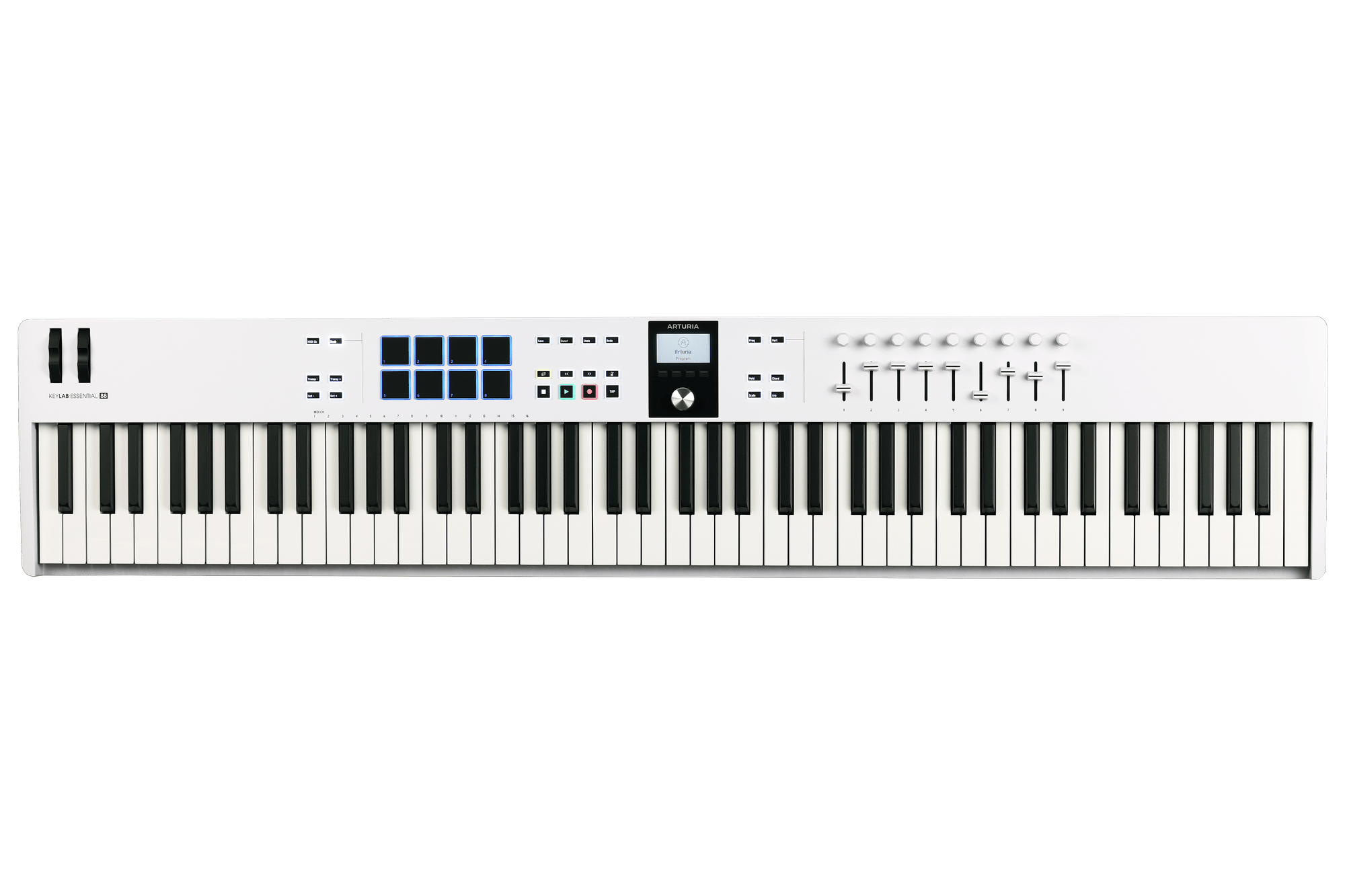
The Essential 88 retains eight velocity- and pressure-sensitive pads, nine rotary encoders, nine faders, eight transport switches, four command switches, performance wheels and a 2.5-inch LCD with contextual buttons. Arturia also lists arpeggiator, chord, scale, hold and transpose functions. The controls can put common DAW and instrument tasks within reach, while the longer keyboard provides a wider playing range. Their benefit still depends on the current control scripts, DAW version, project and assignments; the product page does not prove that every control will operate identically in every setup.
Arturia lists custom DAW scripts and MCU/HUI compatibility, and its support page lists model-specific integration scripts for major applications. Check the current compatibility guidance for your own DAW and operating system. The pad pressure specification concerns the pads, not the keybed. No key-aftertouch capability is established by the sources used here.
Trace the complete connection and audio path
The published connection list includes USB-C for computer communication, USB-C bus power, a five-pin MIDI output and a pedal input assignable to sustain, expression or footswitch use. This offers both a computer path and an external MIDI-data path, but it does not remove the need to plan power. A DIN cable carries MIDI data; it neither powers the controller nor carries audio. Confirm a suitable USB host or supply, the external instrument’s own power, and a separate route for its sound.
Arturia markets this as a MIDI controller and its inspected specification lists no speakers or audio output. The careful conclusion is to plan on a software or external sound source and its audio route, rather than expect the controller itself to produce sound. Before purchase, confirm the exact product documentation if an integrated audio feature matters to your setup.
Resolve a product-page contradiction before relying on details
Arturia’s 88-key store page has a copy inconsistency: its main feature heading says “88-note” but a following bullet refers to a “61-note” hybrid keybed. The dedicated 88-key overview repeats the 88-note semi-weighted specification, so the stray bullet is not applied here. The store and overview also name different bundle items—The Gentleman versus Komplete Select. Verify the exact package and account entitlement instead of assuming either list is guaranteed.
The listed package includes the Essential unit, a USB-A-to-USB-C cable and registration card. No pedal is listed in that box-content section. The product page lists a pedal input, which is a capability of the controller, not proof that an accessory comes in the package.
Choosing between the Essential 49, 61 and 88
The Essential 49 is about 31.1 inches wide and 6.1 pounds; the 61 is about 35 inches and 6.8 pounds. The 88 extends to about 49.53 inches and 18.08 pounds. Those differences are substantial enough to measure before choosing. The smaller versions share many of the family’s pads, display, faders, encoders and connection types, so the decision is chiefly about physical playing range and workspace rather than adding a distinct sound engine. If 61 notes meet your repertoire, the Essential 61 is a much shorter option; if the full span is needed, the 88’s added reach is the reason to accept its size.
Who should shortlist this exact edition?
This White 88-key configuration is worth considering when your parts genuinely need the full note range, the roughly 50-inch body fits a sturdy setup, and the USB-C-plus-DIN workflow suits your studio. It is a poor match for a narrow desk, a lightweight travel rig, a buyer who requires fully weighted hammer action, or someone expecting a self-contained sound-and-audio instrument. Confirm the white 88-key mk3 SKU, support surface, computer connection and DAW mapping, the included cable, current software licenses and whether you need to buy a pedal separately. Arturia lists the 88 mk3 manual and firmware on its support page; the linked manual PDF is too large for the available web fetch and was not reviewed here, so consult it directly for detailed setup and operating instructions.
Key specifications
Key details at a glance
| Keys | 88 |
|---|---|
| Manufacturer's keybed description | Semi weighted velocity sensitive |
| Width | 49.53 in |
| Pads | 8 |
| Velocity-sensitive pads | Yes |
| Pressure-sensitive pads | Yes |
| 5-pin MIDI Out | Yes |
| Computer connection | USB-C |
| USB bus-powered | Yes |
| Assignable pedal input | Yes |
| Display size | 2.5 in |
| Depth | 10.04 in |
Use the exact model’s instructions for operating limits, supplied equipment and version differences.
Sources for this review
Sources for this assessment
- Arturia KeyLab Essential 88 mk3 US store listing
- Arturia KeyLab Essential 88 mk3 overview and specifications
- Arturia KeyLab Essential mk3 included-software page
- Arturia KeyLab Essential 88 mk3 downloads, manuals and DAW scripts
- Arturia KeyLab Essential mk3 general questions and connection setup
- Arturia Keyboard Controllers catalogue, page 1 of 2
Start with your setup, not a headline feature
Use the finder to combine key-count, connection, control and desk-fit requirements. Unverified specifications are never treated as a match.