
Your needs, this model
Does it fit your priorities?
How wide is the KeyStep 37 mk2 body, and what does that number cover?
Arturia publishes a 21.7-inch width, 5.78-inch depth and 1.38-inch height for the controller body. The width is a useful first screen: at a 21.5-inch maximum it misses, while it falls within the next valid finder step at 21.75 inches. Add space for the USB, DIN, pedal and CV connections and hands; a body-width pass is not a desk-fit guarantee.
Explore this need in the finder →What does KeyStep 37 mk2 add over the 32-key KeyStep mk2?
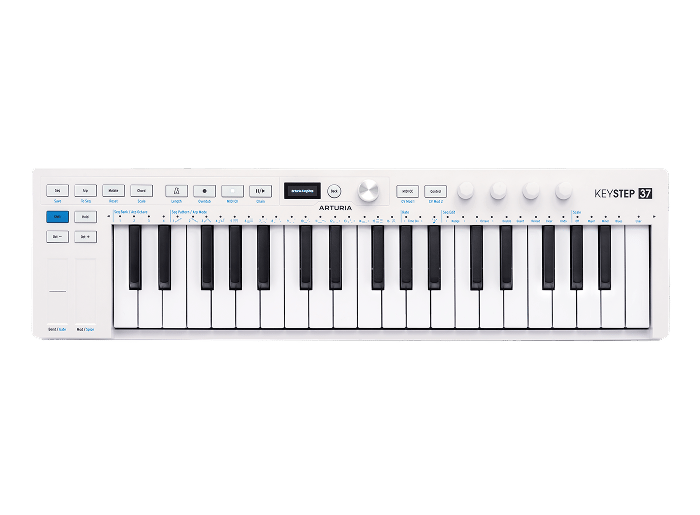
The 37-key model adds five Slimkeys, LEDs above its keys, four mode-aware encoders and dedicated control/MIDI-CC buttons for quicker hands-on editing. Both models have the same documented 64-pattern, 64-step, eight-note polyphonic sequencer, 16-mode arpeggiator, USB-C, DIN MIDI and four CV/Gate outputs. The trade is more immediate controls and range for a body that is wider than 21 inches; it is not an 88-key replacement.
Explore this need in the finder →Can KeyStep 37 mk2 run from a charger in a hardware-only setup?
The manual says a standard USB mobile charger can power the unit without a computer and recommends at least 5 V and 100 mA; it also warns that a marginal supply may call for dimmer LEDs. A charger is not in the listed package. DIN and CV carry control signals, not audio, so plan power and monitoring for the receiving instrument separately.
Explore this need in the finder →Arturia's KeyStep 37 mk2 combines a compact 37-key Slimkey controller with an onboard sequencer, arpeggiator and a deeper set of live editing controls than the 32-key KeyStep mk2. It is aimed at a hybrid workflow: play and shape notes on the keyboard, route MIDI to a computer or hardware, and use CV/Gate or Sync connections where the rest of the setup supports them. This is a research-based assessment of the official product information and manual, not a report of hands-on testing.
The extra range and larger surface
The 37-key model adds five notes to the standard KeyStep mk2. That modest increase may reduce an octave change in a short two-hand sketch or widen a chord shape, but it is still a compact keyboard, not a substitute for a 49-, 61- or 88-key span. The keys are Arturia's velocity- and aftertouch-sensitive Slimkeys; the manual describes them as smaller than standard piano keys. It does not give a measured key width or action curve, so the specification cannot settle whether the feel suits your hands.
For a desk plan, Arturia lists a 21.7-inch body width, 5.78-inch depth and 1.38-inch height, with a listed weight of 3.5 lb. The width is just over 21.5 inches and falls below the next allowed finder increment of 21.75 inches. That makes it a useful numeric threshold, not proof that the whole setup fits: cable bends, a sustain/expression pedal, the stand and room for hands need their own clearance. The 32-key sibling's exact dimensions remain unknown and should not be inferred from this size.
More direct control than the 32-key version
The most practical sibling difference is the surface. KeyStep 37 mk2 has four mode-aware encoders, Control and MIDI CC access, and LEDs above the keys that indicate sequence, bank, pattern or scale context. Those encoders can reach parameters for sequencer, arpeggiator, chord, mutation and recording modes; the MIDI CC interface also provides assignable control banks. This makes the model better documented for immediate editing than the 32-key unit's simpler display-and-encoder surface. It still does not establish that a particular DAW script, plug-in, synth or user assignment will behave exactly as you expect. Verify the software and firmware combination you will use.
The core sequence capacity is shared with the 32-key KeyStep: Arturia documents 64 patterns across four banks, patterns up to 64 steps and up to eight notes per step, plus a 16-mode arpeggiator and chord/scale functions. The 37-key choice therefore adds physical range and direct controls rather than a larger documented pattern store. The onboard tools can create and send control data; no sound engine is specified inside this controller.
A computer-and-hardware route in one arrangement
The reviewed model lists class-compliant USB-C MIDI and bus power, 5-pin MIDI In/Out, analog Sync In/Out, a TRS pedal jack and four assignable CV/Gate outputs. A supported computer arrangement can connect by USB-C, power the controller and use the DIN output to address external gear. The same device can also sequence, arpeggiate and send clock. A DIN lead does not carry audio, while CV/Gate needs compatible equipment and patching; the receiving instrument must still be powered and monitored separately.
For computer-free control, Arturia's manual says a standard USB mobile charger can run the unit and recommends at least 5 V and 100 mA. If the supply is close to that limit, the manual suggests reducing LED brightness. The documented package includes the keyboard and USB-A-to-USB-C cable, not a charger. Confirm the actual supply, the external synthesizer's independent power requirements and an audio-monitoring route before building a stand-alone hardware chain.
Keyboard aftertouch is not pad pressure
The product has aftertouch on its keyboard and CV outputs can use expressive sources, but the exact front-panel image and feature list show no drum-pad bank. A required pressure-sensitive pad feature is therefore a different task from expressive key pressure and does not match this model. The four encoders are useful physical controls, but they are not a row of performance pads. If pad pressure is essential for finger drumming or a mapped software gesture, check an assessed model that documents pads rather than assuming another type of pressure sensing is equivalent.
Package and ownership checks
The current store package summary names Analog Lab Intro and Ableton Live Lite as included software, but the official manual describes registration and license steps. Verify the exact seller package, license transfer and entitlement for the version you are buying, especially for used stock. The charger is not listed as included. The controller itself has no documented audio output, so decide whether a software instrument on the host or a powered external instrument will make sound and how you will listen to it. None of these software, power or audio details can be guaranteed from the model name alone.
Who should compare it closely?
KeyStep 37 mk2 is worth comparing when 37 compact notes, onboard sequencing and arpeggiation, direct mode-aware edits and USB/DIN/CV connectivity fit the same workflow. Its known 21.7-inch width makes it easier to screen against a desk cap than the 32-key sibling, but the body figure leaves out practical clearance. Buyers who need pressure-sensitive pads, a piano-size keybed, a long conventional range or onboard sound should treat those as separate requirements. Before ordering, match the exact SKU keystep-37-mk2,0 and confirm the manual, current firmware, charger, software-license terms, host setup and external instrument connections.
Key specifications
Key details at a glance
| Keys | 37 |
|---|---|
| Manufacturer's keybed description | Velocity-sensitive slim keys (manufacturer description) |
| Width | 21.7 in |
| Pads | 0 |
| Velocity-sensitive pads | No |
| Pressure-sensitive pads | No |
| 5-pin MIDI Out | Yes |
| Computer connection | USB-C |
| USB bus-powered | Yes |
| Assignable pedal input | Yes |
| Keyboard channel aftertouch | Yes |
| 5-pin MIDI In | Yes |
| Depth | 5.78 in |
| Maximum steps per pattern | 64 |
| Maximum notes per step | 8 |
| CV/Gate/Mod voice outputs | 4 |
Use the exact model’s instructions for operating limits, supplied equipment and version differences.
Sources for this review
Sources for this assessment
Start with your setup, not a headline feature
Use the finder to combine key-count, connection, control and desk-fit requirements. Unverified specifications are never treated as a match.