
Your needs, this model
Does it fit your priorities?
What does KeyStep Pro add beyond a compact 37-key controller?
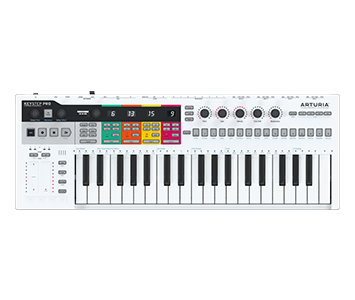
The standard KeyStep Pro combines a 37-key velocity/aftertouch Slimkey bed with four independent polyphonic sequencer tracks, a separate 24-part drum sequencer, arpeggiator and chord modes, 5-pin MIDI, clock, four CV/Gate/Mod voice outputs and eight drum-gate outputs. It is a sequencer and control hub, not a larger piano-range keyboard or an onboard instrument sound source.
Explore this need in the finder →Does the White KeyStep Pro connect to a USB-C computer?
The manual specifies a standard USB Type-B connector on the controller. Its USB host plan carries MIDI data and can power the unit from a computer or tablet, but the controller itself is not USB-C. A USB-C-only host may need a suitable data cable or adapter; the included box lists a USB cable without identifying a USB-C host end.
Explore this need in the finder →Can it control hardware without a computer, and where does the sound come from?
The manual describes standalone operation from the included 12V adapter with DIN MIDI and CV/Gate control available. The controller does not document an onboard instrument sound engine; connect and power a receiving synth or module, then plan its audio-monitoring path. The small speaker and line output are specified for metronome use.
Explore this need in the finder →The White KeyStep Pro is best understood as a keyboard-led sequencer and routing center, not as a conventional USB-C DAW keyboard. Its 37-note Slimkey bed sits above four independent sequencer tracks, a drum sequencer, MIDI DIN, clock and analog CV/Gate outputs. That combination is unusually broad for a compact controller, but the exact cable and power plan matters as much as the key count.
A small keyboard attached to a large sequencing job
Arturia specifies 37 velocity- and aftertouch-sensitive Slimkeys. That gives the performer roughly three octaves to enter notes, trigger sequences or play an external instrument, while the keys remain smaller than standard piano keys according to the manual. The evidence does not establish a measured key width, keybed action, or what the action will feel like to a particular player. Treat aftertouch as pressure information from the keys—not as pressure sensing on drum pads. This configuration has sequencer controls and step buttons, but no documented pressure-sensitive pad bank.
The reason to accept a short range is the rest of the panel. Four independent polyphonic tracks can hold patterns of up to 64 steps, with as many as 16 notes per step; each track also has pattern and arrangement functions. The separate 24-part drum sequencer, eight drum-gate outputs and four assignable voice outputs make the controller relevant to a desk built around synthesizers, drum machines or a modular system. Five encoders can send MIDI CCs, and the keyboard also has chord and arpeggiator modes. These are useful control paths, not sounds inside the controller.
Plan the host, power and audio separately
The common connection mistake is to assume that every modern compact controller has USB-C. The KeyStep Pro manual identifies its computer port as standard USB Type-B. It can exchange USB MIDI with a computer or tablet; the documented connector is not USB-C. A host-only plan can draw its DC power through the USB connection, but a USB-C-only computer may need a suitable data cable or adapter. The included package lists a USB cable without promising a USB-C connector at the host end, so check that exact detail before ordering.
There is also a genuine computer-free arrangement: the manual describes standalone use with the included 12V supply. From there, the DIN outputs, clock and analog outputs can control external gear. The receiving synth or module still needs its own power and audio route. Although the KeyStep Pro includes a small speaker and line output for its metronome, that is not an onboard instrument sound engine; do not mistake a click reference for audio generation.
For more detail, compare the exact White store listing, the manufacturer overview and the English manual. The listed hardware package includes the controller, external supply, USB cable and quick-start material; the store also names Ableton Live Lite and Analog Lab Intro V.5, whose registration and license details should be checked with the exact package.
White versus Black, and the Chroma distinction
The standard KeyStep Pro store page exposes a White SKU and a separate Black finish SKU. The manufacturer records retain the same base 37-key controller and the same feature set, so this review covers the White configuration while the Black model remains a separately recorded finish variant. The dark KeyStep Pro Chroma is different: its manufacturer page and firmware guidance specify per-track LED color customization, a capability not listed for standard Pro models. The standard White version still receives the other documented 2.5 firmware additions; color editing is the Chroma-specific distinction. If colored track feedback is not part of your workflow, the White model retains the same core sequencing and connection plan.
Who should shortlist this configuration?
It belongs on a shortlist when a 37-key playing surface must also serve as a four-track hardware/software sequencer, MIDI router and CV/Gate controller. The main compromise is not a hidden spec: the small key range and USB Type-B port make it a poor match for a buyer who needs a longer keyboard or specifically requires USB-C. Its five rotary controls, sequencing depth and multiple output paths also reward a planned setup; they do not guarantee simple integration with every DAW, synth or Eurorack module.
Before choosing a seller, confirm the White SKU keystep-pro,0, included 12V supply, the cable needed for your host, and the current manual/firmware for connected equipment. Add the external instrument, DIN or CV cables, optional pedal and monitoring path to your system plan. The feature set is well documented; subjective key feel and a particular studio’s compatibility are not settled by a product page.
Key specifications
Key details at a glance
| Keys | 37 |
|---|---|
| Manufacturer's keybed description | Velocity-sensitive slim keys (manufacturer description) |
| Width | 23.2 in |
| Pads | 0 |
| Velocity-sensitive pads | No |
| Pressure-sensitive pads | No |
| 5-pin MIDI Out | Yes |
| Computer connection | USB Type-B |
| USB bus-powered | Yes |
| Assignable pedal input | Yes |
| Keyboard channel aftertouch | Yes |
| 5-pin MIDI In | Yes |
| Depth | 8.2 in |
| Polyphonic sequencer tracks | 4 |
| Drum sequencer parts | 24 |
| Maximum steps per pattern | 64 |
| Maximum notes per step | 16 |
| 5-pin MIDI outputs | 2 |
| CV/Gate/Mod voice outputs | 4 |
| Per-track LED colors customizable | No |
Use the exact model’s instructions for operating limits, supplied equipment and version differences.
Sources for this review
Sources for this assessment
- Arturia KeyStep Pro US English store record; exact White SKU, package and listed dimensions
- Arturia KeyStep Pro overview; sequencing, controller functions and connections
- Arturia KeyStep Pro downloads and manuals; English manual version 2.5.2
- Arturia KeyStep Pro English User Manual, version 2.5.2, revised 5 February 2025
- Arturia Controllers & Sequencers parent catalogue; KeyStep Pro discovery listing
- Arturia keyboard controllers category page 1; separate Chroma card
Start with your setup, not a headline feature
Use the finder to combine key-count, connection, control and desk-fit requirements. Unverified specifications are never treated as a match.