
Your needs, this model
Does it fit your priorities?
Can the Keystage-49 fit a roughly 32-inch space and send MIDI to external hardware?
KORG lists 49 keys, a 32.05-inch body width and a 5-pin MIDI OUT. It clears a 32.25-inch body-width limit on the published measurement, but the manual calls for a separate power supply when controlling an external MIDI tone generator. Add room for cable bends and hands, and confirm the exact desk opening rather than treating the case width as a complete installation footprint.
Explore this need in the finder →Does this model make its own sound when connected to a computer?
No. The owner manual says the Keystage has no built-in sound generator. Its USB-B port carries MIDI and two-channel USB audio, and the keyboard has L/R and headphone outputs, so a configured computer app can supply the sound through the integrated interface. A computer/app and a monitoring route are still necessary.
Explore this need in the finder →What does polyphonic aftertouch add to the 49-key bed?
KORG documents velocity sensitivity, channel aftertouch and polyphonic aftertouch on the semi-weighted Polytouch keyboard. Polyphonic aftertouch means pressure can be reported per key, but the receiving software or hardware must respond to it. It is not pad pressure, and this model's published key count remains 49 rather than 61 or 88.
Explore this need in the finder →The KORG Keystage-49 is a 49-key semi-weighted controller with polyphonic aftertouch, 5-pin MIDI I/O and a USB-B audio/MIDI interface. The case width is a published 32.05 inches, and the operating choice matters: a computer route can be bus-powered, while the owner's manual calls for separate power when the board controls an external MIDI tone generator. Its audio interface is not a sound engine.
A mid-size range with per-key expression
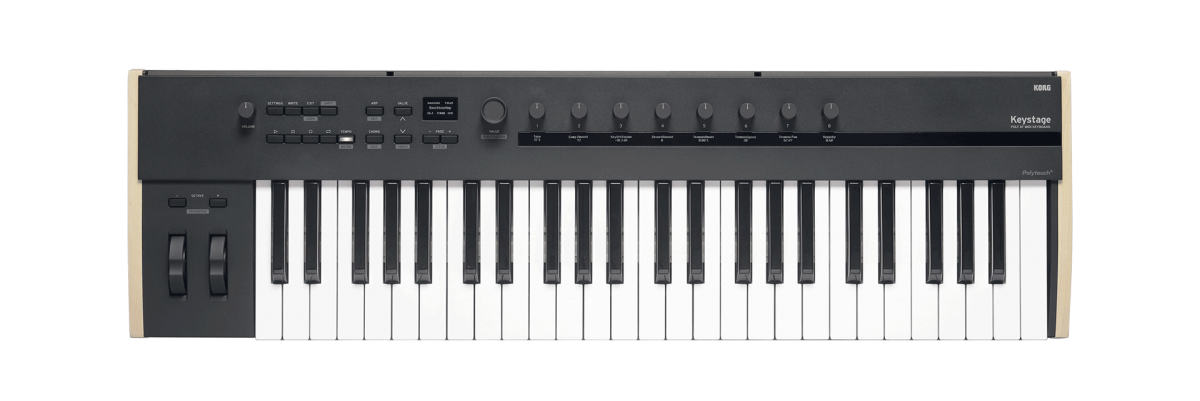
KORG specifies 49 keys on its Polytouch bed, velocity sensitivity, channel aftertouch and polyphonic aftertouch. Semi-weighted is a useful category description, not a promise about how the action will suit your hands. The extra expression is carried by the keys rather than a drum-pad surface; KORG's listed control set has eight parameter knobs, wheels, transport controls and displays, not a bank of pressure-sensitive pads. A receiving synth or plug-in also needs to respond to the expression data before per-key pressure changes what you hear.
Forty-nine notes can cover a compact production desk, synth parts and many two-handed ideas, but it leaves less physical reach than the 61-key sibling or a full 88-note bed. Octave controls change the range that sounds; they do not add keys. If your routine depends on wide two-hand passages without shifting octaves, check the 61-key version or another larger format. If desk length matters, KORG lists this case at 32.05 inches wide, 9.21 inches deep and 3.23 inches high. Add cable clearance and space for hands rather than treating the number as a finished desk layout.
Controls are geared toward changing sounds
The control panel combines eight parameter knobs with small OLED readouts, a main OLED, pitch-bend and modulation wheels, transport buttons and dedicated arpeggiator and chord controls. That arrangement suggests a controller intended to keep common edits and performance tasks close to the keys. KORG lists 16 scenes, 20 arpeggiator patterns and separate preset and user chord sets; those are available tools, not a claim that every buyer needs them. A player who only sends note data and uses one sustain pedal may find much of this panel surplus to the task.
There are damper and expression inputs, but the KORG specifications list pedals as separately sold accessories. The damper jack supports half-damper operation. Before choosing a pedal, confirm its type and compatibility rather than assuming that any two-pedal setup is included in the box.
USB-B audio is useful, but does not make a synth
The Type-B USB connection carries MIDI and works as a two-channel audio output interface. KORG describes using the keyboard with a computer, phone or tablet and says the computer application must be configured for MIDI and audio. The included cable is Type A to Type B. That is not a USB-C connection: a USB-C-only host may need a suitable adapter or cable, and a tablet or phone may require a separate camera/USB adapter. Check the current operating-system and application requirements with KORG, especially if you expect to use a specific DAW or mobile device.
The Keystage has no built-in sound generator. When a DAW or software instrument creates audio, its interface can route that audio to the left/right outputs or headphone jack. A MIDI note stream alone is not sound. KORG advertises software such as Gadget Producer and Ableton Live Lite, but a used unit, seller package or account may not convey the same license. Check the exact offer and registration terms.
DIN hardware control has a separate power check
The rear panel includes MIDI IN and MIDI OUT, so the 49 can send control data over 5-pin DIN to a hardware tone generator. The generator still makes the sound and needs its own audio connection. KORG's manual says to power the Keystage with the separately sold 9 V adapter when using it to control an external MIDI tone generator; it also describes a standards-compliant USB supply of at least 5 V and 550 mA. This is a practical limitation to plan around, not an optional footnote. A box listing the USB cable and expansion plate does not say that the adapter is included.
USB-B connects to the configured host; DIN links to an external instrument. KORG lists DAW integrations and scripts, but its manual still directs users to configure MIDI and audio inside the chosen application. Verify the host, software version, cable and power arrangement before relying on a live workflow.
Where the 49-key size fits—and where it does not
At 9.26 pounds, the Keystage-49 is easier to reposition than a heavy hammer-action 88-key controller, while broader than a miniature travel keyboard. Its included expansion plate can be mounted in the center; that does not establish a laptop-safe placement or a stand's load limit. Check desk depth, cable routes and support capacity.
The Keystage-61 keeps the family concept and adds twelve keys, but its published width is 38.54 inches. Choose between the siblings by the note span and available surface first. This 49 is the more compact of the two, not necessarily the better keyboard for every player; and the semi-weighted specification cannot stand in for trying the action if feel is a deciding factor.
Bottom line
The Keystage-49 merits a closer look when a 49-note range, polyphonic aftertouch, hands-on sound controls, direct 5-pin MIDI and a USB audio interface all serve the same setup. Its main compromises are equally concrete: the USB port is Type B rather than USB-C, the keyboard does not generate sound, DIN hardware operation needs separate power, and a 32.05-inch case needs clearance beyond its published dimensions. Confirm the exact Keystage-49 model, host and seller package instead of relying on an unspecified family listing. This is a research-based source assessment, not a report of ownership, hands-on use or testing.
Primary sources: KORG Keystage product page; KORG Keystage specifications; KORG Keystage Owner's Manual (English, E2); KORG Keystage support downloads. Check current software, OS and seller-package terms before ordering.
Key specifications
Key details at a glance
| Keys | 49 |
|---|---|
| Manufacturer's keybed description | Semi weighted |
| Width | 32.05 in |
| Pads | 0 |
| Velocity-sensitive pads | No |
| Pressure-sensitive pads | No |
| 5-pin MIDI Out | Yes |
| Computer connection | Usb-b |
| USB bus-powered | Yes |
| Assignable pedal input | Yes |
| Keyboard channel aftertouch | Yes |
| 5-pin MIDI In | Yes |
| Depth | 9.21 in |
| 5-pin MIDI outputs | 1 |
| CV/Gate/Mod voice outputs | 0 |
Use the exact model’s instructions for operating limits, supplied equipment and version differences.
Sources for this review
Sources for this assessment
Start with your setup, not a headline feature
Use the finder to combine key-count, connection, control and desk-fit requirements. Unverified specifications are never treated as a match.