
Your needs, this model
Does it fit your priorities?
What 37-key model fits a 22.25-inch width screen?
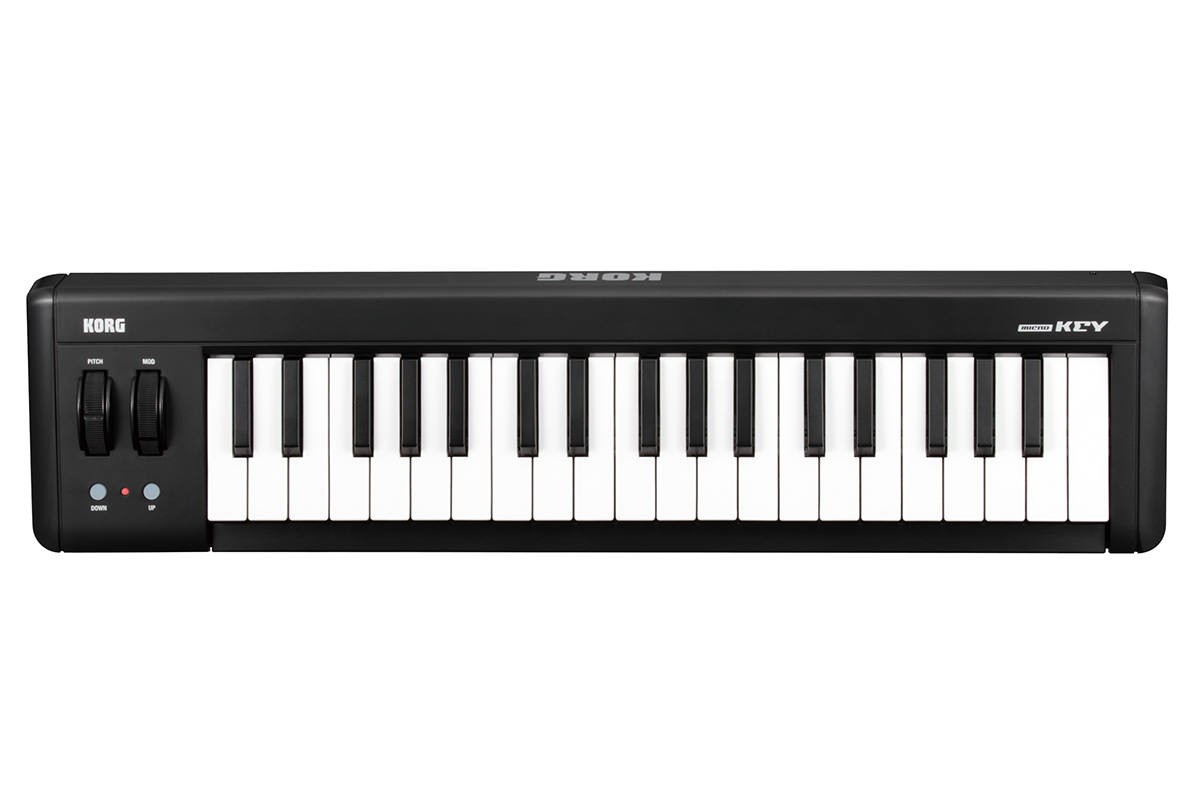
The original microKEY-37 is 565 mm / 22.24 inches wide and fits a 22.25-inch body cap by 0.01 inch. It uses velocity-sensitive Natural Touch mini keys, pitch/modulation wheels and a Type-B host link; allow cable and hand clearance beyond the chassis.
Explore this need in the finder →Can the original microKEY-37 also serve as a USB hub?
The 37-key model has two USB-A downstream ports alongside its Type-B host connector. KORG’s manual says to connect a powered hub where needed and not attach a bus-powered USB device drawing over 100 mA to those downstream ports; they do not turn the keyboard into a standalone USB host.
Explore this need in the finder →Does the microKEY-37 include direct DIN output or a pedal jack?
The reviewed 37-key specifications list USB Type-A hub ports and one Type-B connection, plus pitch/modulation wheels; they do not document a five-pin MIDI output or pedal input.
Explore this need in the finder →The original KORG microKEY-37 gives the non-Air microKEY family a 37-key Natural Touch mini-key bed, pitch- and modulation-wheel control and two USB-A downstream ports. KORG powers it through its USB Type-B computer connection, so the extra ports are a hub extension rather than a standalone MIDI output or a second host connection.
What the 37-key version adds
KORG’s U.S. specification table separates three original sizes: 25, 37 and 61 keys. The 37-key configuration has pitch-bend and modulation wheels rather than the 25-key model’s joystick, arpeggiator and Sustain/TAP buttons. It also has two Type-A USB connectors in addition to one Type-B host connector. The 61-key model shares the wheel and hub layout but differs in physical range, dimensions and octave-shift range. The original microKEY should not be confused with microKEY2 or the Bluetooth microKEY Air; those are separate product families with different source pages and operating capabilities.
KORG describes the keybed as Natural Touch mini keys; the English owner manual calls it a velocity-sensitive mini-keyboard. The feature page documents eight velocity curves plus constant velocity. The sources do not provide key aftertouch, individual key measurements or a subjective key action test. The branded keybed name is useful for identifying the product, but a buyer should not assume that it means weighted piano keys or a personal fit.
Range and desk fit
The 37 physical keys offer more simultaneous range than the 25-key sibling, and octave shift runs from −4 to +4. The body measures 565 × 139 × 54 mm (22.24 × 5.47 × 2.13 inches) and weighs 1.0 kg. KORG’s feature page characterizes this size as balancing playability and compactness, but the actual width is what matters for a fixed desk: a 22.25-inch body cap leaves only 0.01 inch for the width measurement. It does not include cable bend, USB plugs, hands, supports or nearby devices. Measure the usable area rather than equating the published chassis size with a complete workstation footprint.
The size has two wheels for continuous pitch and modulation gestures, which can matter for parts that need them. It has no separately listed drum-pad bank, sustain pedal jack, sound engine or audio output. The 37-key model is still a MIDI controller, not an instrument that makes sound by itself. A computer/software instrument or an external sound module and monitoring path must complete the setup.
Using the downstream USB ports carefully
The computer connection is USB Type-B and supplies bus power. The two USB-A sockets are downstream hub ports that let the microKEY pass attached USB devices through to the host; they do not provide five-pin MIDI output and they are not computer-host inputs. KORG’s original feature page illustrates using a nanoPAD2 or nanoKONTROL2, while the manual gives important limits: connect a USB device only after the hub and USB-MIDI drivers are installed, and do not attach a bus-powered downstream device that draws more than 100 mA. The manual also advises using a powered hub where necessary and connecting the keyboard directly to the computer if a hub arrangement behaves incorrectly.
This is a useful but conditional feature. The keyboard’s own listed consumption is below 500 mA, and host-port power delivery or the attached devices can affect a multi-device chain. Check the computer’s available USB power, attached controllers and driver setup instead of assuming that two ports equal a general-purpose powered hub. There is no USB-C connector or Bluetooth MIDI in the reviewed original 37-key specification. For direct external MIDI gear, a computer/interface or other supported host must provide the missing DIN route.
Compatibility and package checks
KORG’s feature page includes an iPad use case for the 37-key and 61-key versions with a powered USB hub. That older note is not a current tablet compatibility promise. The English Owner’s Manual lists legacy Mac/Windows baselines and explicitly warns that operation is not guaranteed on every computer that meets them. Check the current support downloads, exact operating system, driver and MIDI host application before treating the older manual’s setup steps as current.
KORG lists a USB cable and software-bundle PIN card for the family, but an individual seller’s box, cable presence and code validity are not established by the product page. Do not count on a transferable software entitlement from a used listing. Verify the model marking, 37-key layout, wheels, two Type-A hub ports and single Type-B host connector. No inspected KORG source establishes a retail SKU, current offer, price, stock or unit condition. For a compact host-based setup that needs 37 physical mini keys, wheels and a carefully managed USB hub, the microKEY-37 is a distinct choice; it is not a direct-DIN hardware controller or a self-contained sound source.
Research sources: KORG microKEY product page; features; U.S. specifications; support and downloads; 37/61-key Owner’s Manual.
Key specifications
Key details at a glance
| Keys | 37 |
|---|---|
| Manufacturer's keybed description | Natural Touch mini keys (KORG description) |
| Width | 22.24 in |
| Pads | 0 |
| Velocity-sensitive pads | No |
| Pressure-sensitive pads | No |
| 5-pin MIDI Out | No |
| Computer connection | USB Type-B |
| USB bus-powered | Yes |
| Assignable pedal input | No |
| 5-pin MIDI In | No |
| Depth | 5.47 in |
| 5-pin MIDI outputs | 0 |
Use the exact model’s instructions for operating limits, supplied equipment and version differences.
Sources for this review
Sources for this assessment
Start with your setup, not a headline feature
Use the finder to combine key-count, connection, control and desk-fit requirements. Unverified specifications are never treated as a match.