
Your needs, this model
Does it fit your priorities?
What is the original microKEY-61 footprint for a five-octave setup?
KORG lists 61 physical mini keys and a 850 × 139 × 54 mm body (33.46 × 5.47 × 2.13 inches). Its five-octave range is simultaneous physical span, unlike octave-shift buttons; it still uses mini keys and requires computer-hosted MIDI.
Explore this need in the finder →What controls and connection does the microKEY-61 add?
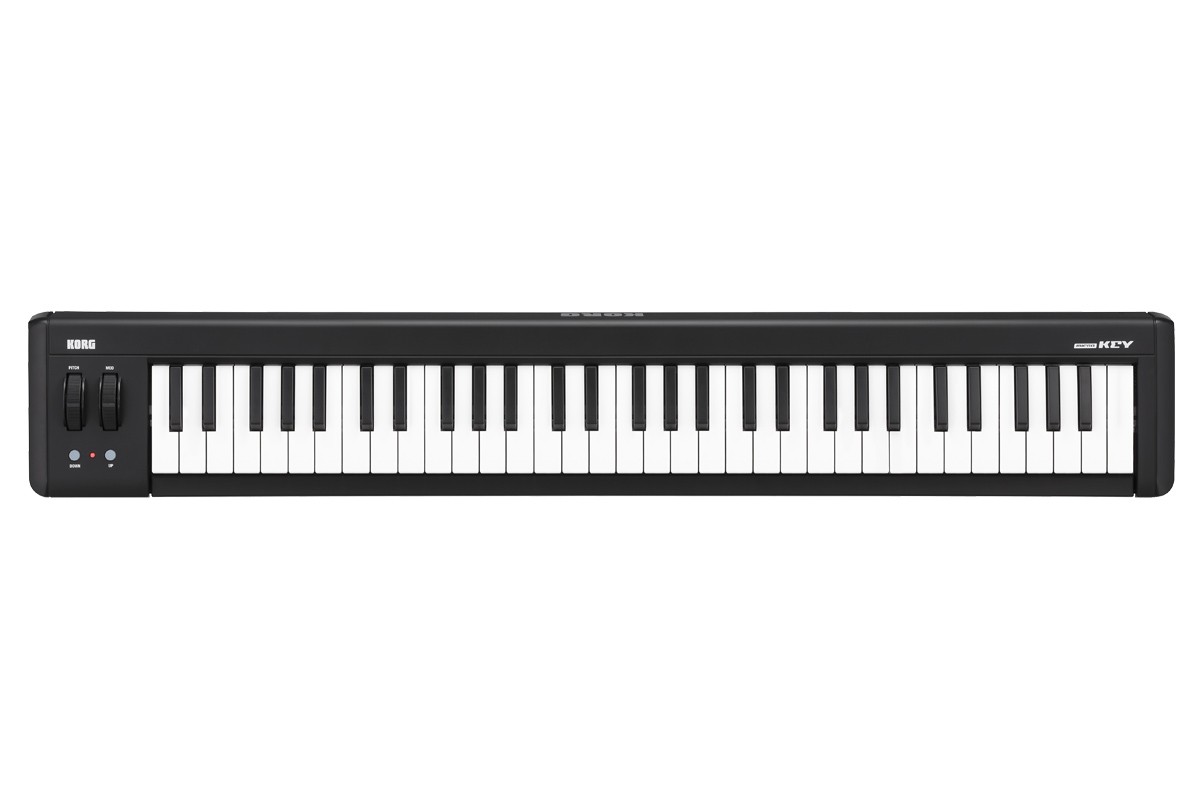
The 61-key configuration has pitch-bend and modulation wheels, octave shift from −3 to +3, a USB Type-B computer link and two USB-A downstream hub ports. It has no documented direct DIN output, onboard audio or pedal input.
Explore this need in the finder →Will an old microKEY-61 manual prove current DAW support?
No. KORG’s English manual lists legacy OS baselines and warns keyboard operation is not guaranteed on every system meeting them. Confirm current driver and host-app support for the exact computer before relying on this older unit.
Explore this need in the finder →The original KORG microKEY-61 is a 61-key USB-powered MIDI controller built around Natural Touch mini keys. Its five-octave physical span and pair of performance wheels distinguish it from smaller members of the original family, but the larger format does not turn it into a full-size-key piano or an external-DIN controller.
Five physical octaves in a mini-key format
KORG’s U.S. specifications list 61 keys for this size, and its product page describes a full five-octave layout. That gives the player more simultaneous notes than the 25- and 37-key microKEYs; octave shift from −3 to +3 changes the active register but does not add more physical keys. The keybed is described as Natural Touch mini keys, and the matching English manual calls it velocity-sensitive. KORG’s feature page documents eight velocity curves plus a constant-velocity option. The reviewed materials do not state key aftertouch, individual key dimensions or a weighted action, so no one should infer those from the family name or the five-octave count.
The 61-key model has pitch-bend and modulation wheels. It does not use the 25-key unit’s joystick/arpeggiator/Sustain-TAP layout. It also shares the 37-key model’s two downstream USB-A ports, with one USB Type-B connector for the computer. The three sizes are distinct configurations; a long listing title that says only “microKEY” is not enough to identify which control layout or footprint is being sold. These are the original non-Air microKEY details, not the separate microKEY2 refresh or Bluetooth microKEY Air.
Measure the case and the surrounding space
The microKEY-61 measures 850 × 139 × 54 mm, or 33.46 × 5.47 × 2.13 inches, and weighs 1.71 kg. A 33.5-inch cap clears the listed body by only 0.04 inch. Cable clearance and support width are additional requirements; a long keyboard can overlap desk supports or leave too little room for other controls even when its stated width is under a numerical limit. Check both usable desk length and where the device sits relative to the player.
The feature page presents five octaves as a useful performing range, but the keys remain mini rather than documented full-size keys. If standard piano key spacing or a particular playing feel is essential, the available specifications cannot answer that question. The key format is a relevant purchase check, not a flaw that can be calculated away from the count. The keyboard also has no documented built-in sound generator or audio output. It sends MIDI to a host instrument or external sound source, so a computer/software instrument or other MIDI/audio equipment is part of the system.
USB hub is not hardware MIDI Out
The single Type-B connection carries host MIDI and USB bus power. Two Type-A connectors act as downstream USB hub ports for compatible devices; they do not send five-pin MIDI to a synthesizer and do not act as alternate inputs from a computer. KORG’s English manual says not to attach a bus-powered device drawing more than 100 mA to those downstream ports and describes powered-hub and driver sequencing requirements. If a multi-device chain is essential, verify actual power delivery and compatibility rather than treating the two sockets as unrestricted hub power.
The specification table lists USB bus power below 500 mA for the 37- and 61-key models. No Bluetooth MIDI, USB-C, pedal jack or direct five-pin DIN output is documented for the original microKEY-61. A USB-C adapter cable cannot change the Type-B device connector into native USB-C, and it does not guarantee a current host will support this older controller. For external MIDI equipment, a separate computer/interface or compatible MIDI host must provide the route.
Older documentation and buying checks
KORG’s iPad guidance for the 37/61 sizes refers to a USB hub that can supply power. That guidance is dated and does not certify modern tablet or app compatibility. The Owner’s Manual lists legacy Windows and Mac minimums and warns that correct operation is not guaranteed on every system that satisfies them. KORG still lists support downloads, but a downloadable manual is not proof that a current driver or chosen DAW will work. Confirm the specific operating system, host USB power, MIDI port selection and app support before purchase.
KORG’s product page lists a USB cable and a bundle-software PIN card for the family; this is not proof that a seller’s used unit includes a cable or a valid, transferable code. Check the exact “microKEY-61” label, 61-key layout, wheels, hub sockets and Type-B host port in the listing photos, and verify package and condition directly. No current stock, retail SKU, seller offer or price is established by the manufacturer sources reviewed here. This model suits a buyer who wants a longer physical mini-key range with a computer-hosted USB route; look elsewhere if direct DIN, audio, pedal input or a confirmed full-size keybed is mandatory.
Research sources: KORG microKEY product page; features; U.S. specifications; support and downloads; 37/61-key Owner’s Manual.
Key specifications
Key details at a glance
| Keys | 61 |
|---|---|
| Manufacturer's keybed description | Natural Touch mini keys (KORG description) |
| Width | 33.46 in |
| Pads | 0 |
| Velocity-sensitive pads | No |
| Pressure-sensitive pads | No |
| 5-pin MIDI Out | No |
| Computer connection | USB Type-B |
| USB bus-powered | Yes |
| Assignable pedal input | No |
| 5-pin MIDI In | No |
| Depth | 5.47 in |
| 5-pin MIDI outputs | 0 |
Use the exact model’s instructions for operating limits, supplied equipment and version differences.
Sources for this review
Sources for this assessment
Start with your setup, not a headline feature
Use the finder to combine key-count, connection, control and desk-fit requirements. Unverified specifications are never treated as a match.