
Your needs, this model
Does it fit your priorities?
Will the 25-key microKEY2 fit my body-width limit?
KORG lists the microKEY2-25 at 15.55 inches wide. That is a chassis-only screen; allow for hands, the USB plug and cable bend, and the support surface. This non-Air model uses USB Type-B and has no listed wireless MIDI mode.
Explore this need in the finder →Can the microKEY2-25 send directly to five-pin MIDI hardware?
KORG lists USB Type-B and bus power for the microKEY2-25; its larger-size pedal-switch jack is an input, not a five-pin MIDI output. KORG does not document direct DIN MIDI Out. Use a separately documented host/interface path or select a model with verified DIN output.
Explore this need in the finder →Does the microKEY2-25 have a USB-C computer socket?
No. KORG specifies USB Type-B for the non-Air microKEY2-25; it is bus-powered and has no listed Bluetooth MIDI mode. A USB-C host may need a suitable cable or adapter, but that connector does not establish OS or music-app compatibility.
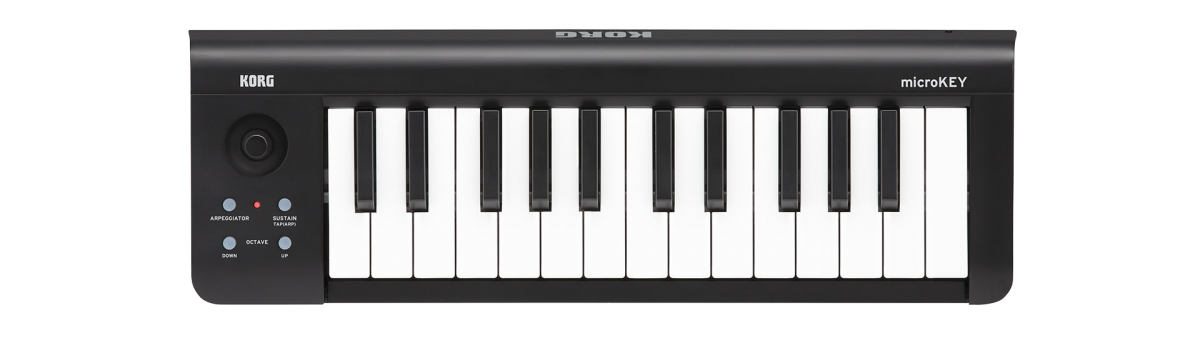
Explore this need in the finder →The KORG microKEY2-25 is the smallest physical keyboard in the current microKEY2 range: 25 velocity-sensitive Natural Touch mini keys, a USB Type-B computer connection and a panel built around a joystick and arpeggiator. That combination makes it a different choice from the longer 37-, 49- and 61-key versions, not simply a shrunken copy. This is a source-based assessment of KORG's US product page, specification table and current English owner manual, not a hands-on test.
The short span is the main decision
Twenty-five physical notes can be enough for a melody, bass line, one-handed part or a small desk where another instrument is already present. Octave-shift and transpose controls extend the MIDI notes you can address, but shifting moves the available range; it does not put more notes under both hands at once. A player who needs broad chords, two-handed arrangements or simultaneous bass and upper-register parts may find 37 keys a more useful floor. KORG still uses mini keys across this line, so even the 25-key board is compact in both range and key format.
KORG identifies the bed as Natural Touch mini-keyboard, and its manual says the keys are velocity-sensitive. The KORG KONTROL Editor can select eight velocity curves or a constant-velocity setting. These settings affect the MIDI values sent to a receiving instrument; they do not establish a weighted piano action or predict whether a particular player will like the key spacing. The product page gives the 25-key octave shift as plus or minus four octaves.
Why this size has a different control panel
Instead of the pitch-bend and modulation wheels fitted to the 37/49/61 versions, the 25 has a joystick. KORG describes it as handling pitch bend and modulation, while its manual details additional assignable control messages and arpeggiator behavior. A dedicated arpeggiator button turns that function on or off; the adjacent Sustain/TAP button sends a sustain message and can tap a tempo while the arpeggiator is active. This is useful if the planned part needs compact performance gestures, but the front-panel shortcut is not the same thing as a separate foot pedal jack. KORG lists the assignable switch jack only on its larger models.
A single wired route keeps the setup simple, with conditions
The microKEY2-25 connects through USB Type-B and draws USB bus power. It is not USB-C, and no Bluetooth MIDI mode is listed for this non-Air model. If the computer has only USB-C ports, the cable or adapter must suit both ends; the connector alone does not guarantee the host, application or operating system will recognize the controller. KORG's product page describes computer use without a separate driver, while its support area also maintains a Windows USB-MIDI driver and its manual discusses choosing the correct MIDI port. Treat those as setup details to check for the actual computer and music program rather than a universal plug-and-play promise.
KORG also says the second generation supports iPad and iPhone when used with an Apple Lightning-to-USB Camera Adapter, which is sold separately. That specific accessory wording matters: the product page does not establish a USB-C tablet route or guarantee compatibility with every modern device or app. A tablet purchase should be checked against the current host documentation before relying on the keyboard for a session.
Small dimensions are not the whole desk plan
The published body measures 15.55 inches wide, 5.16 inches deep and 2.05 inches high; KORG lists the non-Air 25-key weight as 650 g. The width clears a 16-inch bare-body screen by only 0.45 inch. It says nothing about room for hands, a USB plug, cable bend, the device holding the keyboard or neighboring equipment. Measure the playing surface rather than counting the body width as a complete installation fit. A stated USB cable is included in KORG's specification table, along with a KORG Software Bundle code, but the exact entitlement and physical contents of a particular new, used or seller-listed package need separate confirmation.
Where it fits among the microKEY choices
Choose the 25 if the minimum physical span is genuinely enough and its joystick, arpeggiator and on-panel sustain/tap behavior suit the part. The 37 adds 12 physical keys, replaces that control cluster with wheels and adds an assignable pedal-switch jack, at the cost of a 22.24-inch body. The related microKEY Air-25 adds a Bluetooth operating mode but has different power and compatibility considerations; do not mistake an Air listing for this USB-only configuration. None of those distinctions establishes an exact seller SKU, current stock, code eligibility or a preferred key feel.
Before choosing an offer, confirm it is the non-Air microKEY2-25, check the included cable and software-code terms, verify the host and app, and decide whether the short physical range is practical for the actual music. This is a compact MIDI input device: KORG's reviewed pages document control data over USB, not built-in sound or direct five-pin MIDI output. A computer instrument or separate sound module and monitoring path must complete the system.
Key specifications
Key details at a glance
| Keys | 25 |
|---|---|
| Manufacturer's keybed description | Natural Touch mini keys (KORG description) |
| Width | 15.55 in |
| Pads | 0 |
| Velocity-sensitive pads | No |
| Pressure-sensitive pads | No |
| 5-pin MIDI Out | No |
| Computer connection | USB Type-B |
| USB bus-powered | Yes |
| Assignable pedal input | No |
| 5-pin MIDI In | No |
| Depth | 5.16 in |
| 5-pin MIDI outputs | 0 |
Use the exact model’s instructions for operating limits, supplied equipment and version differences.
Sources for this review
Sources for this assessment
Start with your setup, not a headline feature
Use the finder to combine key-count, connection, control and desk-fit requirements. Unverified specifications are never treated as a match.