
Your needs, this model
Does it fit your priorities?
Will the 37-key microKEY2 fit my body-width limit?
KORG lists the microKEY2-37 at 22.24 inches wide. That is a chassis-only screen; allow for hands, the USB plug and cable bend, and the support surface. This non-Air model uses USB Type-B and has no listed wireless MIDI mode.
Explore this need in the finder →Can the microKEY2-37 send directly to five-pin MIDI hardware?
KORG lists USB Type-B and bus power for the microKEY2-37; its larger-size pedal-switch jack is an input, not a five-pin MIDI output. KORG does not document direct DIN MIDI Out. Use a separately documented host/interface path or select a model with verified DIN output.
Explore this need in the finder →Does the microKEY2-37 have a USB-C computer socket?
No. KORG specifies USB Type-B for the non-Air microKEY2-37; it is bus-powered and has no listed Bluetooth MIDI mode. A USB-C host may need a suitable cable or adapter, but that connector does not establish OS or music-app compatibility.
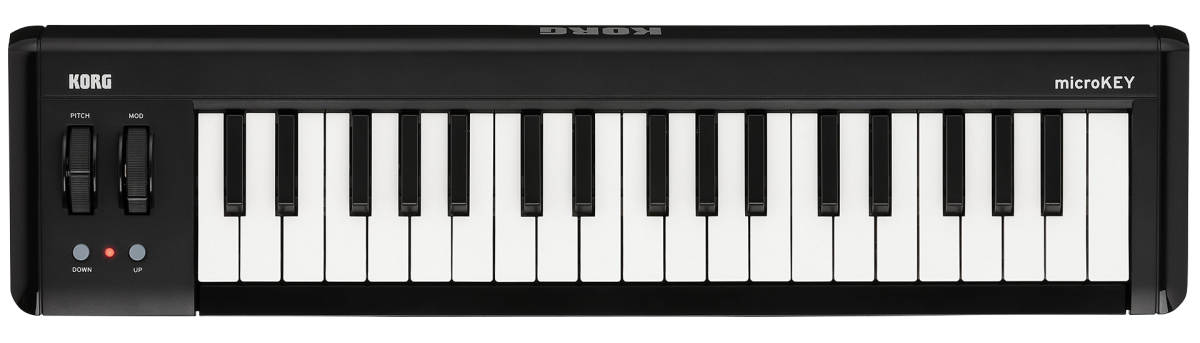
Explore this need in the finder →The KORG microKEY2-37 occupies the middle ground between the very compact 25-key model and the wider 49/61 versions. It has 37 velocity-sensitive Natural Touch mini keys, pitch-bend and modulation wheels, an assignable switch jack for a pedal and USB Type-B bus power. KORG's current US product page lists all four microKEY2 sizes separately, so the 37-key version should be judged on its own span, controls and footprint. This review interprets the maker's current product/specification pages and model-family manual; it is not a report of playing or testing the instrument.
Thirty-seven keys: more room, still a compact layout
A 37-note bed gives more simultaneous range than the 25-key model without taking up the 27.91-inch width KORG lists for the 49. That can matter when a part needs a few extra notes around a melody or when octave changes during a take are inconvenient. The shorter keyboard still requires compromises for broad two-handed passages and it remains a mini-key instrument, not a full-size piano keybed. Octave-shift controls can move the played notes, but cannot expand the physical span at one time.
KORG describes the keys as Natural Touch mini keys; the manual says they are velocity-sensitive and the KONTROL Editor offers eight curves plus a constant-velocity option. This provides a way to change how key response is transmitted to a software or external instrument. It is not evidence of weighted action, a particular response curve from the factory, or subjective comfort. The 37-key model has a plus/minus four-octave shift range in KORG's specification table, like the 25-key version.
Wheels and a pedal socket replace the 25's joystick cluster
The model-specific control list is more restrained than some software-focused controllers: pitch-bend and modulation wheels, octave buttons and an assignable switch jack. The manual describes the jack as configurable for a footswitch or damper-style MIDI control; it does not turn the switch socket into a MIDI DIN output. KORG lists the socket on the 37/49/61 sizes, while its 25-key variant instead has a joystick, arpeggiator button and Sustain/TAP button. That is a real functional distinction for a player who reaches for pitch and modulation wheels or wants a pedal input.
The manual also documents user-adjustable controller assignment through KORG KONTROL Editor. It is useful to check the software version and the exact settings you plan to use, but the keyboard is still only a MIDI controller. Its keys and wheels send instructions; a computer, tablet or other MIDI sound source must make the audio.
USB power means a cable-dependent host arrangement
For this non-Air microKEY2, the documented computer connection is USB Type-B and the power supply is USB bus power. KORG does not list Bluetooth MIDI for the model; if a wireless route is central to the setup, compare the distinct microKEY Air family rather than assuming that the similar name describes the same hardware. A computer with USB-C ports may need an appropriate cable or adapter, and compatibility depends on the computer, operating system, application and MIDI port configuration.
The product page says no driver installation is needed for its basic Mac/Windows description, but KORG also publishes a Windows USB-MIDI driver and the manual explains connection and port selection. Neither source should be stretched into a promise about every host or DAW. The current specifications list an iOS connection through a separately purchased Apple Lightning-to-USB Camera Adapter; that connector-specific route should be checked against the actual tablet and app, especially before substituting a different adapter or port standard.
Measure beyond the body width
KORG lists 22.24 inches wide, 5.47 inches deep and 2.13 inches high, with a weight of 1.0 kg. A 22.25-inch questionnaire limit is the first quarter-inch setting that clears the width as a body measurement, leaving virtually no practical room for adjacent gear. The cable exits at the rear, and hands need more space than the shell alone. The manual also cautions that a passive USB hub may not supply enough power; a direct computer connection or powered hub is the safer starting point if the keyboard does not start reliably.
The specification table lists a USB cable and KORG Software Bundle code. Those are maker-stated box items, not proof that every secondhand or marketplace offer still has the cable or an unused, transferable code. Check the exact package, condition and software terms independently. KORG does not establish the seller's SKU, price or stock in the product material reviewed here.
How to decide between 25, 37 and 49
The 37 is a sensible range choice only if its extra physical keys over the 25 change how you will play. If you regularly need a longer two-handed part, compare the 49 at 27.91 inches; it retains the wheels and pedal switch but adds 12 more notes. The 37's useful boundary is the combination of a still-short physical span, a distinct pedal/control setup and its 22.24-inch body. It does not provide a USB-C socket, direct five-pin DIN output, pressure-sensitive pads, onboard sound or a wireless MIDI plan in KORG's reviewed documentation.
Before ordering, check the precise microKEY2-37 suffix, cable and package, the pedal connector you need, the available width and depth, and the target host's MIDI support. If the mini-key format itself is uncertain, compare the documented action descriptions in person where possible rather than reading “Natural Touch” as a guarantee of personal preference.
Key specifications
Key details at a glance
| Keys | 37 |
|---|---|
| Manufacturer's keybed description | Natural Touch mini keys (KORG description) |
| Width | 22.24 in |
| Pads | 0 |
| Velocity-sensitive pads | No |
| Pressure-sensitive pads | No |
| 5-pin MIDI Out | No |
| Computer connection | USB Type-B |
| USB bus-powered | Yes |
| Assignable pedal input | Yes |
| 5-pin MIDI In | No |
| Depth | 5.47 in |
| 5-pin MIDI outputs | 0 |
Use the exact model’s instructions for operating limits, supplied equipment and version differences.
Sources for this review
Sources for this assessment
Start with your setup, not a headline feature
Use the finder to combine key-count, connection, control and desk-fit requirements. Unverified specifications are never treated as a match.