
Your needs, this model
Does it fit your priorities?
Will the 61-key microKEY2 fit my body-width limit?
KORG lists the microKEY2-61 at 33.46 inches wide. That is a chassis-only screen; allow for hands, the USB plug and cable bend, and the support surface. This non-Air model uses USB Type-B and has no listed wireless MIDI mode.
Explore this need in the finder →Can the microKEY2-61 send directly to five-pin MIDI hardware?
KORG lists USB Type-B and bus power for the microKEY2-61; its larger-size pedal-switch jack is an input, not a five-pin MIDI output. KORG does not document direct DIN MIDI Out. Use a separately documented host/interface path or select a model with verified DIN output.
Explore this need in the finder →Does the microKEY2-61 have a USB-C computer socket?
No. KORG specifies USB Type-B for the non-Air microKEY2-61; it is bus-powered and has no listed Bluetooth MIDI mode. A USB-C host may need a suitable cable or adapter, but that connector does not establish OS or music-app compatibility.
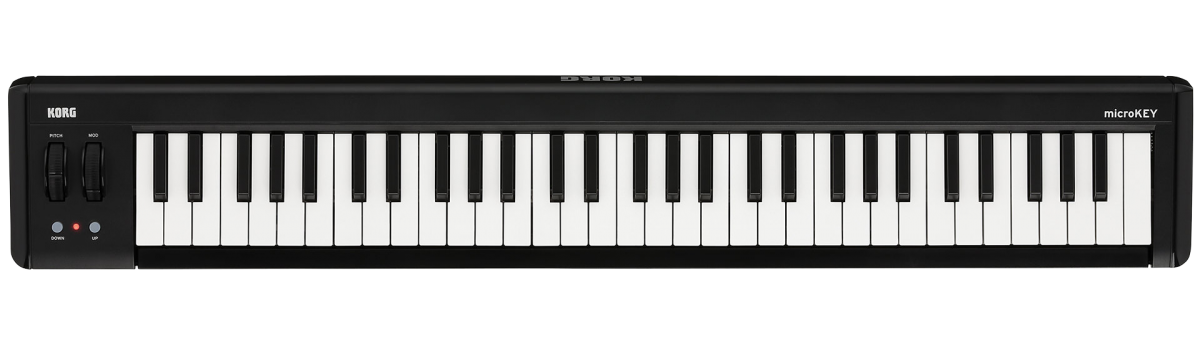
Explore this need in the finder →The KORG microKEY2-61 is the longest physical-key configuration in the microKEY2 range, providing 61 velocity-sensitive Natural Touch mini keys with pitch and modulation wheels, an assignable pedal-switch jack and USB bus power. It covers more simultaneous notes than the 25, 37 or 49 versions, while retaining the same compact mini-key approach and USB Type-B host connection. This assessment is based on KORG's US product and specification pages and its English 37/49/61 owner manual, not on hands-on playing or testing.
Sixty-one keys and the limits of octave shifting
A 61-key span can reduce octave changes during a two-handed part or let a software-instrument player keep a larger section of the range physically available. It is roughly five octaves, not a full 88-note piano keyboard. Octave-shift and transpose functions can redirect the notes sent to a host, but do not make additional physical keys available at the same time. The 61 uses the manufacturer's Natural Touch mini-key format, which is a different decision from choosing full-size, weighted or hammer-action keys.
KORG's manual identifies the keys as velocity-sensitive and allows eight response curves or a constant-velocity option through the KONTROL Editor. This gives a software or hardware instrument a configurable MIDI response, not a quantified statement of action or personal touch. KORG's US table lists the 49/61 models at plus/minus three octaves of shift, distinct from the 25/37's plus/minus four. Check the manual if a specific shift range or controller mapping is part of a performance plan.
Performance controls without a larger workstation layout
The surface pairs a pitch-bend wheel with a modulation wheel and octave controls. An assignable switch jack accepts a pedal or footswitch; KORG does not say that a specific pedal is included in every sale, so verify the exact package. The 61 shares that control arrangement with the 37 and 49, while the 25 trades it for its joystick, arpeggiator button and Sustain/TAP button. That means the 61 adds physical notes, not a more extensive set of pads or DAW controls.
The reviewed product page describes a MIDI keyboard controller, and KORG's connection/specification material lists USB Type-B plus the footswitch jack rather than a five-pin DIN output, audio output or onboard tone generator. Treat the keyboard as a data input: the computer, software or external instrument must generate the sound and be connected to speakers or headphones through its own audio path. A direct-hardware setup needs a separately verified MIDI interface or another controller with the required DIN route.
Host and power planning
The microKEY2-61 is not the wireless microKEY Air. KORG documents USB Type-B to a computer and USB bus power, not Bluetooth MIDI or battery operation, for this non-Air model. A USB-C-only host can require a suitable cable or adapter. KORG's current product page describes connecting to Mac and Windows without a separate driver, while the support page also provides a Windows USB-MIDI driver. The manual points users to host settings and MIDI-port selection; confirm the instructions for the actual operating system and music application instead of assuming all computers behave alike.
KORG's product page describes iPad/iPhone operation through a Lightning-to-USB Camera Adapter sold separately. Check the target tablet, adapter and app before building around that specific path. A successful physical connection alone does not prove that an app exposes the controller as a MIDI input or that every host meets KORG's operational caveats.
A useful 33.46-inch measure, not a placement guarantee
KORG lists the 61 at 850 by 139 by 54 millimeters, or 33.46 by 5.47 by 2.13 inches, and 1.71 kg / 3.77 lb. A 33.5-inch body-width cap clears it by only 0.04 inch. That is a useful first screening boundary, but not enough space for a cable to exit, a hand to move, or neighboring hardware. Check both available width and depth and leave margin around the instrument. The USB cable is listed among the included items; exact condition, cable presence and software-bundle status remain seller-specific.
When the 61 is worth its footprint
Compared with the 49, the 61 adds 12 notes but expands the listed body by about 5.55 inches. If that range would be used often, the extra width can be preferable to octave changes; if it would sit unused, the smaller 37 or 49 can be easier to place. Compared with 88-key options elsewhere in the reviewed library, the 61 saves space but is not a substitute for a full-size piano span. The related Air-61 adds wireless operation, with separate batteries and host-support checks; its radio feature should not be attributed to this product.
This model makes sense when 61 physical mini keys, simple USB-powered host control and wheel-and-pedal input meet the actual workflow. Before selecting an offer, verify the model suffix, target computer or tablet, application, cable/power route, pedal needs, body clearance and exact package. KORG's pages do not establish a seller-specific SKU, current price or stock, and the source-based assessment makes no claim about personal key preference.
Key specifications
Key details at a glance
| Keys | 61 |
|---|---|
| Manufacturer's keybed description | Natural Touch mini keys (KORG description) |
| Width | 33.46 in |
| Pads | 0 |
| Velocity-sensitive pads | No |
| Pressure-sensitive pads | No |
| 5-pin MIDI Out | No |
| Computer connection | USB Type-B |
| USB bus-powered | Yes |
| Assignable pedal input | Yes |
| 5-pin MIDI In | No |
| Depth | 5.47 in |
| 5-pin MIDI outputs | 0 |
Use the exact model’s instructions for operating limits, supplied equipment and version differences.
Sources for this review
Sources for this assessment
Start with your setup, not a headline feature
Use the finder to combine key-count, connection, control and desk-fit requirements. Unverified specifications are never treated as a match.