
Your needs, this model
Does it fit your priorities?
Can nanoKEY Fold connect to a computer through USB-C?
KORG lists a USB-C port and its Owner's Manual describes connecting that port to a computer to exchange USB-MIDI data. KORG also says the host application must be configured for the keyboard's functions. This confirms the connector and documented MIDI route, not compatibility with every computer, operating system, app or DAW; check current support and the exact seller's included cable.
Explore this need in the finder →Can it reach an external instrument with five-pin MIDI?
Yes, through the keyboard's 3.5 mm TRS Type-A MIDI OUT jack. KORG lists a TRS-DIN adapter in the box, and the manual says a standard five-pin MIDI cable is also needed (or use a compatible Type-A TRS-DIN cable). USB power is required for this hardware connection; some compliant adapters may not work, and the external instrument supplies its own sound and power.
Explore this need in the finder →Which width should I use for a desk-fit screen?
Use 11.10 inches while the unit is unfolded for playing; KORG's 5.79-inch width is the folded storage size. The 11.10-inch body fits the finder’s smallest selectable 16-inch body cap, but that is not room for USB/MIDI plugs, cable bends or hands, so measure the usable surface separately.
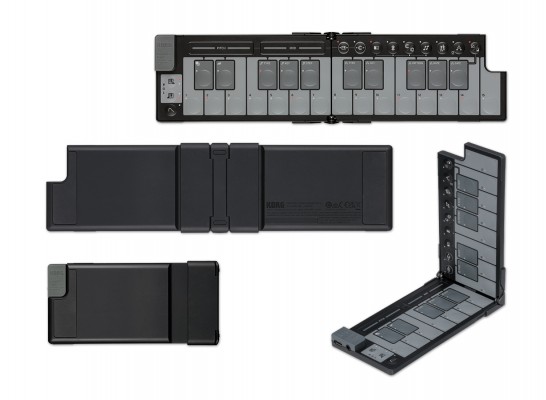
Explore this need in the finder →KORG nanoKEY Fold is a small 25-button MIDI controller built around a foldable body and flexible MIDI controls. KORG lists USB-C for computer connection and a separate 3.5 mm TRS MIDI OUT. That jack can reach standard five-pin hardware through the included Type-A adapter, although the route still needs USB power and a separate MIDI cable. The keybed and operating details matter more here than a long list of modes.
A 25-button surface, not a compact piano action
The specification calls out 25 keys and membrane buttons, and the manual says each button sends a fixed velocity value. You can change that transmitted value, including through thirteen quick settings, but pressure on an individual key does not make it respond like a touch-velocity-sensitive keyboard. If note expression from finger force is central to your playing, this is a real limitation rather than something a velocity menu solves.
The 25-note span is another practical boundary. Octave shift reaches four steps in either direction, and the scale and chord tools can make short melodic ideas easier to map, but octave controls do not turn this into a wider playing surface. It is better assessed as a compact note-entry and MIDI-control surface than as a miniature substitute for a 49- or 61-key board. KORG lists fifteen scale types, an Easy Scale mode, chord mode, fifteen arpeggiator rhythm patterns and a split function; those are useful ways to shape outgoing MIDI, not built-in sounds.
USB-C is a host route; the app still needs setup
KORG specifies a USB-C connector and USB bus power. Its manual describes using the included USB cable to connect to a computer and exchange MIDI data. It also warns that the host application must be configured for the nanoKEY Fold's functions. That confirms the physical connector and documented MIDI path, not seamless compatibility with every computer, tablet, operating system or DAW. Check KORG's current support information and the exact host before treating the connection as plug-and-play.
A separate USB-C port also matters for external MIDI hardware. With a computer connected, the keyboard can draw USB power while its TRS output reaches an external instrument. KORG documents the computer-MIDI route and the external-hardware route, but does not describe whether a note stream is mirrored to both outputs at once. If a particular workflow depends on simultaneous computer and hardware notes, verify that behavior with the target software or receiving device rather than assuming it.
Five-pin MIDI comes through the TRS adapter
The nanoKEY Fold does not have a full-size five-pin DIN socket. Its MIDI OUT is a 3.5 mm TRS jack, and KORG specifies a Type-A TRS-to-DIN connection. The listed package includes a MIDI TRS-DIN adapter cable, but the manual still calls for a standard five-pin MIDI cable between that adapter and the external instrument's MIDI IN. A compatible Type-A TRS-DIN cable is another route; do not substitute a Type-B cable.
Power is easy to overlook in this setup. KORG says the controller must be supplied over USB when its MIDI jack is in use. The manual allows USB from a computer or a compliant commercial supply rated at least 5 V DC and 550 mA, while cautioning that some otherwise compliant adapters may not work correctly. Neither a standard DIN cable nor a USB adapter is listed in the box. The external synth or sound module supplies the audio, so it needs its own power and a separate listening connection.
Folded storage size is not desk width
KORG gives two measurements: 5.79 inches across when folded and 11.10 inches while open for use. The latter is the relevant number for a keyboard-width screen; the body is still very slim front to back at 2.87 inches. At 126 grams, the published mass is light, but neither that nor a body-width pass proves that a connector, cable bend or hand fits in a particular desk space.
The manual advises opening the board without forcing the hinges, using it on a flat surface and keeping it away from items that may be affected by magnets. These are useful ownership checks for a folding controller. Its portability depends on the hinge staying sound and on remembering the extra USB and MIDI leads required for the actual setup.
Choose the finish carefully, but not as a different instrument
KORG's US page shows Black, White, Sand Beige, Lava Orange and Alpine Green finishes. The displayed gallery identifies color, while the listed specifications describe the same nanoKEY Fold configuration; no different key count, jack layout or operating mode is given by color. A seller's exact color code or SKU is not established by KORG's page, so check the listing itself if shade matters. The Black photo used here is the exact Black gallery image, not the lifestyle banner that combines several folded colors.
The product page also mentions software, lessons and editor support. Those descriptions are not proof that every used or remaining-stock package includes current license codes, a transferable registration or access to each service. Confirm the exact offer and any account requirements independently.
Where it fits—and where it does not
The nanoKEY Fold makes sense when a fold-flat 25-note controller with USB-C and a route to external MIDI is the priority. Scale/chord modes, an arpeggiator, touch sliders and saved scenes expand its MIDI control options, but cannot supply more than 25 notes or pad pressure.
Look elsewhere if you need touch-sensitive key velocity, a longer range, pressure-responsive pads, built-in audio or a directly fitted DIN jack. For a close desk fit, plan for the open 11.10-inch body plus hands and connectors, not the folded 5.79-inch storage measurement.
Key specifications
Key details at a glance
| Keys | 25 |
|---|---|
| Manufacturer's keybed description | Membrane buttons |
| Width | 11.1 in |
| Pads | 0 |
| Velocity-sensitive pads | No |
| Pressure-sensitive pads | No |
| 5-pin MIDI Out | Yes |
| Computer connection | USB-C |
| USB bus-powered | Yes |
| Assignable pedal input | No |
| 5-pin MIDI In | No |
| Depth | 2.87 in |
| 5-pin MIDI outputs | 1 |
Use the exact model’s instructions for operating limits, supplied equipment and version differences.
Sources for this review
Sources for this assessment
Start with your setup, not a headline feature
Use the finder to combine key-count, connection, control and desk-fit requirements. Unverified specifications are never treated as a match.