
Your needs, this model
Does it fit your priorities?
Can the compact 25-key taktile drive external MIDI gear directly?
Yes, the taktile-25 has a documented five-pin MIDI Out, but the stand-alone operating route needs a separate USB 5 V adapter rated at least 550 mA and correct MIDI routing; it is not just a USB-only keyboard.
Explore this need in the finder →What does the 25-key taktile add beyond a compact note keyboard?
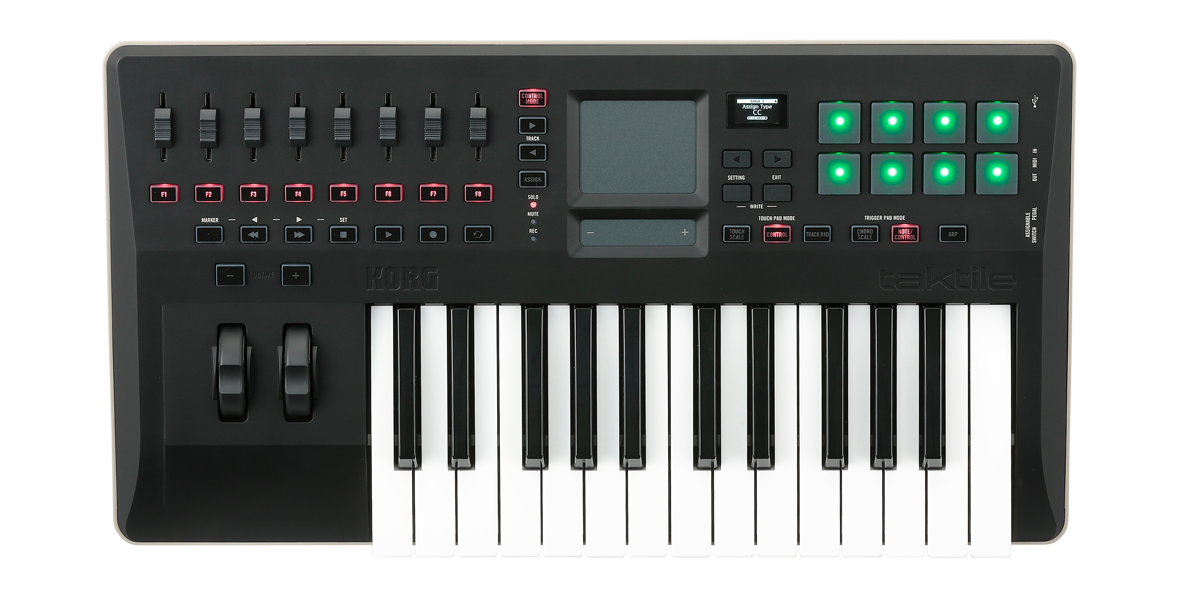
Its 25 semi-weighted keys sit beside eight velocity-sensitive pads, eight switches, eight sliders, touch modes and DAW transport controls. There are no knobs on this size, and the pads are not documented as pressure-sensitive.
Explore this need in the finder →Will the taktile-25 fit a strict 21-inch body-width screen?
KORG lists 531 mm / 20.91 inches wide, so it clears a 21-inch bare-body cap by 0.09 inch; leave more space for plugs, hands and stand support.
Explore this need in the finder →The KORG taktile-25 is a compact-format controller with semi-weighted, velocity-sensitive keys, a small pad bank and hands-on DAW controls. It is more than a USB keyboard, but its direct hardware-MIDI route takes deliberate setup: KORG specifies a separate rated USB supply for standalone use and a routing choice that has to match the job.
What the 25-key version actually includes
KORG’s U.S. specification page identifies a 25-key taktile with a semi-weighted, velocity-responsive keybed and explicitly says aftertouch is not supported. It lists eight velocity-sensitive trigger pads, eight switches, eight sliders and no knobs on this size. Seven transport switches cover marker, forward, rewind, play, stop, record and cycle. Two wheels provide pitch bend and an assignable control. The screen is a 128-by-64 high-contrast OEL display, and the touch surface can be set to Touch Scale, Control or Track Pad mode.
That array makes this particular short keyboard different from a simple travel MIDI input. KORG describes using the pads for chords or single notes, and its touch surface for expressive gestures or pointer-style tasks. The arpeggiator offers six types and 50 rhythm patterns. These are documented controls, not a guarantee that a chosen DAW maps every button automatically. KORG’s support FAQ tells users to match the scene’s Target DAW and configure the application; the exact controls available depend on that setup. The included manual also describes alternate MIDI ports for the keyboard/control section and the DAW section, so this is a control surface whose routing may take more preparation than a generic class-compliant note keyboard.
Short range, broad surface
Twenty-five physical keys make the 25-key model the smaller taktile, but octave buttons do not add notes that can be played at the same time. If a passage needs a wider simultaneous span, a 49-key layout is the relevant sibling. The 25-key version occupies 531 × 290 × 72 mm, or 20.91 × 11.42 × 2.83 inches, and weighs 2.5 kg. Its width is under a 21-inch body cap by only 0.09 inch. That is a measurement of the chassis, not the room needed for a USB or MIDI cable, hands, a stand, or nearby equipment.
The control allocation is a useful differentiator: eight sliders and eight switches are present, while the 49-key model adds eight knobs and doubles the pad count. The smaller one remains dense with controls despite its limited key span. If knobs are central to a particular workflow, the 25-key model does not have them in KORG’s specification. The semi-weighted designation is manufacturer language; it does not establish a buyer’s personal preference, and KORG does not provide individual key dimensions here.
Two MIDI routes, not one universal plug-in setup
The USB Type-B connection can carry MIDI to a computer and supply bus power. For external hardware there are also five-pin MIDI In and Out connectors. KORG’s FAQ distinguishes two routing choices: Controller In/Out sends taktile controller messages to external gear, while USB-MIDI Interface passes MIDI messages between the computer and external equipment. The standalone plan is therefore not simply “plug in DIN and play.” The manual says the device may be powered by USB from a computer or by an adapter; KORG’s specifications support a USB 2.0-compliant 5 V supply rated 550 mA or higher. The listed accessories are an owner’s manual, USB cable and bundle-software PIN card, not a specified power adapter, so confirm the individual package rather than assuming one is included.
For a computer-only session, connect USB Type-B, choose the appropriate scene and MIDI ports in the DAW, and verify that the application’s control-surface implementation supports the functions wanted. KORG’s old manual and its current support listing show downloadable setup tools and drivers, but they do not warrant compatibility with every current operating system or application. No USB-C or Bluetooth route is specified. The keybed has no supported aftertouch, and the pads are documented as velocity-sensitive; pressure response on the pads is not established by these sources, so buyers who need pressure-sensitive pads should not treat this model as confirmed for that requirement.
Who should shortlist it
The taktile-25 is a plausible match when a short keyboard, semi-weighted keys, pads, sliders, transport and a configurable touch surface all matter more than a broad note span or a row of knobs. It can also control external MIDI gear when the correct routing and power arrangement are in place. It is a poor shorthand recommendation for someone who needs a one-cable USB-C controller, key aftertouch, a documented pressure-sensitive pad bank, or direct hardware MIDI with no additional power/setup check.
The reviewed model is the standard taktile, not the separate TRITON taktile sound module/workstation variant. KORG’s U.S. page still provides a product entry and support downloads; that establishes model identity and documents support materials, not an active retail offer, present stock or a seller’s box contents. The sources date from an older generation and list DAW presets that may no longer match current software. Before buying a used or new-old-stock unit, check exact model suffix, physical condition, USB and DIN sockets, included cable, any adapter, and whether the host can be configured for the required scene and MIDI route. A listing that says “taktile” alone does not prove those details.
Research sources: KORG taktile product page; U.S. specifications; support downloads; KORG support FAQ; Owner’s Manual; Parameter Guide.
Key specifications
Key details at a glance
| Keys | 25 |
|---|---|
| Manufacturer's keybed description | Semi weighted |
| Width | 20.91 in |
| Pads | 8 |
| Velocity-sensitive pads | Yes |
| 5-pin MIDI Out | Yes |
| Computer connection | USB Type-B |
| USB bus-powered | Yes |
| Assignable pedal input | Yes |
| Keyboard channel aftertouch | No |
| 5-pin MIDI In | Yes |
| Depth | 11.42 in |
| 5-pin MIDI outputs | 1 |
Use the exact model’s instructions for operating limits, supplied equipment and version differences.
Sources for this review
Sources for this assessment
Start with your setup, not a headline feature
Use the finder to combine key-count, connection, control and desk-fit requirements. Unverified specifications are never treated as a match.