
Your needs, this model
Does it fit your priorities?
Which taktile size supplies 49 keys, 16 pads and hardware MIDI?
The taktile-49 is the 49-key configuration with 16 velocity-sensitive pads and eight knobs in addition to its switches/sliders. KORG specifies five-pin MIDI In/Out, but stand-alone DIN operation needs separately sourced 5 V / 550 mA-or-higher USB power and routing setup.
Explore this need in the finder →Does the 49-key taktile add knobs as well as more keys?
Yes. Its 49-key configuration has eight knobs and 16 velocity-sensitive pads; the 25-key taktile has eight pads and no listed knobs. Both have eight switches, eight sliders, transport controls and assignable MIDI routing.
Explore this need in the finder →Does the taktile-49 clear a 30-inch body-width cap?
KORG lists 750 mm / 29.53 inches wide, so the body fits a 30-inch threshold, but the remaining 0.47 inch is not working clearance for plugs, hands or a stand.
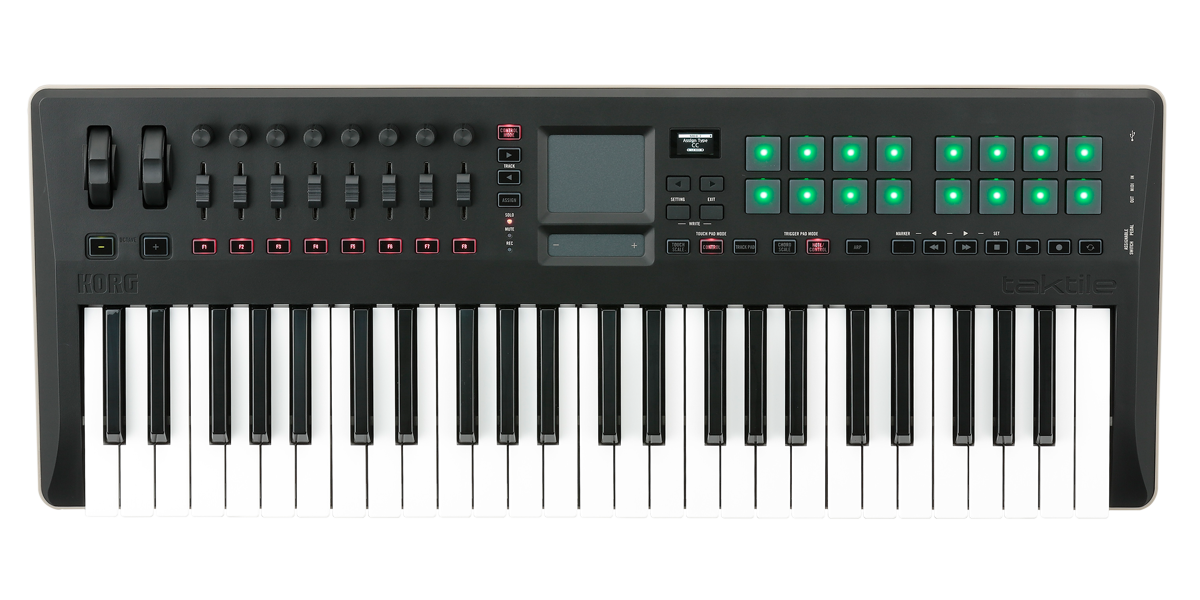
Explore this need in the finder →The KORG taktile-49 combines a 49-key semi-weighted controller keyboard with 16 velocity-sensitive pads, eight knobs, eight sliders and a configurable touch surface. Its important distinction is not just the longer key range: compared with the taktile-25, this version adds a knob bank and doubles the pads, while preserving the same DAW, USB and DIN routing decisions.
A separate 49-key configuration
KORG lists the taktile-49 as a 49-key semi-weighted keyboard with velocity response and no key aftertouch. The surface includes 16 velocity-sensitive trigger pads, eight switches, eight sliders and eight knobs. Seven buttons cover DAW transport and marker navigation. One wheel sends pitch bend and the other is assignable. A touch pad offers Touch Scale, Control and Track Pad modes, with a 128 × 64 OEL display for settings and selected values. The arpeggiator has six types and 50 rhythm patterns.
Those controls can support several different working patterns, but there is no claim that the hardware will automatically control every application. KORG’s manual separates keyboard/controller, DAW and MIDI-interface ports; the support FAQ instructs users to choose a scene whose Target DAW matches their software and to set up that application’s control-surface/MIDI preferences. This makes the taktile more configurable than a basic note-only board, but the buyer should verify the actual host and task before valuing the extra surface. A pictured knob or transport label does not mean every DAW exposes the same mapping.
More range and a different control allocation
The 49 keys give this model more physical range than the 25-key sibling. Octave shifting can move the playable register, but it does not extend the number of simultaneous keys. The taktile-49 measures 750 × 290 × 83 mm (29.53 × 11.42 × 3.27 inches) and weighs 3.8 kg. The body clears a 30-inch width screen by 0.47 inch; that remaining margin should not be mistaken for cable bend, hand space, a stable stand or other desk clearance.
The pad and knob change is concrete: the 49-key model has 16 velocity-sensitive pads and eight knobs, while taktile-25 has eight pads and no listed knobs. Both list eight switches, eight sliders, seven transport controls, two wheels, a touch surface and the same named modes. The 49-key option therefore makes sense when its extra keys and knobs are useful together, not just because “49” is a larger number. KORG does not state continuous pressure sensitivity for the pads in the inspected product/specification/manual pages. Key aftertouch is explicitly unsupported. Buyers who need either kind of pressure response should ask for positive documentation rather than infer it from velocity sensitivity.
USB and five-pin MIDI require an operating plan
USB Type-B is the computer connection and can provide bus power. KORG also specifies five-pin MIDI In and Out. Its support FAQ explains that Controller In/Out routing sends the taktile’s own controller output to external MIDI equipment, whereas USB-MIDI Interface routing passes messages between computer and attached MIDI gear. For a standalone controller-to-synth arrangement, the manual and specification page document USB adapter power, with the specification requiring a USB 2.0-compliant 5 V adapter rated at least 550 mA. The official accessory list names the manual, USB cable and bundle PIN card; it does not list that adapter. Confirm what a particular seller actually supplies.
For computer control, configure the relevant MIDI ports and DAW scene, and check current driver/host support. A bundled PIN card does not establish that a seller has an unused code or a transferable software license. KORG’s support downloads show old and newer software/driver files, but the product’s age and an available support page are not a compatibility guarantee. The manual also notes that pedal polarity is detected at power-on and that the pedal should be connected before startup; half-damper support is explicitly excluded. USB-C and Bluetooth MIDI are not documented for this standard taktile configuration.
Trade-offs before ordering
The taktile-49 is a strong feature-count option on paper for a buyer who wants a broad controller surface around a 49-key keyboard. It is not a piano with its own sound system: KORG documents MIDI control, not an onboard sound engine or audio outputs. Plan for a computer/software instrument or external sound module and an appropriate audio-monitoring path. The 3.8 kg body also makes it less of a featherweight travel board than the smallest controllers.
This assessment is for the standard KORG taktile-49, not a TRITON taktile workstation. KORG’s U.S. page and support downloads confirm the model and its documentation, but no inspected source establishes current offer, stock, exact retail code, used-unit condition or package completeness. The manual’s DAW examples are historical; verify the contemporary host can use the needed MIDI ports and that the seller’s exact unit includes the expected USB cable. If direct DIN is required, check routing, adapter rating and cable direction before purchase. If USB-only, remember that the DIN sockets do not eliminate the need to configure host-side control mappings.
Research sources: KORG taktile product page; U.S. specifications; support downloads; KORG support FAQ; Owner’s Manual; Parameter Guide.
Key specifications
Key details at a glance
| Keys | 49 |
|---|---|
| Manufacturer's keybed description | Semi weighted |
| Width | 29.53 in |
| Pads | 16 |
| Velocity-sensitive pads | Yes |
| 5-pin MIDI Out | Yes |
| Computer connection | USB Type-B |
| USB bus-powered | Yes |
| Assignable pedal input | Yes |
| Keyboard channel aftertouch | No |
| 5-pin MIDI In | Yes |
| Depth | 11.42 in |
| 5-pin MIDI outputs | 1 |
Use the exact model’s instructions for operating limits, supplied equipment and version differences.
Sources for this review
Sources for this assessment
Start with your setup, not a headline feature
Use the finder to combine key-count, connection, control and desk-fit requirements. Unverified specifications are never treated as a match.