
Your needs, this model
Does it fit your priorities?
Can the Hammer 88 Pro cover a full-range part on a shelf capped at 56 inches?
M-Audio's v1.3 guide lists an 88-key graded hammer-action bed and a 56.0-inch width. It is right at a 56-inch body-only cap, so the number leaves no nominal allowance for side clearance, plugs, hands, a stand or the music rest. Measure the actual location and check the exact unit before treating it as a fit.
Explore this need in the finder →Can its five-pin output feed an external sound module?
Yes, the exact product page and v1.3 guide document both 5-pin MIDI In and Out. The DIN Out is configurable: choose KEYS for the controller's performance messages, USB for computer MIDI, or KEYS/USB for both. M-Audio says an external-synth setup still needs USB power from a computer, laptop or powered hub; MIDI does not carry audio, so the module and monitoring route remain separate.
Explore this need in the finder →Are the Pro's sixteen pads documented as pressure sensitive?
The manufacturer specifies sixteen backlit, assignable, velocity-sensitive pads and Note Repeat. The inspected page and v1.3 guide do not confirm pad-pressure sensing, so this record does not treat them as satisfying a pressure-sensitive-pad requirement. The keys' separate Channel Aftertouch feature is not the same capability.
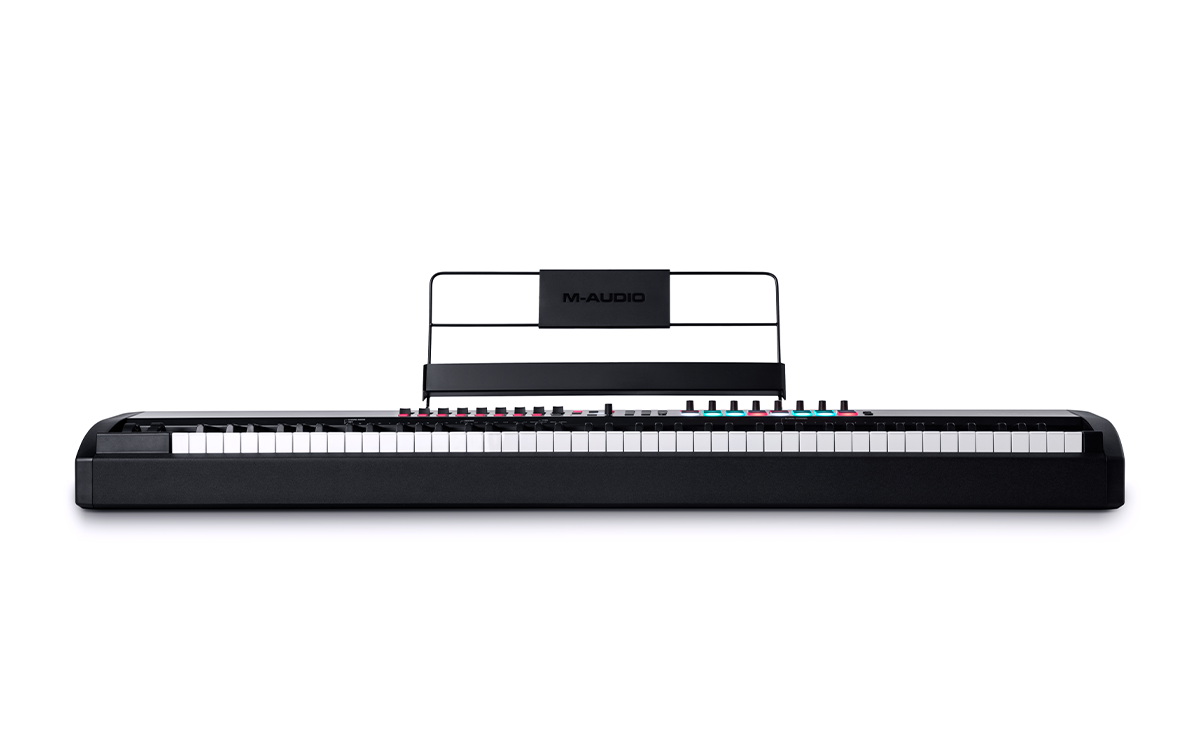
Explore this need in the finder →The Hammer 88 Pro is a MIDI controller with a piano-oriented 88-key graded hammer-action bed, not a self-contained digital piano. Its case for a place in a setup is the combination: a weighted playing surface with channel aftertouch, a large hands-on DAW and instrument-control area, and configurable five-pin MIDI connections for external equipment. That breadth also makes it a much larger commitment than an uncomplicated keyboard controller.
What the control surface adds
M-Audio specifies sixteen RGB-backlit, assignable, velocity-sensitive pads, eight assignable knobs and buttons, nine faders, pitch and modulation controls, preset/DAW buttons and a central OLED display. The product page describes automatic mapping for common transport, fader and pan functions in several DAWs, as well as mapped controls for its bundled virtual instruments. The display and mapping layer are useful if a session actually benefits from changing sounds or parameters from the keyboard; the hardware is not automatically a better fit merely because it has a longer feature list. A player who mainly enters notes and adjusts one volume parameter may not need this many controls.
The sixteen pads are documented as velocity-sensitive, and the guide describes their note messages and repeat behavior. The manufacturer materials reviewed here do not establish that these pads sense continuous finger pressure. That is a separate question from the keyboard's Channel Aftertouch: M-Audio explicitly describes aftertouch on the keys, which can transmit pressure after the initial key strike. Do not use the key feature as evidence for pad pressure.
A full-size bed with a real footprint
The 88-key graded hammer-action mechanism is the defining choice. It is intended for a piano-style range and gives a player the full register without octave-shift buttons becoming the main way to move around. The published body measures 56.0 by 11.1 by 5.0 inches and weighs 40.8 pounds. Treat those as product dimensions, not a promise that a 56-inch shelf is adequate: leave room for plugs, the player's hands, the music rest, stand hardware and safe lifting. This is a poor match for a small tabletop or frequent solo travel even though the unit can be moved.
The product page calls the keybed graded and weighted, with high-speed scanning and Channel Aftertouch. Those are documented design features, not a claim about measured touch response or a substitute for trying the key action in person. If the exact feel, return behavior or key noise matters, inspect the exact unit or arrange a seller return option rather than relying on adjectives.
USB and external MIDI are different routes
For software instruments, USB carries controller data to the computer; the computer, DAW and virtual instrument then produce audio through a separate sound device or monitor path. There is no onboard sound engine in the reviewed documentation. The rear-panel photo and guide show USB Type-B alongside five-pin MIDI In and Out. This is more flexible than a computer-only controller, but it is not a plug-and-forget DIN port: the guide exposes an output setting with OFF, KEYS, USB and KEYS/USB choices. Confirm which messages should reach the external instrument before a session.
M-Audio describes the keyboard as USB powered. The guide's hardware-synth setup specifically calls for a connected computer, laptop or powered USB hub as the power source while using DIN Out. A sound module still needs its own audio output and monitoring. Do not assume that the 5-pin jack powers a synth or carries sound, or that a passive hub will be adequate for every combination of USB devices.
How it differs from simpler 88-key choices
Compared with M-Audio's Hammer 88, the Pro adds the documented 16-pad bank, nine faders, eight knobs and buttons, OLED, keyboard aftertouch, 5-pin MIDI In, and much deeper programmable control. The Keystation 88 MK3 is a different kind of trade: a semi-weighted bed, a volume fader, wheels, transport and a DIN output in a narrower published body. Those products are not just color or bundle versions; the action and control workload differ. Choose the Pro because those additional interactions solve a real task, not as a proxy for sound quality.
What to check before choosing it
Verify the exact Hammer 88 Pro name rather than the original Hammer 88, then measure the full usable location and plan for its 40.8-pound body. Check whether the box includes the stand or pedals you need; the page's feature list and its in-box list are not interchangeable, and the inspected listing does not establish the seller's present package. A software download card is not proof of an unused registration entitlement or continuing license support. Finally, test the intended DAW mapping and select the MIDI Out mode for the external gear. There is no basis here for current stock, a retail SKU, a price, or a hands-on performance claim.
Key specifications
Key details at a glance
| Keys | 88 |
|---|---|
| Manufacturer's keybed description | Graded weighted hammer action (M-Audio wording) |
| Width | 56 in |
| Pads | 16 |
| Velocity-sensitive pads | Yes |
| 5-pin MIDI Out | Yes |
| Computer connection | USB Type-B |
| Assignable pedal input | Yes |
| Keyboard channel aftertouch | Yes |
| 5-pin MIDI In | Yes |
| Depth | 11.1 in |
Use the exact model’s instructions for operating limits, supplied equipment and version differences.
Sources for this review
Sources for this assessment


Start with your setup, not a headline feature
Use the finder to combine key-count, connection, control and desk-fit requirements. Unverified specifications are never treated as a match.