
Your needs, this model
Does it fit your priorities?
Is the Hammer 88 an 88-key hammer-action controller with direct hardware MIDI?
M-Audio's page and v1.2 guide identify 88 velocity-sensitive, fully weighted hammer-action keys and a five-pin MIDI Out. The controller does not contain an audio engine; a computer instrument or external module is still needed to make sound.
Explore this need in the finder →Will it fit a 56-inch shelf?
The guide's dimension-axis label conflicts with the metric dimensions and the long edge visible in the instrument layout. It lists 55.9 inches as the longest dimension, which this assessment uses as an interpreted body-width screen, and reports 38.5 pounds. A nominal 56-inch cap leaves almost no practical margin; check the exact model and allow room for hands, stand and connections.
Explore this need in the finder →What can the three pedal connections do?
The Hammer 88 page and manual identify separate sustain, soft and expression pedal inputs. They are inputs for external pedals, not three pedals built into the keyboard; the exact package and whether any pedals are present must be confirmed with the seller.
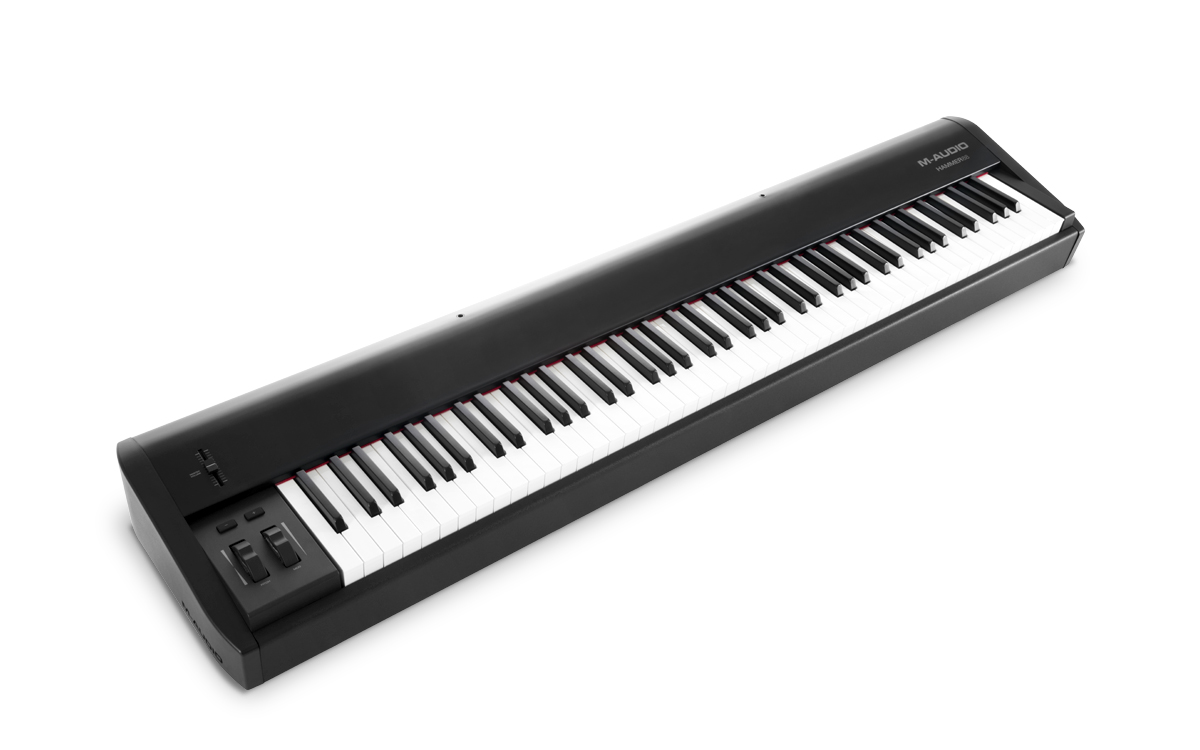
Explore this need in the finder →The original Hammer 88 is the piano-action member of M-Audio's keyboard-controller family, with 88 fully weighted, velocity-sensitive hammer-action keys and a short list of performance controls. It sends MIDI; it does not make piano sound on its own. The distinction matters because this is not a choice between two self-contained digital pianos. The computer, virtual instrument or external sound module supplies the tone and must be connected to an audio-output and listening system.
A piano-range controller with a focused layout
M-Audio specifies a full 88-note span and a fully weighted hammer-action bed. The product page adds a pitch wheel, modulation wheel, master-volume fader, assignable up/down buttons and support for keyboard zones that can be layered or split. It also describes a four-note chord function. Those features make the instrument more than a bare note entry surface, but the panel remains relatively restrained beside the Hammer 88 Pro: the original model has no documented 16-pad bank, nine-fader array or OLED control screen. If the main job is entering piano parts and adjusting a few performance controls, that simpler layout may be easier to understand than a dense DAW surface.
The published weight is 38.5 pounds, so the full-size weighted mechanism comes with real handling and support considerations. The product page says a music rest is included; check the exact seller's package for its condition and any pedal. The manufacturer identifies separate sustain, soft and expression inputs, but the inspected box list does not establish that those pedals are supplied.
Check the long edge, not just the number on a shelf
The manual prints 11.9 by 5.0 by 55.9 inches and labels that order width, depth and height, while its metric line gives 30.2 by 12.7 by 142.0 centimeters. Those axis labels do not agree with the instrument's orientation: the 142-centimeter value is the long edge along the keybed. The 55.9-inch figure is therefore treated here as an interpreted long-edge body width for comparison, not a claim that the manual's axis caption is correct. Measure the actual shelf and confirm the exact unit if the fit is close. Even a body that nominally clears a 56-inch opening needs extra room for hands, plugs, a stand and cable bends.
Two useful signal paths
On a computer, the USB connection carries MIDI to recording or performance software and provides power. The manual describes a five-pin MIDI Out for external synthesizers and modules, which lets a hardware instrument receive the Hammer's performance data. A separately sold 9 V DC, 800 mA pin-positive adapter is listed for stand-alone use. That adapter powers the controller; it does not turn it into an audio instrument or power the sound module. The module's audio output still needs to reach a mixer, interface, amplifier or other suitable monitor path.
The guide also discusses zone setup, pedal assignment and an editor for changing the keybed and controls. These functions are useful when a player wants layered or split MIDI behavior, but they involve configuration. Verify how the receiving sound source handles the intended messages, and check the pedal polarity/setup instructions if a sustain pedal seems reversed at startup. The rear-panel illustration and guide show USB Type-B and MIDI Out, but no MIDI In or built-in audio output.
Where it differs from the other M-Audio 88s
The Keystation 88 MK3 is the lighter semi-weighted alternative with a basic volume fader, transport/directional controls and MIDI Out. Hammer 88 is the more piano-oriented weighted option with three pedal jacks and zone features. Hammer 88 Pro builds on a separate, more complex brief: M-Audio documents Channel Aftertouch, 16 velocity-sensitive pads, nine faders, an OLED and both DIN In and Out. The original Hammer 88 should not inherit those Pro specifications. Pick between them according to the action and controls your setup actually needs, not a shared key count.
Practical checks before ordering
Confirm the exact original Hammer 88 rather than the similarly named Pro, then check the long-edge dimension interpretation against the installation. Ask the seller whether the music rest, USB lead and any required pedals or power adapter are present; the page's optional adapter and pedal inputs do not mean those items are in every offer. If using a hardware synth, check its MIDI channel and audio route as well as the Hammer's power source. The current manufacturer catalogue and support page establish a current reference entry, not a live offer, stock level, exact retail code or price. No hands-on test or measured key feel is claimed.
Key specifications
Key details at a glance
| Keys | 88 |
|---|---|
| Manufacturer's keybed description | Fully weighted hammer-action keys (M-Audio wording) |
| Width | 55.9 in |
| Pads | 0 |
| Velocity-sensitive pads | No |
| 5-pin MIDI Out | Yes |
| Computer connection | USB Type-B |
| Assignable pedal input | Yes |
| 5-pin MIDI In | No |
| Depth | 11.9 in |
Use the exact model’s instructions for operating limits, supplied equipment and version differences.
Sources for this review
Sources for this assessment


Start with your setup, not a headline feature
Use the finder to combine key-count, connection, control and desk-fit requirements. Unverified specifications are never treated as a match.