
Your needs, this model
Does it fit your priorities?
Is the Keystation 49 MK3 full-size, and does its body fit under 32.5 inches?
M-Audio specifies 49 full-size velocity-sensitive synth-action keys. The v1.6 guide gives a 32.3 x 7.4 x 2.6-inch body and a 4.7-pound weight, making a 32.5-inch cap a tight, body-only screen. Add plug clearance, hands, stand space and sustain-pedal placement before choosing a fixed shelf.
Explore this need in the finder →Does the 49 MK3 have a five-pin MIDI output for a hardware synthesizer?
The dedicated feature list names USB-MIDI and the v1.6 manual/rear photo show USB, a sustain input, power and security connections without a five-pin MIDI DIN jack. It therefore does not directly send to a DIN-only sound module; plan on a host/interface route. The keyboard itself does not generate sound.
Explore this need in the finder →Can I connect an expression pedal as well as sustain?
The inspected 49 MK3 materials document one sustain-pedal input and do not show an expression-pedal jack. Treat an external sustain pedal as separate equipment unless the seller confirms one in the package; do not transfer the expression input from the Keystation 88 MK3.
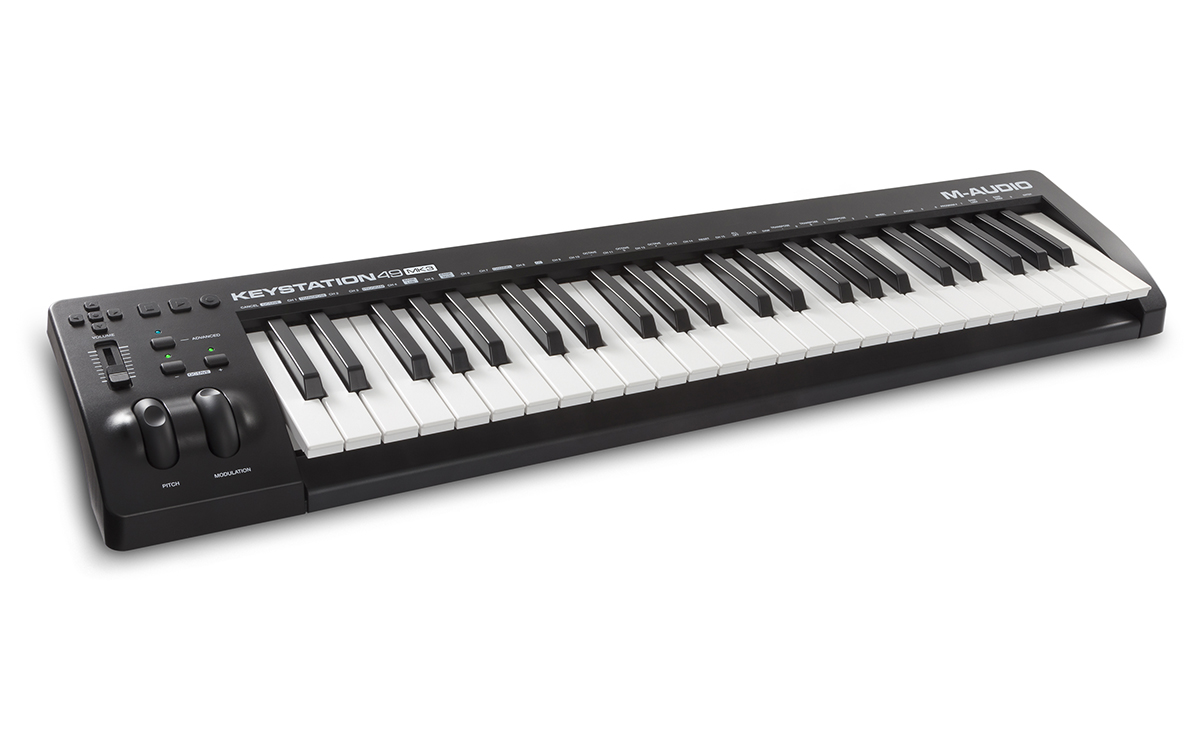
Explore this need in the finder →The Keystation 49 MK3 is a four-octave controller built around full-size, velocity-sensitive synth-action keys. It adds the controls many computer sessions need most often—pitch and modulation wheels, an assignable volume fader, octave buttons, transport and directional buttons—without moving into a large drum-pad or fader-bank layout. It is a USB-MIDI controller, not an instrument with its own sounds. One important distinction from its 61-key sibling is that the reviewed 49 MK3's manufacturer materials do not document a five-pin MIDI output.
Four octaves and simple control
M-Audio calls the keybed full-size, velocity-sensitive and synth-action. That is a different design brief from a semi-weighted or fully weighted piano-style bed: the wording identifies the manufacturer's action category but does not report a measured touch response. At 49 keys, the physical range covers more than a compact two-octave controller while remaining much narrower than an 88-key board. Octave buttons provide a way to move the MIDI range, but they do not create more simultaneous physical keys.
The front panel has pitch and modulation wheels, a volume slider, transport and directional buttons, an advanced/edit function and assignable octave buttons. The manual explains MIDI, Mackie Control and HUI options for some DAW controls; actual behavior depends on compatible software and setup. A player who wants a plain note keyboard may not use every function, while someone who likes hardware transport and a few assignable controls may prefer this compact strip to a larger surface.
Body fit and practical setup
The v1.6 manual lists a 32.3-inch width, 7.4-inch depth, 2.6-inch height and 4.7-pound weight. That is a reasonably narrow chassis relative to many 49-key boards, but a 32.5-inch shelf leaves only a small nominal body margin. The numeric fit is not a desk plan: include cable bends, room for a hand to reach the controls, pedal placement and any stand or riser. The precise manual measurement matters more than a generic product title calling it compact.
USB connects the Keystation to a computer, carries MIDI and provides power. The rear panel and manual document a USB port, a sustain-pedal input, a power switch and a Kensington-style security point, not a five-pin DIN output. If the intended setup is a DIN-only external synth, this model cannot be treated as a direct hardware-output choice. A computer or another MIDI-host/interface route may bridge the data, but that additional equipment changes the setup. The keyboard itself does not make audio; a DAW instrument or external module has to supply it.
Sustain is a separate purchase check
The manual identifies a momentary-contact sustain-pedal input and says the pedal is sold separately. It also explains that pedal polarity is read during startup, so the pedal should be in its released state when the controller powers up. The 49 MK3 page does not establish an expression-pedal jack; do not assume the inputs from the 88 MK3 transfer to this product just because their names are similar. Check whether the exact seller package includes a compatible sustain pedal, USB cable and any download materials, and confirm what software registration remains available.
How it compares with the 61 and 88 MK3
The Keystation 61 MK3 adds a larger physical range and a documented five-pin MIDI Out, so it is the more relevant comparison when a five-octave bed or direct hardware-MIDI path is required. The 88 MK3 expands that range again and uses semi-weighted full-size keys, with sustain and expression inputs. Neither is simply a larger finish option for the 49: key format, action description, body, and external routes differ. Conversely, all are basic compared with a control-heavy product such as Hammer 88 Pro.
Who should keep looking
Choose this model for full-size 49-key entry and basic computer control when USB is the planned route. Look elsewhere if you require a five-pin output on the keyboard itself, a weighted 88-key action, pressure-sensitive pads or an expression-pedal jack. The exact product page and manual establish the published features, but no present retailer offer, SKU, price, current software entitlement or measured playing feel was verified. This is a research-based assessment, not a claim of personal use or testing.
Key specifications
Key details at a glance
| Keys | 49 |
|---|---|
| Manufacturer's keybed description | Full-size velocity-sensitive synth-action keys (M-Audio wording) |
| Width | 32.3 in |
| Pads | 0 |
| Velocity-sensitive pads | No |
| 5-pin MIDI Out | No |
| Computer connection | USB Type-B |
| Assignable pedal input | Yes |
| 5-pin MIDI In | No |
| Depth | 7.4 in |
Use the exact model’s instructions for operating limits, supplied equipment and version differences.
Sources for this review
Sources for this assessment
- M-Audio Keyboard Controllers catalogue entry
- M-Audio Keystation 49 MK3 product page
- M-Audio support downloads selector: Keystation 49 MK3
- M-Audio Keystation 49 MK3 User Guide, version 1.6
- M-Audio Keystation 49 MK3 official front-angle product image
- M-Audio Keystation 49 MK3 official rear-panel product image


Start with your setup, not a headline feature
Use the finder to combine key-count, connection, control and desk-fit requirements. Unverified specifications are never treated as a match.