
Your needs, this model
Does it fit your priorities?
Does the 88 MK3 clear a 54.25-inch body limit?
The product page publishes a 54.24-inch width for the full-size 88-key semi-weighted controller, so it narrowly clears a 54.25-inch body-only screen on paper. The margin is 0.01 inch, far too small to count as usable clearance; measure the exact space and add room for plugs, hands, a stand and cable bends. The manual rounds its width to 54.2 inches.
Explore this need in the finder →Can it send notes to a hardware sound module without a computer?
The rear panel has a five-pin MIDI Out. M-Audio's v1.9 guide says to engage MIDI Out mode so keyboard data reaches that jack, and documents a separately sold 9 V, 500 mA center-positive adapter when the keyboard is powered without USB. The module needs its own power and audio/monitoring path; the Keystation does not make sound by itself.
Explore this need in the finder →Is this the same weighted action as a piano-style Hammer controller?
No such equivalence is documented. M-Audio describes the Keystation 88 MK3 bed as full-size, velocity-sensitive and semi-weighted. The Hammer 88 and Hammer 88 Pro are separately named fully weighted/graded hammer-action controllers, with substantially greater published weight and a different playing/control brief.
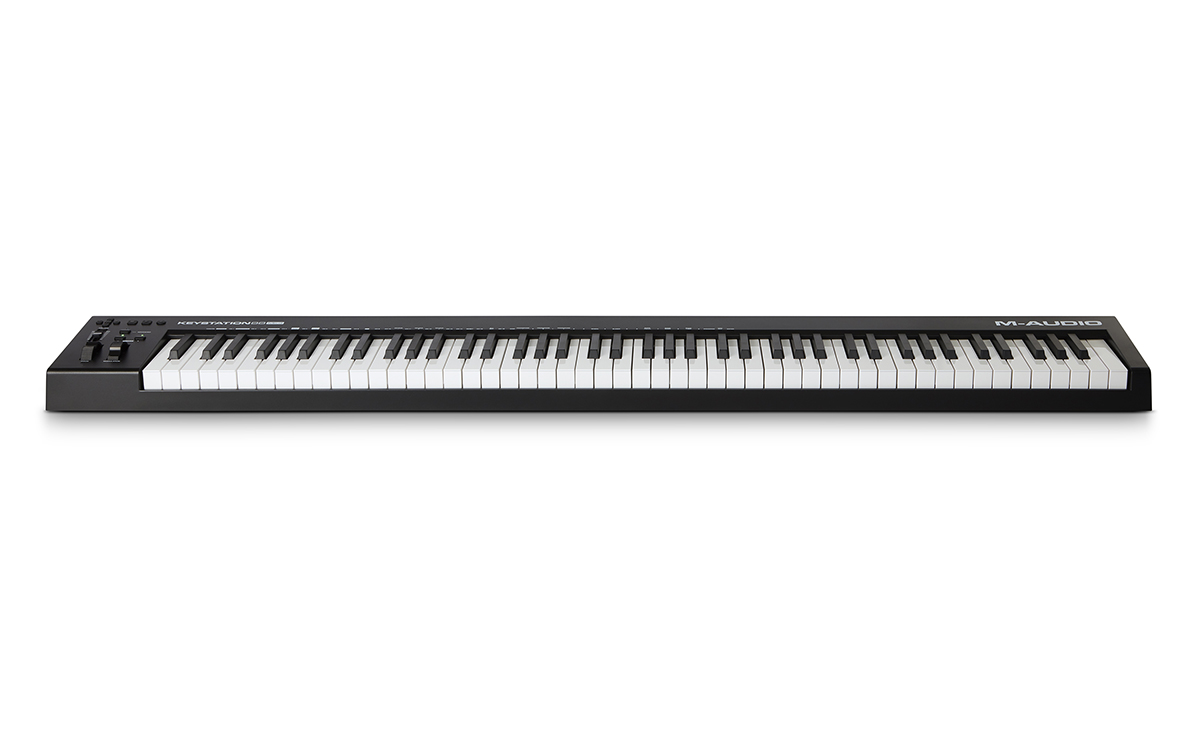
Explore this need in the finder →The Keystation 88 MK3 is an 88-key MIDI controller whose appeal is the broad note range in a relatively direct layout: semi-weighted full-size keys, a volume fader, pitch and modulation wheels, transport and direction buttons, and an optional pedal setup. It is not an electronic piano with its own speakers or sounds. The attached five-pin MIDI output gives it a second route beyond the computer connection, but an external sound module and an audio-monitoring path still have to be supplied separately.
What the 88-key range buys
A full 88-note span can make two-handed parts, wide voicings and low-register accompaniment easier to lay out without shifting octaves. M-Audio describes the keys as full-size, velocity-sensitive and semi-weighted. That phrase is useful for identifying the design, but it is not a measurement of action weight, key noise or piano feel. The product page does not present the bed as the fully weighted hammer action used on the separate Hammer family. If the physical action is decisive, try the exact unit or confirm the return terms instead of treating the shared 88-key count as a substitute.
The published width is 54.24 inches, with an 8.52-inch depth and 2.88-inch height. The guide rounds the body to 54.2 by 8.5 by 2.9 inches. That is a long instrument, even though the published weight is about 13.75 pounds on the page and 13.88 pounds in the guide. The source discrepancy is small for lifting but worth retaining rather than pretending the numbers agree. For desk planning, add clearance around the bare body for cable plugs, hands, a music rest or stand, and any nearby equipment.
A useful set of basic controls
The top panel adds an assignable volume fader, pitch and modulation wheels, octave buttons, transport controls and directional buttons. Those controls can help when recording or operating a DAW without reaching immediately for a mouse. M-Audio says the advanced functions can assign controls to DAW or plugin parameters, but the degree of integration depends on the software and setup; the presence of buttons does not promise a ready-made mapping for every application.
The product materials document sustain and expression pedal inputs. The pedals are not listed in the box, so treat them as separate equipment unless a seller's exact package says otherwise. There are no drum pads in the documented layout; buyers wanting pressure-sensitive pads, multiple faders or a large performance-control surface should compare other models rather than counting the 88 keys as a substitute for those features.
Computer and hardware connections
USB-MIDI connects the controller to a computer, and the product page describes it as USB powered and class compliant. The rear-panel photo shows a USB Type-B socket, a five-pin MIDI Out, sustain and expression inputs, and the separate power connection. The manual explains that MIDI Out mode must be engaged to send the keyboard's performance data through the DIN port. When operating from that port without computer USB power, the guide lists an optional 9 V, 500 mA center-positive adapter. Check the mode before troubleshooting a silent external synth.
MIDI is control information, not audio. With a computer, the DAW or a virtual instrument generates the sound and sends it onward to an audio device. With a hardware module, the module generates the sound and needs its own power and output connection. No onboard sound engine or speaker is documented for this Keystation.
Where it sits among M-Audio's 88-key controllers
Compared with the Hammer 88, the Keystation 88 MK3 uses semi-weighted rather than fully weighted hammer-action keys and is substantially lighter by the manufacturers' published figures. Compared with the Hammer 88 Pro, it has a simpler control surface: one volume fader and basic transport/directional controls instead of the Pro's sixteen pads, nine faders, OLED and keyboard aftertouch. It is a sensible assessment for someone who wants note range plus straightforward DAW control and a DIN output, not a feature-for-feature substitute for either Hammer.
Before buying
Confirm the exact MK3 suffix, body clearance and which USB cable is in the package. If using an external synth, verify the five-pin MIDI Out mode, required adapter, synth input and separate audio path. The product page names a software download card and bundled software, but that does not establish an unused registration, present license entitlement or current support for a particular computer. The inspected manufacturer page and manual establish the model and its features; they do not establish the seller's current stock, exact retail code, price or package condition. No hands-on test is claimed here.
Key specifications
Key details at a glance
| Keys | 88 |
|---|---|
| Manufacturer's keybed description | Full-size piano-style semi-weighted keys |
| Width | 54.24 in |
| Pads | 0 |
| Velocity-sensitive pads | No |
| 5-pin MIDI Out | Yes |
| Computer connection | USB Type-B |
| Assignable pedal input | Yes |
| 5-pin MIDI In | No |
| Depth | 8.52 in |
Use the exact model’s instructions for operating limits, supplied equipment and version differences.
Sources for this review
Sources for this assessment
- M-Audio Keyboard Controllers catalogue entry
- M-Audio Keystation 88 MK3 product page
- M-Audio support downloads selector: Keystation 88 MK3
- M-Audio Keystation 88 MKIII User Guide, version 1.9
- M-Audio Keystation 88 MK3 official front-angle product image
- M-Audio Keystation 88 MK3 official rear-panel product image


Start with your setup, not a headline feature
Use the finder to combine key-count, connection, control and desk-fit requirements. Unverified specifications are never treated as a match.