
Your needs, this model
Does it fit your priorities?
Will a 32-key Mini MK3 fit a 16.5-inch body cap?
M-Audio gives a 16.46-inch long edge, a 4.13-inch second dimension and a 1-pound weight. Its manual's millimeter line is 418 x 105 x 20; the web page's 198 mm third value conflicts with that guide, so it is not used. A 16.5-inch cap leaves only 0.04 inch of nominal body margin and no cable or hand clearance.
Explore this need in the finder →Can this Mini 32 send notes directly to a hardware synth over 5-pin MIDI?
The exact Mini 32 MK3 page, box contents and v1.0 guide describe USB-MIDI and an included USB A-to-mini-B cable but do not document a 5-pin MIDI DIN output. It is USB powered and has no sound engine. A hardware synth needs a separate host/interface route plus the synth's own audio and power path.
Explore this need in the finder →Does the sustain control take a floor pedal?
M-Audio specifies a sustain button and the manual describes selectable momentary and latch behavior. The inspected page and guide do not show an external sustain-pedal input, so a floor pedal should not be assumed to connect directly. This small controller also uses mini keys and cannot replace an 88-key physical span.
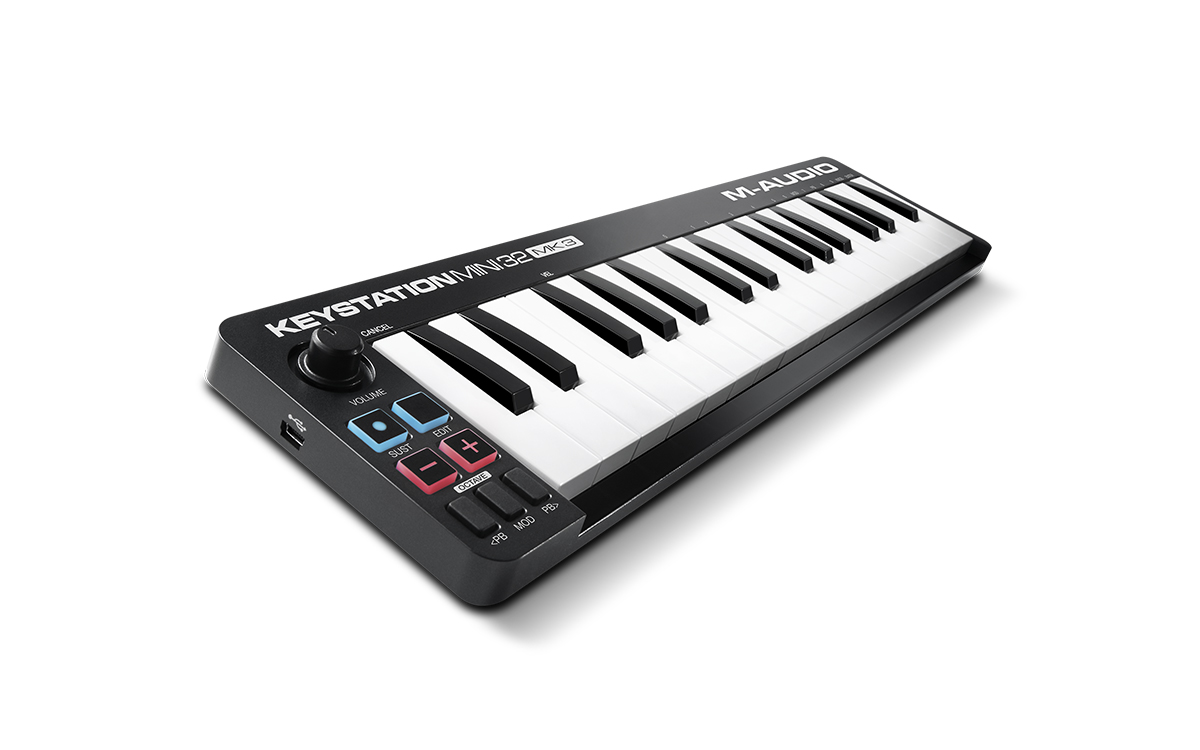
Explore this need in the finder →The Keystation Mini 32 MK3 is a small USB-MIDI keyboard with 32 low-profile, velocity-sensitive mini keys. Its design is about portable note entry and a handful of immediate controls, not a full piano span or a large DAW surface. It sends performance data to a computer or compatible host; it has no onboard sound engine. The distinctions from M-Audio's Oxygen Pro Mini and from the full-size Keystation models matter: this model has its own key count, key format, control layout and connection set.
What fits on the top panel
M-Audio lists 32 mini keys, selectable velocity curves, octave-up/down buttons, pitch-bend and modulation buttons, a volume knob, an edit-mode button and a button-based sustain function. The user guide describes about two and a half playable octaves before shifting; its octave controls can move the range to reach notes outside the physical bed. That expands the note addresses available, but it does not turn 32 small keys into a full-size playing surface. For broad two-handed piano parts or repeated wide chords, the short physical range and mini-key spacing are meaningful compromises.
The small panel is useful when the job is sketching melodies, entering short parts or controlling a software instrument without reserving a full keyboard shelf. The published long edge is 16.46 inches, the next dimension is 4.13 inches and weight is 1 pound. The manufacturer page's metric text gives an inconsistent 198 mm for the third dimension; the v1.0 guide gives 418 by 105 by 20 mm, which agrees with the inch height of about 0.78 inches. This assessment preserves the error rather than silently treating the wrong conversion as a real height.
Its route is USB, not DIN
The product page calls the controller USB powered and class compliant. The box list names a USB A-to-USB B mini cable, and the guide describes choosing the keyboard in the computer's MIDI setup. The connection is a miniature Type-B USB socket, not a five-pin MIDI output. If a hardware synthesizer is part of the setup, plan for a suitable computer or MIDI interface to route the data; a cable cannot turn the Mini 32's USB port into a direct DIN port.
There is no onboard audio engine or audio output in the manual. A virtual instrument in a computer or a separate sound module generates the sound and has to feed headphones, speakers or another monitoring destination. USB power and USB-MIDI do not provide audio. The one-touch sustain control is also not a pedal jack: M-Audio documents momentary and latch behavior for the button, not a place to plug in a floor pedal.
How it differs from the full-size Keystations
The Keystation 49 and 61 MK3 increase physical key range and use full-size keys; they also have a volume fader and pitch/modulation wheels. The 88 MK3 adds 5-pin MIDI Out and sustain/expression pedal inputs. The Mini 32 is lighter and smaller but replaces those features with mini keys, buttons and a simplified single-cable arrangement. The similarly named Oxygen Pro Mini is a separate controller with a different control surface; its specifications should not be carried over to this Keystation.
Best use and practical checks
Consider the Mini 32 when moving the keyboard, saving desk width or adding a compact second input surface is more important than full-size touch or long-range playing. Before ordering, check that the exact MK3 name is on the unit, confirm the mini-B cable and current computer compatibility, and decide whether button-based sustain is acceptable. If you need direct DIN, a sustain pedal jack, pressure-sensitive pads or the breadth of a piano keyboard, the reviewed evidence does not support this model as a substitute. The product page includes software names, but download-card text does not guarantee current availability, an unused license or an account entitlement. No price, current stock, exact retail code or hands-on feel is claimed.
Key specifications
Key details at a glance
| Keys | 32 |
|---|---|
| Manufacturer's keybed description | Low-profile, velocity-sensitive mini keys (M-Audio wording) |
| Width | 16.46 in |
| Pads | 0 |
| Velocity-sensitive pads | No |
| 5-pin MIDI Out | No |
| Computer connection | USB Type-B mini connector |
| Assignable pedal input | No |
| 5-pin MIDI In | No |
| Depth | 4.13 in |
Use the exact model’s instructions for operating limits, supplied equipment and version differences.
Sources for this review
Sources for this assessment

Start with your setup, not a headline feature
Use the finder to combine key-count, connection, control and desk-fit requirements. Unverified specifications are never treated as a match.