
Your needs, this model
Does it fit your priorities?
Can the 25-key MK IV suit a compact setup capped at a 19.5-inch body width?
The version 1.3 manual lists 19.3 inches as the longest of its 3.7 x 9.6 x 19.3-inch measurements. Its printed Length x Width x Height label conflicts with the illustrated keyboard orientation, so the guide uses that longest dimension as a body-width screen and states the interpretation. It clears 19.5 inches nominally; cable plugs, hands, pedal reach and stand support still need separate room.
Explore this need in the finder →Can this Oxygen 25 send MIDI directly to a DIN-only sound module?
No direct five-pin output is documented. The model manual's rear-panel list and the exact rear view show USB, sustain, power and security connections, not DIN MIDI Out. USB-MIDI reaches a computer host; a different hardware route would need a host or MIDI interface. The controller itself does not supply the sound or audio-monitoring path.
Explore this need in the finder →Do the eight MK IV pads have verified pressure response?
M-Audio identifies eight velocity-sensitive pads, and the manual describes pad note and velocity messages. Neither inspected source establishes pressure-sensitive pads. Treat that capability as unknown rather than equating pad velocity with pressure or keyboard aftertouch; a pressure requirement should favor a separately documented model.
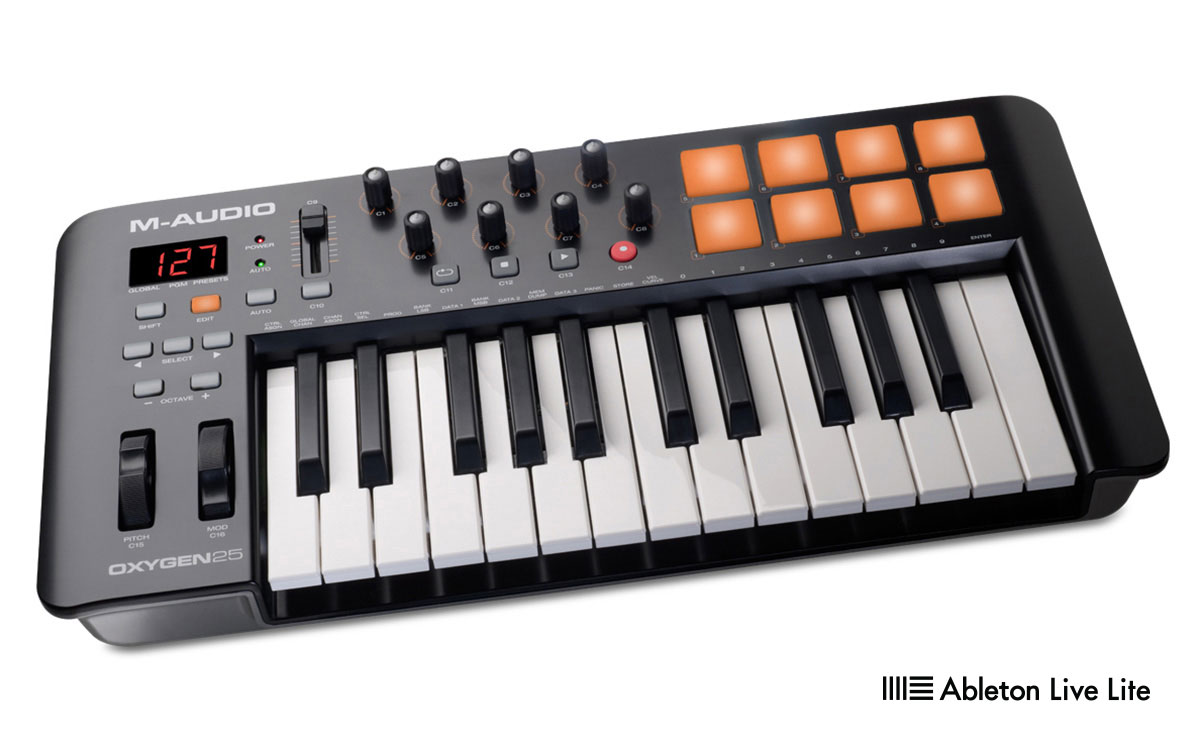
Explore this need in the finder →The Oxygen 25 MK IV is a compact, full-size-key MIDI controller from an earlier Oxygen generation. M-Audio describes a synth-action, velocity-sensitive 25-key bed, eight assignable knobs, eight velocity-sensitive pads and a single fader. This is a document-based assessment of the exact MK IV model, not a playing test; the similar MKV and Oxygen Pro names refer to separate configurations.
Twenty-five physical keys are the real limit
The attraction is a familiar desktop compromise: full-size keys in a short control surface. Twenty-five physical keys can cover a one-hand part, bass line, short chord voicings or note entry without taking the space of a 49- or 61-key controller. The octave buttons shift the active register, but they cannot make a low note and a distant high note available at once. If your routine includes broad two-handed passages, splits across a wide range or long held notes while reaching elsewhere, more keys are the more meaningful upgrade than an extra mapping preset.
The version 1.3 manual lists a 19.3-inch measurement, a 9.6-inch second dimension, a 3.7-inch third dimension and a four-pound weight. Its table labels the sequence “Length x Width x Height,” which conflicts with the keyboard orientation in the manufacturer’s illustrations. For the finder’s desk-width screen, this review interprets the longest listed axis as the body’s long edge and keeps that ambiguity visible. The nominal 19.3-inch value is not clearance: allow additional room for the USB lead, hands, optional pedal, nearby controls and a stable supporting surface. If an exact cutout or shelf is involved, confirm dimensions against the particular unit before committing.
A small surface with one fader
M-Audio documents eight velocity-sensitive trigger pads, eight assignable rotary controls and one assignable fader on the 25-key model. Transport buttons, track navigation, octave buttons, pitch-bend and modulation wheels, and a three-digit LED display round out the hands-on controls. The manual describes the pads as transmitting note and velocity data; it does not confirm pressure-sensitive pad response. Nor do the inspected sources specify a keyboard aftertouch system, key weight or measured key travel. “Synth-action” and velocity response are the claims the manufacturer actually makes.
That one fader is a useful size-specific difference rather than a cosmetic detail. It gives you a direct control to map to a master level, one track or another MIDI parameter, but it cannot provide nine simultaneous track faders like the 49- and 61-key MK IV siblings. Their longer cases add a real playing span as well as a wider control surface. If you mostly want tactile control of several mixer channels, compare the nine-fader panels before deciding that the 25’s lower footprint is a net gain. The pads are eight physical pads; do not treat a software bank or a different Oxygen generation as extra hardware pads on this exact unit.
USB is the documented signal and power path
The model guide says its USB 2.0 computer connection sends MIDI and supplies power. The rear panel and M-Audio’s model-specific rear image show a USB Type-B port, a sustain-pedal input, a power switch and a Kensington-style security connector. They do not show or list five-pin MIDI In or Out. That makes the MK IV a straightforward controller for a computer or supported USB host, not a direct cable choice for a DIN-only hardware sound module. A host or separate interface can create a different route, but that is another part of the setup.
The product does not document a self-contained sound engine or audio output. It sends performance data; a software instrument or separate hardware sound source must make the audio, and that source needs its own headphone or speaker route. M-Audio’s product page describes USB-MIDI and a sold-separately iPad Camera Connection Kit route. Treat the kit, host compatibility and current app support as separate checks, not as a promise that any tablet connects directly. The manual also warns that a passive USB hub may not provide enough power when other devices share it and advises against placing an audio interface on the same hub.
Control mapping is useful but depends on software
M-Audio describes DirectLink mappings for named DAWs, alongside customizable controller assignments. That can make transport, mixer and plug-in control more immediate than starting from a blank MIDI map, but “out of the box” should not be read as universal automatic support for every current DAW version. The manual points users to install the relevant DirectLink personality when needed. Its box list names a USB cable and software download cards as well as the controller and printed setup/safety material. The product page promotes legacy applications and sound libraries, but a decades-old download card does not prove that a current seller has an unused license or that a registration still works. Verify software access independently.
Choose the exact generation and package
This is Oxygen 25 MK IV, not Oxygen 25 (MKV) and not Oxygen Pro 25. Those similarly named models have their own reviews and their own documented control or port details; do not borrow DIN, key-action or software claims across them. The MK IV can make sense when 25 full-size synth-action keys, eight velocity pads, eight knobs and one fader cover the job, and a USB-connected computer is already the plan. Look elsewhere if you need a verified pressure-sensitive pad, a built-in sound source, a direct DIN output, more than 25 simultaneous physical keys, or a multi-fader mixer surface. Before considering an older-generation offer, confirm the exact suffix, physical condition, USB cable, sustain pedal status, current software entitlement, return terms and the seller’s actual bundle. No price, stock, reliability, customer experience or hands-on result is claimed here.
Key specifications
Key details at a glance
| Keys | 25 |
|---|---|
| Manufacturer's keybed description | Synth-action |
| Width | 19.3 in |
| Pads | 8 |
| Velocity-sensitive pads | Yes |
| 5-pin MIDI Out | No |
| Computer connection | USB Type-B |
| Assignable pedal input | Yes |
| 5-pin MIDI In | No |
| Depth | 9.6 in |
Use the exact model’s instructions for operating limits, supplied equipment and version differences.
Sources for this review
Sources for this assessment


Start with your setup, not a headline feature
Use the finder to combine key-count, connection, control and desk-fit requirements. Unverified specifications are never treated as a match.