
Your needs, this model
Does it fit your priorities?
Does the 49-key MK IV fit a 32.25-inch body cap while meeting a 49-key minimum?
M-Audio lists 49 full-size synth-action keys; the version 1.3 manual's longest measurement is 32 inches and its listed weight is 6.4 pounds. The manual's printed Length x Width x Height label is inconsistent with the pictured keyboard orientation, so this review interprets the longest axis as body width and flags that choice. A 32.25-inch body screen leaves only nominal margin and says nothing about plugs, hands, pedal or stand.
Explore this need in the finder →Can the 49 MK IV drive external five-pin MIDI gear directly?
No direct DIN output appears in the model's documented rear-panel connections. The USB Type-B port carries MIDI to a computer and powers the controller; it is not a five-pin output for a hardware module. Plan for a host/interface if DIN equipment is part of the route, and account separately for audio generation and monitoring.
Explore this need in the finder →Are its pads documented as pressure sensitive?
M-Audio specifies eight velocity-sensitive pads and the guide explains their MIDI note/velocity behavior, but the inspected model page and version 1.3 manual do not confirm pressure response. A pad-pressure essential is therefore not satisfied by the evidence; do not transfer a specification from another Oxygen generation.
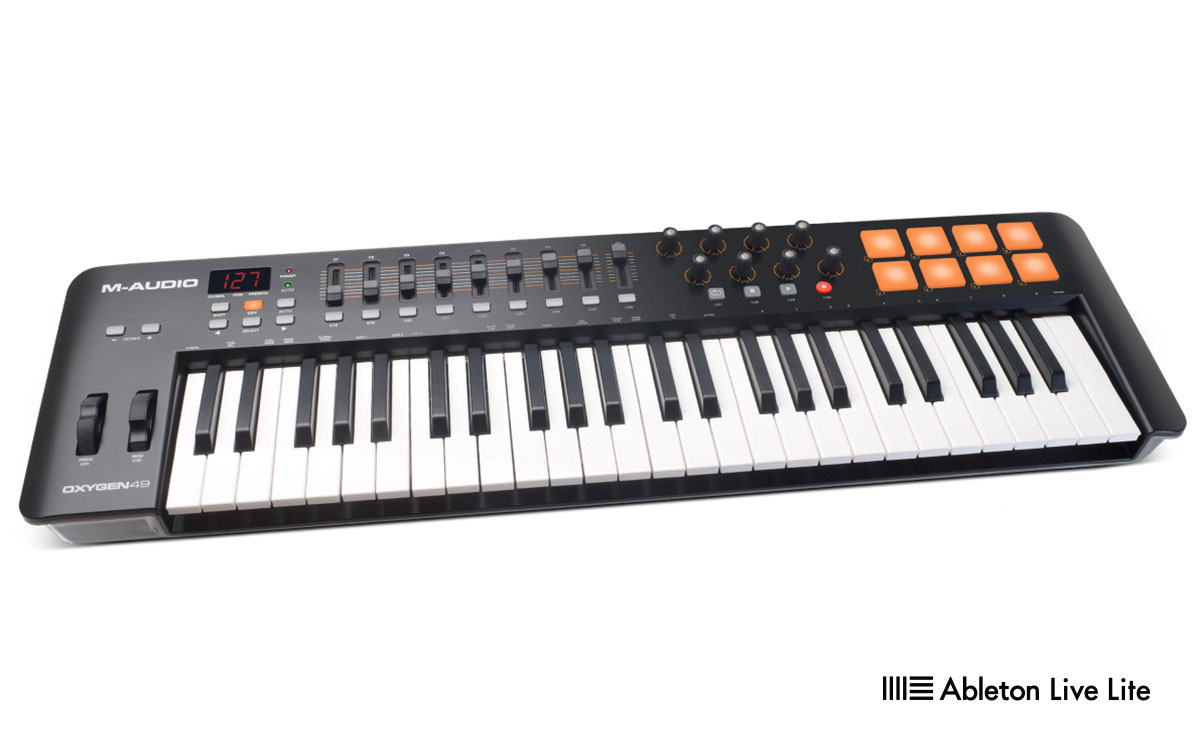
Explore this need in the finder →Oxygen 49 MK IV combines a four-octave, full-size synth-action keybed with a nine-fader control surface. M-Audio’s product page also specifies eight velocity-sensitive pads, eight assignable knobs, transport controls and a USB-powered MIDI route. It is a distinct earlier model, not a 49-key version of Oxygen Pro or MKV. This assessment follows its exact product page and v1.3 manual rather than a hands-on session.
Four octaves balance reach and desk area
Forty-nine physical keys give more simultaneous range than a 25-key controller while keeping the case shorter than the 61-key sibling. That can make it a sensible middle size for two-handed parts, broad synth chords or entering notes without constant octave shifts. It is still not a full piano range, and the octave buttons only relocate the notes under the keybed. A part that spans bass and melody at the same time needs the wider physical range, a split arrangement in software or another deliberate workaround.
M-Audio’s version 1.3 manual lists the dimensions as 3.7 x 9.6 x 32 inches and the weight as 6.4 pounds. Its printed axis label says “Length x Width x Height,” but that order does not align with the illustrated keyboard orientation. This review uses the longest listed measurement, 32 inches, as the long-edge body-width screen and records the manual’s ambiguity. The 32-inch number is not space for a plug, cable bend, hands, music stand, optional sustain pedal or neighboring gear. Check the actual unit if the controller must sit inside a fixed shelf or drawer rather than on an open desk.
Nine faders are the defining surface difference
The 49-key model has nine assignable faders, eight knobs and eight velocity-sensitive pads. The manual describes a three-digit LED, pitch-bend and modulation wheels, transport controls, track navigation and octave shifts. A fader can be assigned to a MIDI parameter or used in a supported DirectLink arrangement; in a software session, nine physical faders can make several track-level adjustments easier to reach than a single master fader. The 25-key MK IV has one fader, whereas the 49- and 61-key models use nine. That hardware distinction matters more than the shared Oxygen name if your workflow depends on controlling several levels at the same time.
The manufacturer calls the keys full-size, synth-action and velocity-sensitive. The reviewed sources do not specify key aftertouch, a weighted action, graded response or a measured key feel. The eight pads are described as velocity-sensitive, and the manual explains their note/velocity messages; pressure response is not confirmed. Do not infer that pad pressure or key aftertouch comes with the larger 49-key body. If either is essential, require explicit evidence for that capability on the exact model.
Plan a computer-centered MIDI route
The user guide identifies USB 2.0 as the connection that carries MIDI to and from a computer and powers the keyboard. Its rear-panel drawing, model-specific product photo and USB cable illustration are consistent with a USB Type-B host connection. The remaining rear connections are a sustain-pedal input, on/off switch and security lock; no five-pin MIDI In or Out is documented. The result is not a direct controller-to-DIN-synth route. A computer, tablet host or suitable separate interface would have to provide the routing, and the sound module must still supply audio through its own output.
This is a MIDI controller, not an audio keyboard. M-Audio describes software-based use, USB-MIDI and an iPad Camera Connection Kit option; the kit is sold separately, and current host/software compatibility needs its own check. The manual says a momentary-contact sustain pedal can be connected but does not list one in the box contents. It also cautions that a passive hub may not supply enough power when other devices are attached. For a stable DAW setup, check the computer port, cable and power arrangement before blaming a mapping problem on the keyboard.
Older software claims need a fresh check
The MK IV pages mention DirectLink and legacy applications, while the user guide instructs owners to choose the controller in their DAW and, for some applications, install a DAW-specific DirectLink personality. That is more precise than assuming that every control is automatically mapped in every current software version. The listed box includes the controller, USB cable, software download cards, quickstart guide and safety/warranty manual. A card in a used package does not establish unused redemption rights, current operating-system support or a valid license, and the current product page is not evidence that a seller has stock.
Who should keep it on the shortlist?
Oxygen 49 MK IV is a fit to investigate when the four-octave span and nine faders matter, the roughly 32-inch body can be accommodated, and USB-host MIDI is sufficient. It is less compelling if the main need is a direct DIN output, USB-C, confirmed pressure-sensitive pads, a weighted keybed, an onboard sound engine or modern software support without extra setup. Compare exact listings against the MKV and Oxygen Pro assessments rather than treating those families as cosmetic revisions. Before considering an older-generation offer, verify the MK IV suffix, physical condition, cables, pedal, any software entitlement, exact bundle, seller terms and return policy. The review does not claim product ownership, measured playability, test results, current price or availability.
Key specifications
Key details at a glance
| Keys | 49 |
|---|---|
| Manufacturer's keybed description | Synth-action |
| Width | 32 in |
| Pads | 8 |
| Velocity-sensitive pads | Yes |
| 5-pin MIDI Out | No |
| Computer connection | USB Type-B |
| Assignable pedal input | Yes |
| 5-pin MIDI In | No |
| Depth | 9.6 in |
Use the exact model’s instructions for operating limits, supplied equipment and version differences.
Sources for this review
Sources for this assessment


Start with your setup, not a headline feature
Use the finder to combine key-count, connection, control and desk-fit requirements. Unverified specifications are never treated as a match.