
Your needs, this model
Does it fit your priorities?
Does the 61-key MK IV fit a 38.75-inch body-width screen?
The model page identifies 61 full-size synth-action velocity-sensitive keys. Manual v1.3 lists 38.5 inches as its longest dimension and 7.5 pounds in weight, but labels its axis order Length x Width x Height inconsistently with the keyboard illustration. This assessment uses the longest axis as the desk-width screen and flags the interpretation; cable reach, hands, pedal and stand space remain additional requirements.
Explore this need in the finder →Can the 61 MK IV connect directly to a DIN-only hardware synth?
The model's rear-panel manual and exact rear view document USB, sustain, power and a security connector, not five-pin MIDI Out. USB Type-B provides the documented host connection; it does not become direct DIN by changing a computer cable. A separate host/interface and audio path would be required for that hardware arrangement.
Explore this need in the finder →Does the MK IV 61 include confirmed pressure-sensitive pads?
The product page specifies eight velocity-sensitive pads; its manual describes note and velocity messages, but does not verify pressure response. This is an unknown field, not affirmative pad-pressure evidence. The larger keybed also does not imply a different pad sensor or key aftertouch.
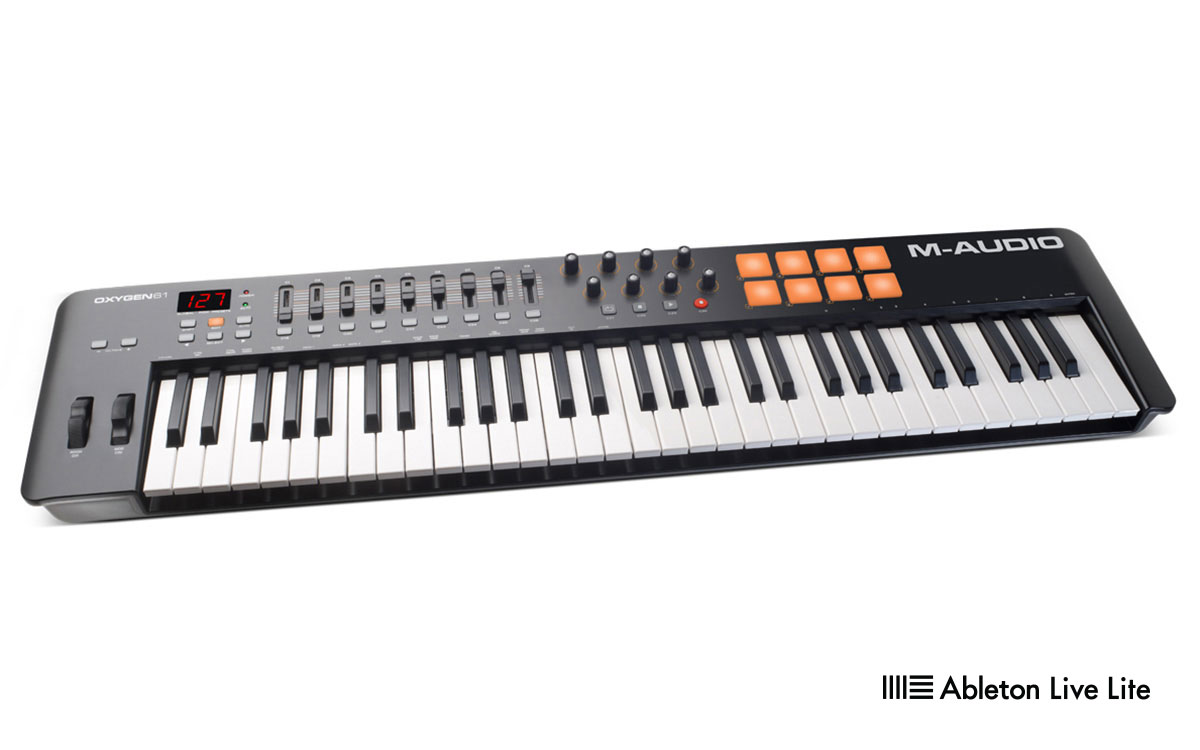
Explore this need in the finder →The Oxygen 61 MK IV is the largest of this earlier M-Audio trio: 61 full-size, synth-action velocity-sensitive keys, eight assignable knobs, eight velocity-sensitive pads and nine faders. It is a USB-powered MIDI controller for a host-based setup, not an all-in-one keyboard with an onboard sound source. These conclusions are based on the exact 61 model page, version 1.3 manual and official product images; no playing test is claimed.
Sixty-one physical keys change the working range
A 61-key bed offers more space for two-handed parts and sustained notes than the MK IV 25 or 49. It can reduce register switching in arrangements that move between bass and melody, although it still is not an 88-key piano range. Octave shift is available, but, as on the smaller models, it changes the active notes rather than adding physical keys. The product page calls the keybed full-size, synth-action and velocity-sensitive. It does not establish a hammer action, key aftertouch, graded weight or any measured response. If a specific touch is central to the purchase, inspect or audition the exact unit rather than treating “velocity-sensitive” as a description of its feel.
The v1.3 manual lists 3.7 x 9.6 x 38.5 inches and a weight of 7.5 pounds. As with the 25 and 49 manuals, the table labels the order “Length x Width x Height,” an axis sequence that conflicts with the pictured keyboard orientation. This assessment treats the longest listed axis as the long-edge body width for a desk screen and states that interpretation rather than hiding the manual’s inconsistency. At 38.5 inches, it is the widest MK IV in this group. The footprint still excludes cable plugs, the reach of a sustain pedal, hand clearance, stand support and neighboring equipment; a stand or desk should be checked independently.
Nine faders and eight pads suit software control
Compared with the 25-key MK IV’s single fader, the 61-key panel has nine assignable faders. It retains eight assignable knobs and eight velocity-sensitive pads, with transport buttons, track navigation, octave controls, pitch-bend and modulation wheels, and a three-digit LED display. The physical faders can provide a direct point of adjustment for several DAW channels, while the longer keybed covers a broader simultaneous note range. Those features make this configuration a more plausible desktop or studio surface than a compact travel controller, but a count of hardware controls does not guarantee that a particular DAW maps them as you want.
M-Audio describes DirectLink support and custom mapping presets. The manual explains that some DAWs require a separate DirectLink personality and that mappings depend on the application. Its pad section discusses velocity data; neither the exact product page nor the manual confirms pressure-sensitive pads. The consulted sources also leave keyboard aftertouch unspecified. Do not confuse the pad’s velocity response with pad-pressure sensing or with a different Oxygen generation’s keybed features.
USB powers it; the controller does not make audio
The guide says a USB 2.0 connection transmits MIDI and powers the instrument. The model-specific rear image shows USB Type-B, sustain, a power switch and a security connector, in line with the manual’s rear-panel diagram. The inspected sources document no five-pin DIN input or output. A DIN-only synthesizer therefore is not a direct connection target for this controller; a computer or separate MIDI interface would need to route data. The receiving instrument or software makes the sound, and its own output must connect to headphones or speakers.
The manual names a momentary-contact sustain-pedal socket, but lists the pedal as sold separately. It also describes an iPad Camera Connection Kit as a possible host route; that accessory and current iOS/app compatibility are separate matters, not an included modern tablet package. The USB power note is practical: M-Audio says a passive hub shared with other devices may not supply enough power, and advises against sharing the same hub with an audio interface. A properly powered host path is part of the plan.
Read the exact model page carefully
One paragraph on M-Audio’s Oxygen 61 product page unexpectedly refers to CODE 49 software and its controls. Because that text conflicts with the page’s Oxygen 61 identity, it is not used here as evidence of this model’s feature set or of a guaranteed software bundle. The model-specific feature list and Oxygen 61 manual are the relevant sources for the 61-key, nine-fader configuration. The support selector lists Oxygen 61 MK IV and a version 1.3 manual, but that does not establish current retail stock or a seller’s warranty.
The manual’s box list names the controller, USB cable, software download cards, quickstart guide and safety/warranty material. For an older offer, verify those items rather than assuming a used unit still has its original cable or redeemable software. Check the exact MK IV suffix, condition, USB Type-B host path, pedal, and space around a 38.5-inch case. Oxygen 61 MK IV suits a buyer who needs more physical range and a fader bank yet accepts USB-host MIDI and a separate sound source. It is not the right default if DIN output, USB-C, confirmed pad pressure, a documented weighted bed, built-in audio or modern plug-and-play software compatibility are essential. This assessment makes no claim of ownership, testing, measured feel, price or availability.
Key specifications
Key details at a glance
| Keys | 61 |
|---|---|
| Manufacturer's keybed description | Synth-action |
| Width | 38.5 in |
| Pads | 8 |
| Velocity-sensitive pads | Yes |
| 5-pin MIDI Out | No |
| Computer connection | USB Type-B |
| Assignable pedal input | Yes |
| 5-pin MIDI In | No |
| Depth | 9.6 in |
Use the exact model’s instructions for operating limits, supplied equipment and version differences.
Sources for this review
Sources for this assessment


Start with your setup, not a headline feature
Use the finder to combine key-count, connection, control and desk-fit requirements. Unverified specifications are never treated as a match.