
Your needs, this model
Does it fit your priorities?
Does Oxygen Pro 25 clear a 19.5-inch body-width limit while retaining five-pin MIDI Out?
M-Audio lists a 19.3-inch body and direct five-pin MIDI Out, so this model clears a 19.5-inch chassis-only screen by 0.2 inch. The number leaves no allowance for the USB-B or DIN cable bend, hands, pedal placement, or stand support; compare the full station layout before buying.
Explore this need in the finder →Can Oxygen Pro 25 send notes to a hardware synthesizer without USB-C?
Yes, its Quickstart Guide documents a standard five-pin MIDI Out and a USB-B power/data connection. Set an appropriate preset and MIDI-output source in Global Settings, and power the controller from a computer, laptop, or powered USB hub. The receiver needs its own power and audio path; this is not an onboard-sound keyboard.
Explore this need in the finder →What should I verify if I want the smallest Oxygen Pro with faders?
This is the 25-key, 19.3-inch Oxygen Pro 25, not the similarly named Oxygen 25 MKV or the 32-mini-key Oxygen Pro Mini. The reviewed page lists nine faders and sixteen velocity-sensitive pads; it does not establish pad pressure response. Confirm the exact model, USB-B cable, software-card status and whether 25 physical keys are enough for your parts.
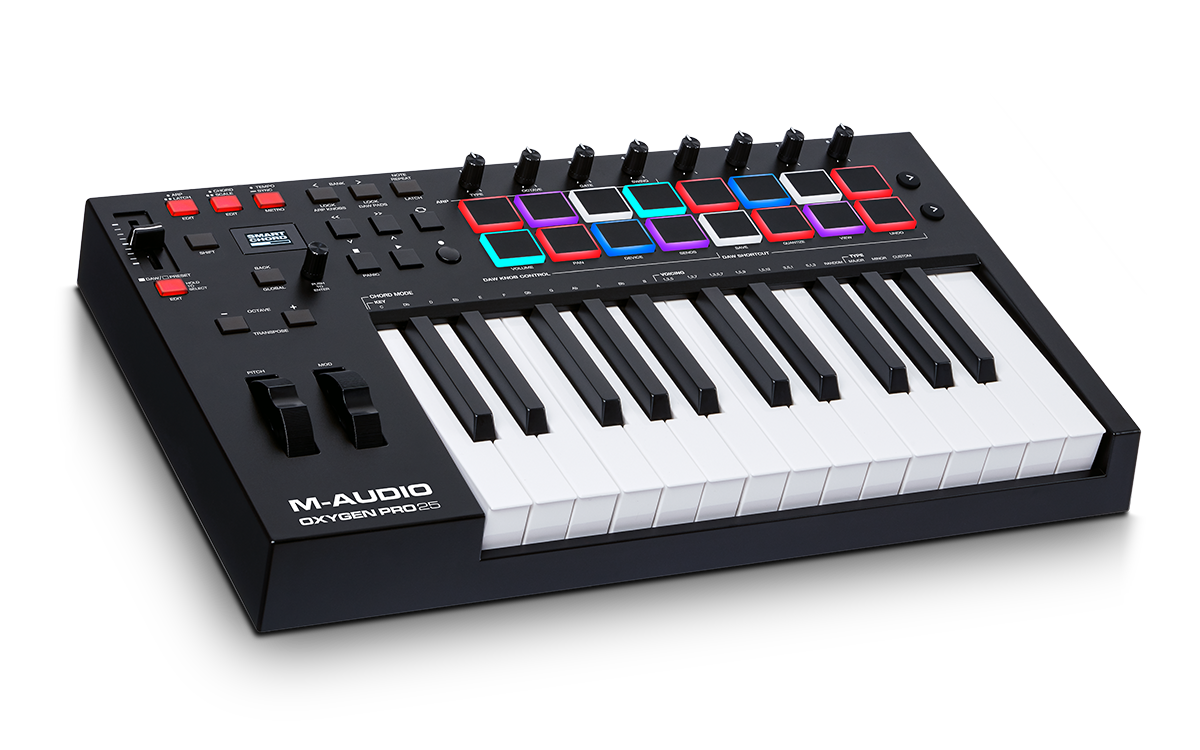
Explore this need in the finder →Oxygen Pro 25 is a 25-key USB MIDI controller whose control surface is unusually broad for its key count: M-Audio documents sixteen velocity-sensitive pads, eight knobs, nine faders, assignable controls, chord and scale modes, and direct five-pin MIDI Out. This is a source-based assessment of the named model and its manual, not a playing test.
A short range with a large control section
M-Audio describes the 25-key PrecisionTouch bed as semi-weighted, velocity-sensitive and equipped with channel aftertouch. The guide explains that the octave buttons shift the active range; the bed is not a substitute for notes that need to be played simultaneously. If a part needs a bass register and a high melody under both hands at once, octave changes cannot make those keys physically present. A 49- or 61-key sibling is the more appropriate range comparison when repeated shifting would interrupt the part.
The maker's wording is useful but limited: “semi-weighted” is not a measured action curve and says little about whether the key resistance or travel will suit a particular player. M-Audio does not give key dimensions on this page. The published chassis is 19.3 inches wide, 10.4 inches deep and 3.3 inches high, with a listed weight of 5.4 pounds. That is a compact 25-key footprint, but the controller is not a bare key strip: the pads, wheels and fader bank use much of its panel. Treat 19.3 inches as body width only and leave room for a cable bend, hands and any pedal.
More than a row of pads
The product page and the Pro-series manual describe sixteen RGB, velocity-sensitive pads, eight knobs, nine faders, DAW and preset controls, a display, pitch and modulation wheels, and a sustain-pedal input. The controls support an involved software workflow: DAW mode recalls a DAW mapping, while preset mode supports edited assignments. M-Audio also documents an arpeggiator, Smart Chord and Smart Scale functions. The maker says Smart Chord can assign a chord to one key or pad, and Smart Scale can restrict played notes to a selected scale; these are controller behaviors, not a replacement for the instrument software that makes sound.
Pad velocity, pad pressure and keyboard aftertouch are different claims. The inspected sources specify velocity-sensitive pads and channel aftertouch on the keys, but do not establish pressure response on the pads. Do not count keyboard aftertouch as evidence for a pressure-sensitive drum-pad requirement. A shopper who needs continuous pad pressure should choose only a model whose own documentation confirms it.
USB to a computer; DIN to external instruments
The model-specific Quickstart Guide identifies the keyboard-side connection as USB-B and says the included cable carries MIDI data and powers the controller from a computer. M-Audio recommends a powered hub when the hub also carries other devices. The rear-panel MIDI Out is a standard five-pin socket; the guide describes selecting a custom preset and choosing the MIDI output source in Global Settings. A hardware synth still needs its own power and an audio route. For a computer-centered setup, select the Oxygen Pro in the DAW and follow that DAW's control-surface and MIDI-port setup; a preset name alone does not complete the host configuration.
The controller has no documented onboard sound engine or audio output. M-Audio lists software in the product package, but its guide directs the owner to register the device and use the Software Manager to obtain included software and the preset editor. Treat those as registration-dependent entitlements, not as evidence that a seller's used unit includes an unused code or that a given software version will suit every current host. The sustain pedal and standard DIN cable are not in the box list.
Where it fits—and what to verify
Oxygen Pro 25 makes the most sense when 25 physical keys are enough for the planned passages and hands-on faders, pads and transport controls matter more than a longer keybed. It is a better fit for a compact production surface than for a player who expects a broad piano-like span from one position. The 49-key version keeps the same documented broad control concept while taking a 31.5-inch body; the 61-key version grows to 38 inches. Neither should be silently substituted for the 25-key identity.
Before choosing a particular offer, check that it is the Oxygen Pro 25 rather than Oxygen 25 MKV or the Pro Mini; confirm the USB-B cable and software card/package status; and decide whether a 25-key limit is acceptable without relying on octave shift as extra simultaneous range. If the job includes external hardware, confirm the DIN receiver, MIDI channel, Global Settings source and independent power/audio path. M-Audio's current product page and exact quickstart are the basis for these claims; this review makes no claim of ownership, hands-on testing, measured key feel, present stock or price.
Key specifications
Key details at a glance
| Keys | 25 |
|---|---|
| Width | 19.3 in |
| Pads | 16 |
| Velocity-sensitive pads | Yes |
| Computer connection | Usb-b |
| Assignable pedal input | No |
| Depth | 10.4 in |
Use the exact model’s instructions for operating limits, supplied equipment and version differences.
Sources for this review
Sources for this assessment
Start with your setup, not a headline feature
Use the finder to combine key-count, connection, control and desk-fit requirements. Unverified specifications are never treated as a match.