
Your needs, this model
Does it fit your priorities?
Does Oxygen Pro 49 meet a 49-key, 31.5-inch desk-and-DIN brief?
M-Audio lists 49 keys, a 31.5-inch-wide body and direct five-pin MIDI Out, so the model clears that bare-body width screen exactly. Reserve extra space for the USB-B and MIDI cables, hands, sustain pedal and stand; the listed width is not a usable-space guarantee.
Explore this need in the finder →What is the practical difference between Oxygen Pro 49 and 25?
The assessed Oxygen Pro 49 has 49 keys and a published 31.5-inch width; the separate Pro 25 has 25 keys and a 19.3-inch width. Both pages document nine faders, sixteen velocity-sensitive pads, USB-B and five-pin MIDI Out. Choose by the notes that must be physically available at once and the space you can reserve, not by assuming a different signal path.
Explore this need in the finder →Can Oxygen Pro 49 feed an external MIDI instrument without a computer running a DAW?
The 49-specific Quickstart Guide says to power the keyboard from a computer, laptop or powered USB hub for external-hardware use, select a custom preset, and choose the MIDI Out source in Global Settings. The receiving instrument must be powered independently and its audio needs another path. USB-B is the documented computer connector; this model does not meet a USB-C requirement.
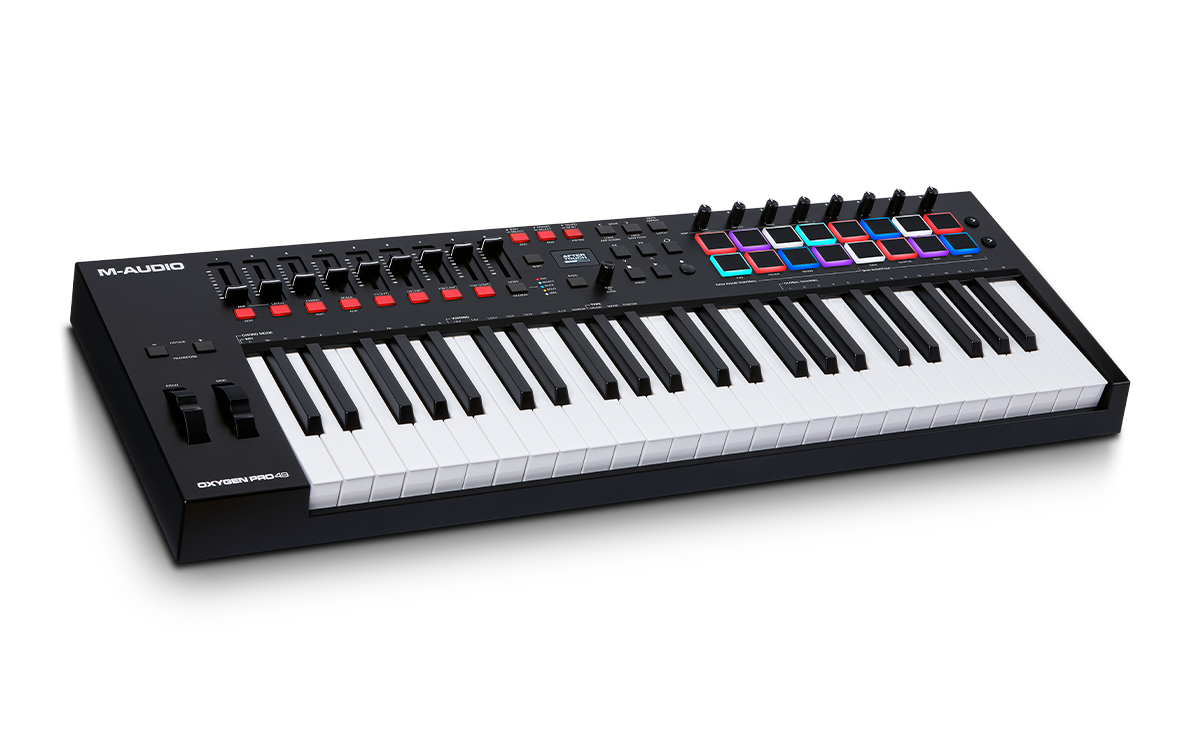
Explore this need in the finder →The Oxygen Pro 49 sits between the compact 25-key controller and the wider 61-key model, pairing a 49-key semi-weighted bed with sixteen velocity-sensitive pads, eight knobs, nine faders and direct five-pin MIDI Out. This assessment compares the manufacturer page with the 49-specific quickstart and shared Pro-series guide; it is not a hands-on feel or reliability test.
The middle range is a real compromise, not a full piano span
Forty-nine keys give more room for chords and two-hand parts than the 25-key Oxygen Pro, while remaining materially narrower than the 61-key body. M-Audio describes the bed as semi-weighted and velocity-sensitive and documents channel aftertouch. Octave and transpose controls expand the note range available across separate passages. They do not eliminate the physical limit: a passage requiring notes outside the keys at the same time still needs a larger bed or a changed arrangement. The manufacturer does not publish key dimensions or a measured action profile, so “semi-weighted” should be read as the maker's category rather than a promise that the keyboard feels like a particular piano action.
The product page lists a 31.5-inch width, 10.4-inch depth, 3.3-inch height and 9.3-pound weight. This is enough width to affect a desk shared with a computer keyboard, mixer or tablet stand. Leave space beyond the chassis for the USB-B connector, the five-pin MIDI lead and a sustain pedal. The printed width is not the clearance envelope for a working station.
A substantial DAW surface around the keys
Sixteen backlit velocity-sensitive pads, eight assignable knobs and nine faders make the 49's panel more suited to a production desk than a controller designed only to enter notes. The page and manual also document a display, transport controls, a selection encoder, pitch and modulation wheels, dedicated function controls and a sustain input. In DAW mode the hardware can use a selected DAW mapping; in Preset mode controls can be customized and saved. The shared guide describes up to sixteen stored user presets for the 25, 49 and 61 models.
Smart Chord, Smart Scale, an arpeggiator and pad Note Repeat add ways to shape MIDI performance before it reaches the software instrument. They do not add an onboard sound engine. M-Audio's feature copy presents Smart Scale as limiting notes to selected scales, but the chosen DAW or instrument still has to receive the MIDI messages and produce audio. The source set confirms velocity-sensitive pads and keyboard channel aftertouch; it does not establish pressure response on the pads. Do not treat the keybed's aftertouch as pad-pressure support.
Two useful signal paths, with setup work attached
The 49-specific Quickstart Guide says to connect the included USB cable's USB-B end to the keyboard and USB-A end to a computer or hub; the cable supplies power and MIDI data. For a loaded hub, M-Audio recommends using a powered one. The same guide documents the rear five-pin MIDI Out for an external synth and directs the owner to choose a custom preset and set the output source in Global Settings. A powered USB hub can substitute for the computer as the controller's power source in a hardware-oriented setup, but it does not power the receiving instrument or provide an audio monitoring path.
For DAW control, M-Audio's support material distinguishes the keyboard's DAW and Preset modes and supplies setup steps for specific hosts. That is a helpful starting point, not a guarantee that every DAW will automatically expose every control. Check the exact host's control-surface and MIDI-port settings, and plan to configure a custom mapping if the supplied preset does not suit the session. The box list names the keyboard, USB cable, software download card and paper guides; it does not list a pedal or DIN cable.
Who should compare it with the siblings?
The 49 is the candidate to examine when a 25-key board would force too many range shifts but a 38-inch 61-key body would crowd the desk. The Oxygen Pro 25 offers the same basic family control concept at 19.3 inches wide, but cannot supply the same simultaneous span. The Oxygen Pro 61 reaches more notes and lists the same 16 pads and nine faders, at a published 38-inch width and 10.6 pounds. The deciding difference is key reach and footprint, not an assumed difference in the overall MIDI workflow.
Before purchase, confirm the exact “Oxygen Pro 49” label rather than Oxygen 49 MKV or an older Oxygen generation; verify the USB-B cable and any software entitlement with the seller; and measure a usable 31.5-inch body space plus connector and hand clearance. For external MIDI, check the receiver's input, channel, selected output source and independent power/audio connections. M-Audio's product page, exact quickstart and Pro-series guide support the specifications here. Current listing is not proof of stock, price or seller package condition, and this review does not claim personal use or measured performance.
Key specifications
Key details at a glance
| Keys | 49 |
|---|---|
| Width | 31.5 in |
| Pads | 16 |
| Velocity-sensitive pads | Yes |
| Computer connection | Usb-b |
| Assignable pedal input | No |
| Depth | 10.4 in |
Use the exact model’s instructions for operating limits, supplied equipment and version differences.
Sources for this review
Sources for this assessment
Start with your setup, not a headline feature
Use the finder to combine key-count, connection, control and desk-fit requirements. Unverified specifications are never treated as a match.