
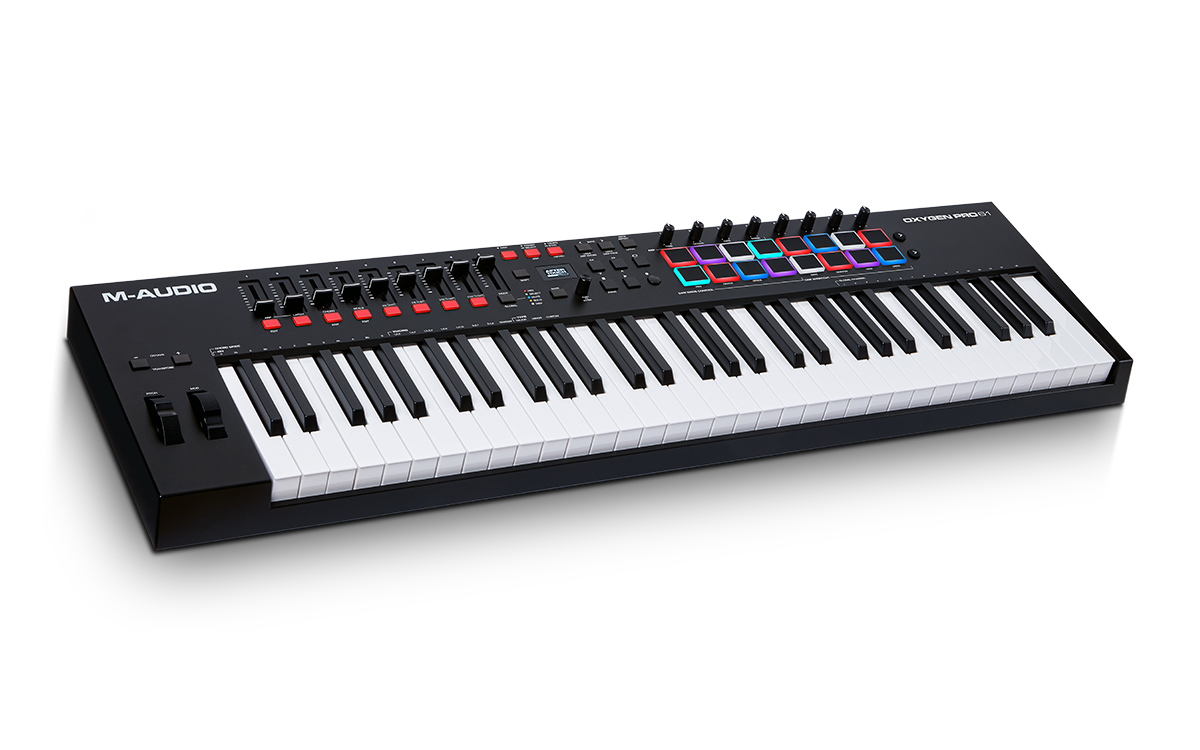
Your needs, this model
Does it fit your priorities?
Will Oxygen Pro 61 fit a 38-inch body-width cap?
M-Audio publishes a 38.0-inch body width, so Oxygen Pro 61 meets a 38-inch chassis screen exactly. Leave extra clearance for the USB-B and DIN plugs, cable bends, hands, pedal placement and stand support; a numeric match does not verify the whole setup.
Explore this need in the finder →Does the 61-key model add a different MIDI-out route from Oxygen Pro 49?
Both exact product pages and model manuals document USB-B computer MIDI, USB bus power and a standard five-pin MIDI Out, with the source selected in Global Settings. The main assessed difference is the keybed and body: 61 keys at 38.0 inches and 10.6 pounds versus 49 keys at 31.5 inches and 9.3 pounds.
Explore this need in the finder →Can Oxygen Pro 61 control external hardware by DIN without making audio?
Its MIDI Out transmits control data, not sound. The Quickstart Guide says to power the controller from a computer, laptop or powered USB hub, select a custom preset and enable the output source in Global Settings. The external instrument needs its own power and audio connection; the Oxygen Pro 61 has no sound engine documented in the reviewed material.
Explore this need in the finder →Oxygen Pro 61 combines a 61-key semi-weighted MIDI bed with sixteen velocity-sensitive pads, eight knobs, nine faders and a direct five-pin MIDI output. Its main trade is easy to state: more physical range than the 25- and 49-key Oxygen Pro models, but a 38-inch-wide body that asks for more desk or stand space. This is a research-based review of M-Audio's exact model page and documentation, not a playing test.
More reach, with a measured footprint to plan around
M-Audio describes the PrecisionTouch keys as velocity-sensitive and semi-weighted and documents channel aftertouch. A 61-key bed reduces octave changes for wider chord voicings, two-hand parts and lines that move across more registers than a 25-key controller can hold. It is still not an 88-key range, and shifting octaves changes where the bed sends notes rather than making additional keys available at once. If a piece depends on the complete piano range without moving octaves, compare an 88-key controller rather than treating 61 as full range.
The manufacturer lists the Oxygen Pro 61 at 38.0 inches wide, 10.4 inches deep, 3.3 inches high and 10.6 pounds. That body needs a suitably broad desk or stand. Published dimensions are not a stand-fit certification: the USB-B and DIN leads need bend room, pedal access takes floor space, and a player needs room at the controls. “Semi-weighted” is M-Audio's description; the inspected sources do not provide a force curve, individual key measurements or a basis for predicting a specific player's preferred feel.
Faders and pads still matter on a longer keybed
The 61 does not trade away the family control surface for its longer range. M-Audio lists sixteen RGB velocity-sensitive pads, eight knobs, nine faders, display and DAW/preset controls, transport buttons, pitch and modulation wheels, and a sustain input. The manual describes DAW mode for mapped software functions and Preset mode for editable control assignments. It also documents an arpeggiator, Smart Chord, Smart Scale and pad Note Repeat. These are MIDI-control tools; the controller itself has no documented sound generator or audio output.
Keep pad response separate from key expression. The manufacturer documents channel aftertouch on the keys and velocity-sensitive pads, but the inspected product materials do not establish aftertouch or continuous pressure response on the pads. If pad pressure is a hard requirement, this evidence is not enough to recommend the Oxygen Pro 61 for it. Likewise, the advertised software is delivered through registration and a software manager, so a used unit or an incomplete seller package may not provide the same redeemable bundle as a new retail box.
Computer and hardware connections
The model-specific Quickstart Guide identifies a USB-B-to-USB-A cable in the package and says that it carries MIDI data and powers the keyboard from a computer. M-Audio recommends a powered hub when other devices share a hub. The back panel also has a standard five-pin MIDI Out. To send data to a hardware synth, the guide instructs the user to choose a custom preset and select the desired MIDI source in Global Settings; it says to power the controller from a computer, laptop or powered USB hub for this workflow. The receiving synth needs its own power and an audio path to a mixer, interface, amplifier or headphones.
For DAW use, select the appropriate DAW mode and configure that application's MIDI/control-surface ports. M-Audio documents separate ports for note data and DAW control in its setup instructions, so a controller can be connected yet still need a host configuration change before faders or transport behave as expected. The included box list names the controller, USB cable, software download card, Quickstart Guide and safety/warranty manual; it does not list a sustain pedal or five-pin MIDI cable.
Compare the 49-key version before committing
Oxygen Pro 49 lists the same 49-key-through-DIN family workflow at 31.5 inches wide and 9.3 pounds. It is a meaningful alternative if the 61-key span is not needed or the desk is limited. Oxygen Pro 25 shrinks to 19.3 inches and 5.4 pounds but gives up a large portion of the simultaneous key range. The control counts listed by M-Audio remain similar across these three standard Pro sizes; do not assume that more keys mean extra faders or that the smaller one is the same product in a compact colorway.
Before buying, verify the full model name, the actual included USB cable and software-card status, a stand or desk that supports the 38-inch body, and the host's mapping procedure. For a DIN setup, check the receiving device's MIDI In, channel, Global Settings selection, power and audio monitoring. These recommendations rely on M-Audio's current page, exact 61-key Quickstart and Pro-series guide; they do not assert present retail availability, price, seller condition, personal ownership or measured key feel.
Key specifications
Key details at a glance
| Keys | 61 |
|---|---|
| Width | 38 in |
| Pads | 16 |
| Velocity-sensitive pads | Yes |
| Computer connection | Usb-b |
| Assignable pedal input | No |
| Depth | 10.4 in |
Use the exact model’s instructions for operating limits, supplied equipment and version differences.
Sources for this review
Sources for this assessment
Start with your setup, not a headline feature
Use the finder to combine key-count, connection, control and desk-fit requirements. Unverified specifications are never treated as a match.