
Your needs, this model
Does it fit your priorities?
Can the Oxygen Pro Mini fit a 16-inch body-width limit?
M-Audio publishes a 15.8-inch body width, so the controller clears a 16-inch chassis-only screen by 0.2 inch. That is not complete desk clearance: allow space for the USB-B plug, the separately sourced MIDI adapter/cable, hands and a sustain pedal. Its 32-note mini-key bed is a separate reach decision.
Explore this need in the finder →Does Oxygen Pro Mini have a direct five-pin MIDI Out?
No direct five-pin socket is documented. The version 1.2 guide specifies a 3.5 mm TRS Type-A MIDI Out and calls for a separately purchased Type-A TRS-to-five-pin-DIN female adapter cable for DIN gear. The keyboard also needs power from a computer/laptop or powered USB hub during hardware use; the receiver needs its own power and audio path.
Explore this need in the finder →Can its knobs and faders be reassigned for different sessions?
The manual distinguishes DAW mode from Preset mode: selected DAW controls can map to the software's faders/buttons, while Preset mode supports editable saved mappings. The four faders and four knobs remain four physical controls at a time, and DAW setup still needs the matching configuration or user mapping in the host.
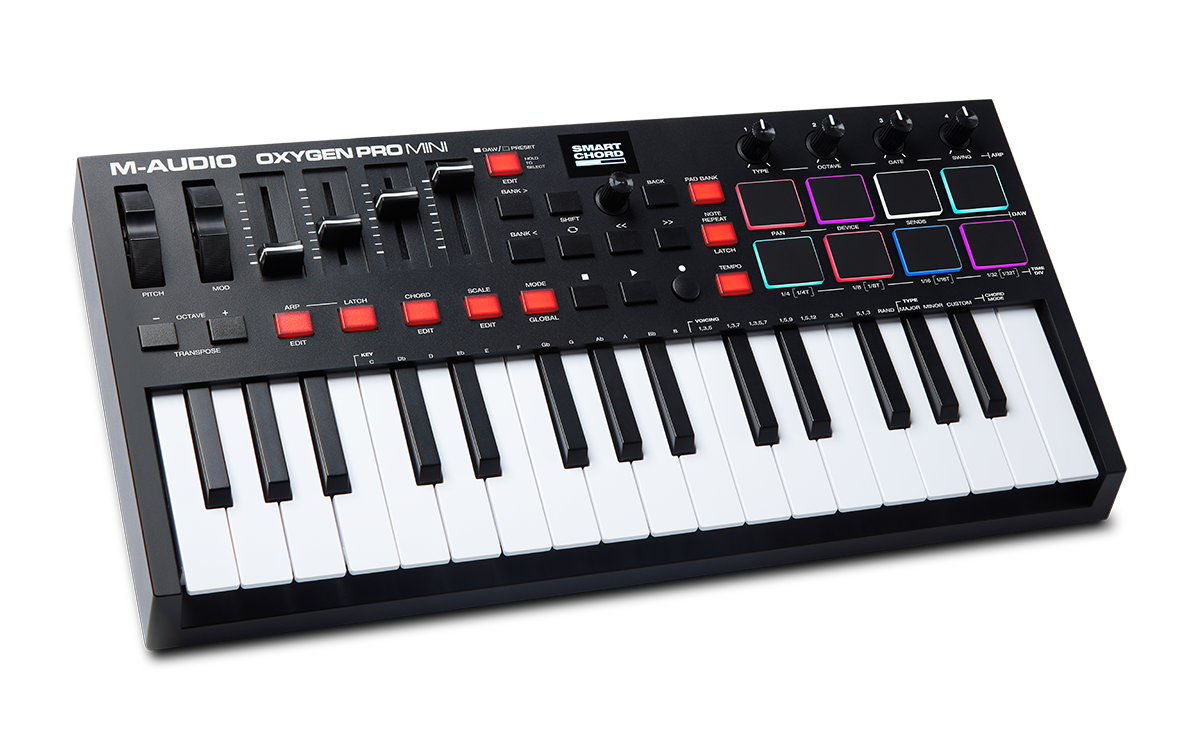
Explore this need in the finder →The Oxygen Pro Mini is a compact, 32-mini-key controller built around a small playing span and a surprisingly hands-on DAW surface. This assessment is based on M-Audio’s product information and version 1.2 user guide; it is not a hands-on playing test.
Thirty-two mini keys, not a short full-size keyboard
M-Audio describes the PrecisionTouch bed as semi-weighted mini keys, with velocity-sensitive note entry. Thirty-two keys provide more reach than the common 25-key compact board, but fewer than a 37-key model. The octave controls can move the range up or down, and the manual describes accessing the full MIDI-note range through octave shifts. That expands what can be addressed in separate takes; it does not let two hands occupy notes that are not physically present at once. If your parts need broad voicings, a simultaneous bass line and melody, or continuous piano-style reach, treat 32 mini keys as a firm physical limit rather than a software setting.
“Semi-weighted” is the maker’s action description, not a measured force curve or a prediction of how the keys will feel to you. The sources document velocity response, but do not establish keyboard aftertouch or the individual key dimensions. M-Audio lists selectable keyboard velocity curves, including low, medium, high, linear and fixed values. That is useful for adjusting note response in software, but it cannot change the mini-key size.
A compact surface for a DAW workflow
The visible layout gives this model a different job from a bare travel keyboard: eight velocity-sensitive pads in two banks, four assignable faders, four knobs, four function buttons, pitch and modulation wheels, a display, transport buttons and a sustain input. M-Audio also documents Note Repeat, an arpeggiator, Smart Chord and Smart Scale features. Those tools can make one-hand sketching or pad-triggered patterns more immediate, while octave shifting lets you move a part to another register. The pads are described as velocity-sensitive; the reviewed material does not confirm pressure-aftertouch on them. Do not treat pad velocity response as evidence of keyboard aftertouch or pad pressure sensing.
The guide separates DAW and Preset modes. In DAW mode, selected controls map to the chosen software; in Preset mode, mappings can be edited and saved to the keyboard. The product page lists presets for several major DAWs, but automatic mapping still depends on selecting a matching configuration in the software. “Auto-mapped” should not be read as a guarantee that every version of every DAW configures itself with no setup. The editable modes and small display help when switching jobs, while four physical faders remain four at a time: banks can extend the assignments, not the number of controls under your hands simultaneously.
USB power and the small-print MIDI connection
The USB port is Type-B, and the included cable is specified as USB-B at the keyboard to USB-A at a computer. The same lead sends MIDI and powers the keyboard. That is a meaningful distinction if your computer has only USB-C ports: you will need a compatible cable or adapter, and the controller itself is not a USB-C device. M-Audio recommends a powered hub when other devices share a hub, rather than implying that every unpowered hub will provide enough current.
There is an external MIDI Out, but it is a 3.5 mm TRS Type-A jack, not a five-pin DIN socket. For a DIN-equipped synth, the manual calls for a separately purchased Type-A TRS-to-five-pin-DIN female cable. It also says to power the controller from a computer, laptop or powered USB hub when using external hardware. Global settings let you send performance controls and keys, incoming computer MIDI, or both to the output. The receiver still needs its own power and sound-generation path; the Oxygen Pro Mini sends control data rather than audio. Verify the Type-A wiring and budget for the adapter before planning a hardware rig. A DIN requirement in a finder should not be confused with the presence of a direct five-pin connector on the keyboard itself.
What the footprint and package do—and do not—tell you
The maker gives a body size of 15.8 by 7.52 by 2.56 inches and a weight of 2.65 pounds. That is portable and clears a 16-inch body-width screen by only 0.2 inch on paper. This is not desk-clearance guidance: allow room for the USB cable, the TRS adapter and MIDI lead, hands, the sustain pedal and nearby equipment. The package list names the keyboard, USB cable, software download card, quickstart guide and safety/warranty manual; it does not list a sustain pedal or the TRS-to-DIN adapter.
The manual describes access to Ableton Live Lite, MPC Beats and AIR instruments through registration and the M-Audio Software Manager. Treat that as a software redemption workflow, not as proof that a particular seller still includes an unused code or that every named license remains available under current terms. Check the exact unit’s registration status and current software requirements if the bundle is central to your purchase.
Who should shortlist it
This is a plausible fit for a producer who wants more than two octaves of mini keys, a small chassis, a few physical faders and pads, and is comfortable with USB Type-B and a separate Type-A MIDI adapter. It is not the straightforward pick for someone who requires a direct five-pin DIN socket, USB-C at the controller, verified pad-pressure response, or a long, full-size keybed. A 37-key mini model gives more physical notes; a full-size 49-key controller gives a different reach and footprint. Compare those requirements first, then check the exact package, host cable, adapter, software redemption and desk clearance. None of the published specifications substitutes for trying the key size and action in person.
Key specifications
Key details at a glance
| Keys | 32 |
|---|---|
| Manufacturer's keybed description | Semi-weighted mini keys (manufacturer description) |
| Width | 15.8 in |
| Pads | 8 |
| Velocity-sensitive pads | Yes |
| 5-pin MIDI Out | No |
| Computer connection | USB Type-B |
| USB bus-powered | Yes |
| Assignable pedal input | Yes |
| Depth | 7.52 in |
Use the exact model’s instructions for operating limits, supplied equipment and version differences.
Sources for this review
Sources for this assessment
Start with your setup, not a headline feature
Use the finder to combine key-count, connection, control and desk-fit requirements. Unverified specifications are never treated as a match.