
Your needs, this model
Does it fit your priorities?
Is the Kontrol S88 MK3 a full-range weighted controller with polyphonic aftertouch?
The exact S88 MK3 product page and S-Series manual describe 88 fully weighted hammer-action Fatar keys with polyphonic aftertouch. NI identifies this as the TP100 bed; the S49/S61 share the different semi-weighted TP/90 bed. The S88's published 1,353 mm body width and 13.5 kg weight make desk, stand and lifting checks central rather than incidental.
Explore this need in the finder →Can the S88 MK3 drive external gear while connected to a computer?
NI documents a USB-C HOST port for the computer and rear 5-pin MIDI OUT/IN sockets for external devices, so USB-C host control and DIN hardware routing are part of a documented setup. The controller does not provide a sound engine or audio output; software instruments require a host/audio path and a hardware synth needs its own audio connection. With a USB-A-only computer, the manual requires an adapter plus a separate suitable USB-C power supply.
Explore this need in the finder →Will the S88 MK3 fit a normal keyboard tray or be easy to move?
Do not decide from key count alone. NI publishes a body width of 1,353 mm (about 53.27 in), depth 347 mm (13.66 in), height 120 mm (4.72 in) and weight 13.5 kg (29.76 lb). Measure the usable tray and include cable, hand and stand clearance; confirm the support's safe load and a practical lift path. The stated body dimensions are not a promise that a specific furniture setup will fit.
Explore this need in the finder →The Native Instruments Kontrol S88 MK3 combines an 88-key fully weighted hammer-action Fatar TP100 bed with polyphonic aftertouch and the current S-Series software-control surface. It adds USB-C computer integration and direct 5-pin MIDI I/O, but its published 53.27-inch body and 13.5 kg mass make physical support and installation as important as the feature list.
The keybed is the reason to compare the S88
Native Instruments distinguishes the S88 MK3 from its smaller S-Series siblings by both capacity and action. The S88 has 88 fully weighted hammer-action keys on a Fatar TP100 bed; S49 and S61 use semi-weighted Fatar TP/90 keys. The S88 also supports polyphonic aftertouch, which reports pressure for individual keys. In a compatible instrument, that can add per-note expression while multiple keys remain held. It is not a drum-pad feature, and a plugin or hardware destination must support the relevant messages to make practical use of it.
An 88-key layout allows a broader note range to remain under the hands than a 49- or 61-key board. But “hammer action” is a specification, not a tactile verdict. The maker's documentation can identify the mechanism class; only a player can decide whether its resistance, return and overall response suit their technique. If your work needs a more compact semi-weighted bed, the S49 or S61 may be a better physical and musical fit even though they have fewer keys.
Studio control and external routing
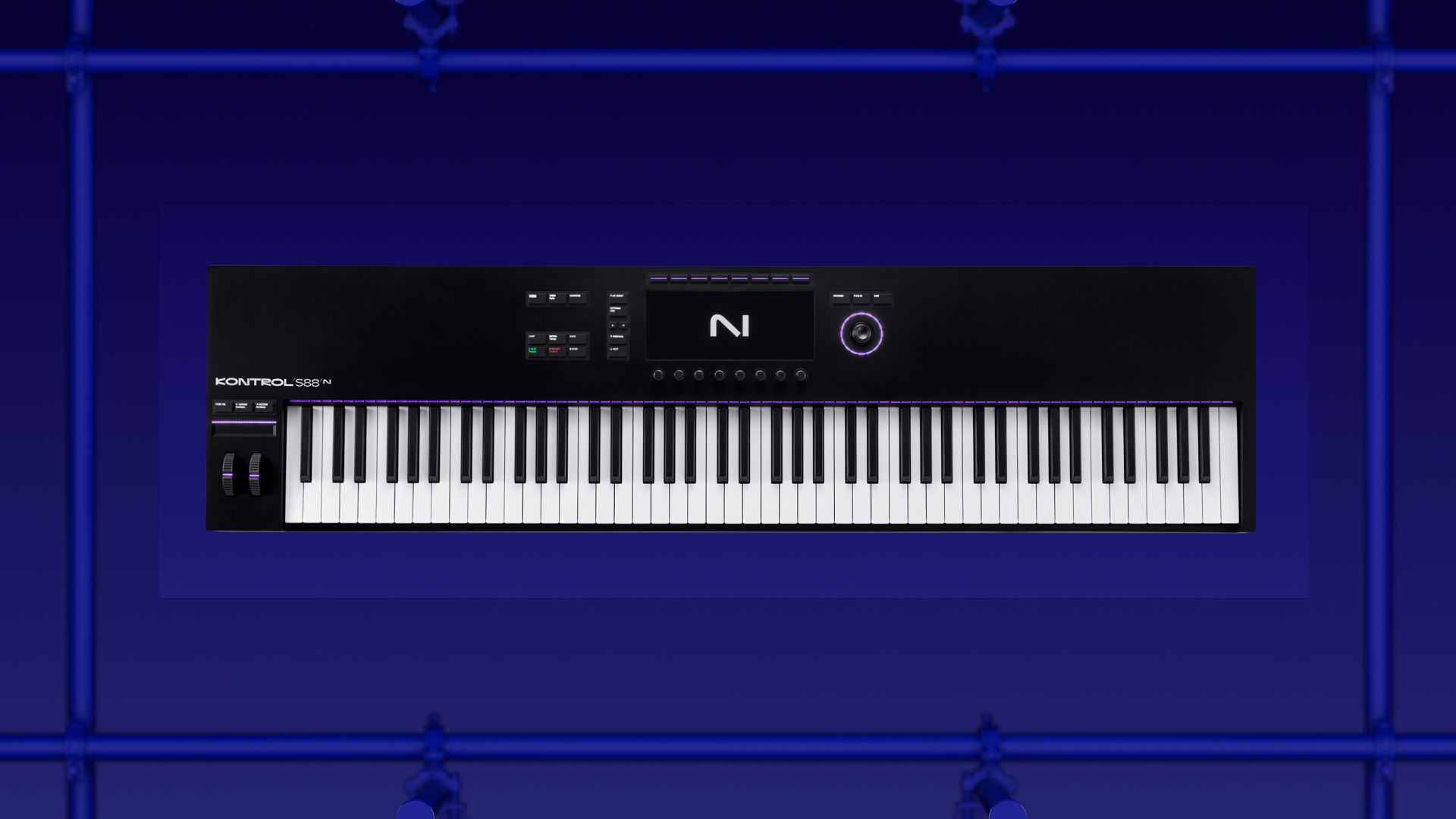
The S88 shares the current S-Series control concept: a 1280-by-480 glass color display, eight touch-sensitive encoders, a four-direction push encoder, pitch and modulation wheels, touch strip, Light Guide, transport and four assignable pedal inputs. NI positions it for browsing and controlling software instruments and effects, including its Kontakt/NKS workflows and compatible DAWs. This is a deep controller surface rather than a plain note-only keyboard, but it also means setup and software support matter. Check the exact DAW and OS version in the current NI compatibility information before expecting transport, parameter mapping or direct browsing to work the way a feature heading suggests.
USB-C connects the keyboard to a computer; dedicated 5-pin MIDI IN/OUT sockets give it a route to external hardware. The official manual documents using the keyboard as a MIDI interface or a standalone MIDI controller. That does not mean it makes sound by itself. A software instrument needs a computer and audio monitoring route; an external synthesizer needs its own power and audio connection. MIDI cables carry note/control data, not the resulting audio signal.
USB-C power needs a separate check
The rear panel has a USB-C HOST/data socket and a separate power-only USB-C socket. NI says the S88 can be bus-powered if the host or hub provides enough power. Its documented setup for a USB-A-only computer uses an adapter or cable and an additional USB-C power supply rated at least 5 V, 7.5 W and 1.5 A. If your desk depends on a dock, verify that its USB-C port carries data and has adequate power. Do not assume the cable included with a keyboard, the port's shape or a computer's advertised USB-C feature guarantees the required power path.
The same manual describes four pedal connections and DIN MIDI wiring. This gives the controller more routing options than the A-Series boards, but more ports mean more cables around the stand. Measure how those plugs exit the rear and whether a wall, shelf or tray blocks access before committing to a tight installation.
Measure the actual footprint and lifting plan
NI publishes the S88 body at 1,353 mm wide, 347 mm deep and 120 mm high, with a mass of 13.5 kg. That's about 53.27 inches by 13.66 by 4.72 inches, and 29.76 pounds. These are instrument dimensions, not required clearance. Add space for cable bends, pedal leads, your hands and the stand's own footprint. Check the support's load rating and whether the intended lift and setup can be done safely; this is a materially bigger installation than the 31.58-inch S49 or 38.09-inch S61.
There are other 88-key MIDI controllers in this library with their own action, width and routing combinations. The S88's distinct evidence-backed appeal is its combination of full weighted hammer-action keys, per-key polyphonic aftertouch, a high-resolution display and direct hardware MIDI connections. It should not be reduced to “the 88-key one” without checking whether you want its large physical format, software environment and expression features.
Software and package checks
NI's product page lists S-Series software and content benefits, but registration, account eligibility and current license terms matter. Verify what a seller actually supplies, whether the hardware is registered and what happens to any voucher or downloadable instruments after transfer. The product is not documented as a keyboard with built-in sound or an audio output, so plan the software host or external sound module separately. Its control capabilities also depend on current host versions and correct routing, not just on plugging in a USB cable.
Bottom line
Consider the Kontrol S88 MK3 when the 88-key weighted bed and per-key aftertouch are genuinely needed alongside S-Series software control, USB-C and 5-pin hardware MIDI. Its width and weight rule it out for many compact trays before price or features enter the discussion. If you can accommodate the body, verify the stand, cable clearance, host power and exact software package; if not, the S61 preserves much of the S-Series control surface in a shorter semi-weighted format. This is an assessment from NI's current model page and MK3 manual, not a hands-on test or a claim about a seller's stock.
Primary sources: Native Instruments Kontrol S88 product page and specifications; Kontrol S-Series MK3 Manual, English; Native Instruments MIDI-keyboard collection. Confirm current support and seller-specific software/box contents before buying.
Key specifications
Key details at a glance
| Keys | 88 |
|---|---|
| Manufacturer's keybed description | Weighted hammer action |
| Width | 53.27 in |
| Pads | 0 |
| Velocity-sensitive pads | No |
| Pressure-sensitive pads | No |
| 5-pin MIDI Out | Yes |
| Computer connection | USB-C |
| USB bus-powered | Yes |
| Assignable pedal input | Yes |
| Keyboard channel aftertouch | Yes |
| 5-pin MIDI In | Yes |
| Depth | 13.66 in |
| 5-pin MIDI outputs | 1 |
| CV/Gate/Mod voice outputs | 0 |
Use the exact model’s instructions for operating limits, supplied equipment and version differences.
Sources for this review
Sources for this assessment
Start with your setup, not a headline feature
Use the finder to combine key-count, connection, control and desk-fit requirements. Unverified specifications are never treated as a match.