
Your needs, this model
Does it fit your priorities?
Does 61SL MkIII meet a 61-key DIN-and-pad brief under a 38.75-inch body cap?
Yes. Novation lists 61 keys, pressure-responsive pads, five-pin DIN output and a 981 mm body. The listed width converts to 38.62 inches, within a 38.75-inch bare-body limit; the remaining 0.13 inch is not plug, hand or neighboring-equipment clearance. This is the USB Type-B version and requires an external 12 V supply.
Explore this need in the finder →What does 61SL MkIII add over its 49-key sibling?
Both share the semi-weighted keybed, aftertouch, 16 pressure-responsive pads, five displays, eight knobs/faders, eight-track sequencer and MIDI/CV ports. The 61 adds twelve physical notes, but also increases the published width from 817 to 981 mm and the listed mass from 5.56 to 6.54 kg. The extra reach is useful only if the part needs it and the longer body fits.
Explore this need in the finder →Is 61SL MkIII USB-C or bus-powered for a DAW?
No. The product page and manual specify USB Type-B and require a separate external 12 V DC, 1 A supply even when connected to a computer. Its USB data route can coexist with DIN or CV control outputs, but the published setup does not treat USB as the power source.
Explore this need in the finder →The 61SL MkIII is Novation's longer SL controller configuration: a 61-key semi-weighted keyboard joined to an eight-track sequencer, DAW controls, MIDI DIN and CV/Gate routing. Its documentation supports a computer-linked or computer-free control workflow, but both require a separate power supply. This is a source-based assessment of the exact US model, not a hands-on test or an audio-instrument review.
Keep the 61-key identity separate
Novation's US product page identifies the exact 61SL MkIII as SKU and MPN NOVSL61MK3, UPC 815301001072. It is not the 61SL MkII and not merely a larger image of the 49SL MkIII. The applicable English V2 guide distinguishes the 61-key edition in its dimensions, weight and default keyboard-zone range. Novation continues to provide the exact product and downloads pages, but the visible store page's sold-out message conflicts with the embedded store metadata. This review places it in the earlier-model comparison without claiming that every marketplace offer is available or that the line was permanently discontinued.
Five octaves and two kinds of pressure control
The 61 velocity-sensitive keys use an individually sprung synth-style semi-weighted action. The manufacturer also documents keyboard channel-pressure aftertouch. That should not be confused with the separate 16 RGB pads, which are velocity-sensitive and have polyphonic aftertouch. Both features create more expressive control paths, but the published term “semi-weighted” does not describe a graded hammer action, and the sources do not provide key dimensions or an independent account of feel. Anyone choosing it chiefly for touch should try the action in person.
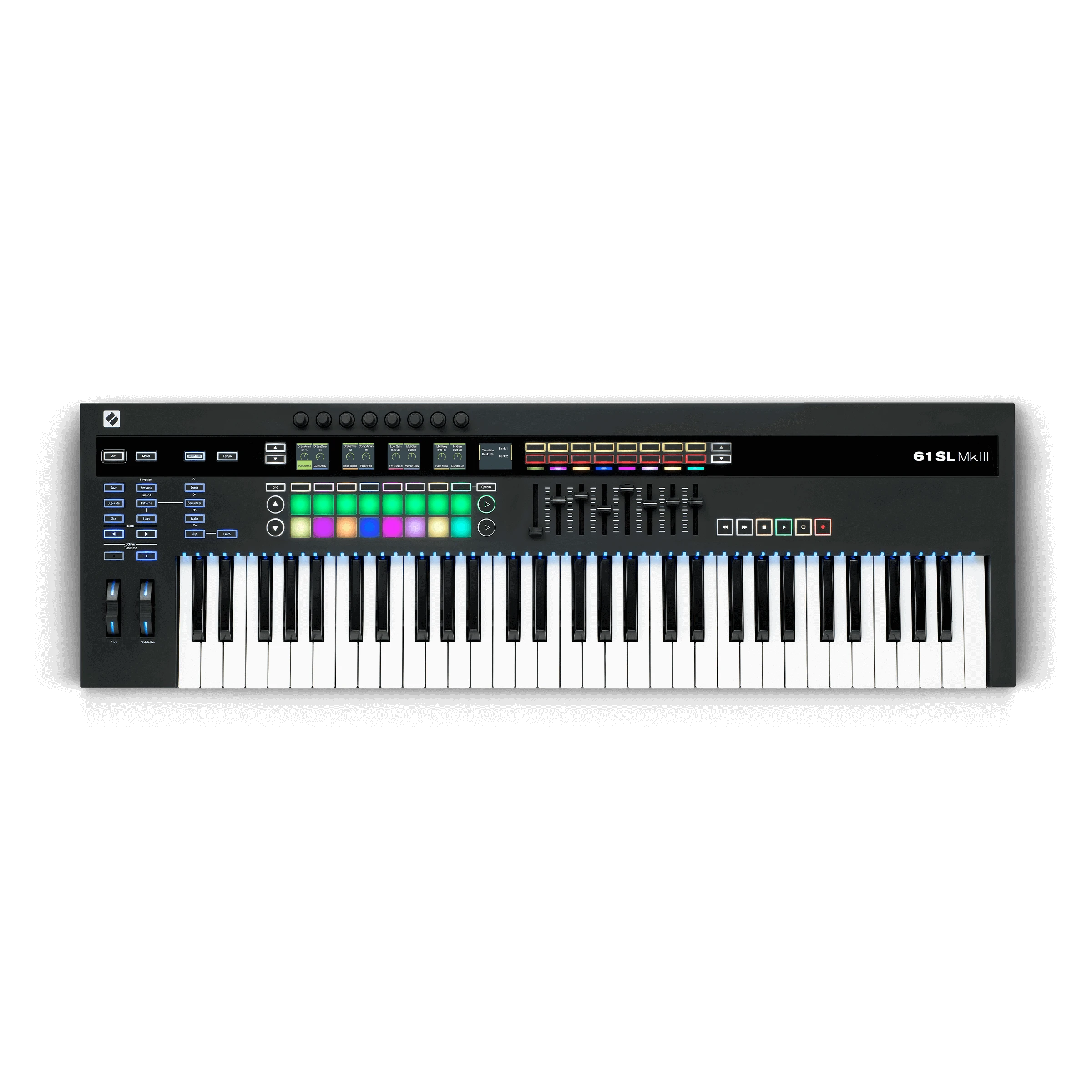
The surface combines eight knobs, eight sliders, five RGB TFT LCD screens, dedicated transport, two wheels and programmable buttons and pads. The 61-key width gives a broader simultaneous range than the sibling 49; it is useful when a part needs a low line and upper voicing without splitting takes or shifting octaves. It is not an 88-key substitute, and octave controls do not add physical keys. Range should be selected from the passages you actually need to play, not a beginner/advanced label.
An eight-track sequencer for hybrid workflows
Novation specifies an internal eight-track polyphonic sequencer, with real-time or step entry, automation recording, eight patterns per track, 16 steps per pattern and session storage. The manual explains pattern editing, session switching and tempo/swing controls. It also covers an arpeggiator, scale modes, chromatic transposition and eight playable keyboard zones. Those functions let the keyboard act as a control center when a studio contains several hardware voices as well as a computer.
DAW integration is another part of the proposition. Novation lists Ableton Live, Logic and Reason support and HUI compatibility with Cubase, Pro Tools, Studio One and Reaper. Treat that as a starting point rather than a universal compatibility guarantee: the host's version, templates, driver and firmware all matter. The unit does not replace a sound source. Its documentation describes MIDI and CV control; the listed rear-panel connections contain no audio output. Use a software instrument or external synthesizer, then plan that instrument's power and the audio-monitoring path separately.
Power and connectors are not optional details
The computer port is USB Type-B 2.0, not USB-C. The manual's box list includes a 1.5-metre USB-A-to-Type-B cable and a 12 V DC, 1 A external supply; Novation states that USB cannot power the keyboard. A USB host connection and an external MIDI destination can be part of the same supported setup, but power still comes from the adapter. For a computer-free rig, the manual describes the keyboard and internal sequencer controlling external instruments with the same supply attached.
On the back are MIDI In, Out and Out2/Thru on three full-size five-pin DIN sockets; two CV/Gate/Mod output groups; an analog clock output; and sustain, expression and footswitch inputs. This is more comprehensive than a USB-only controller, but each connection has to match the destination. Confirm MIDI channel and clock settings, CV pitch scaling, gate behavior, pedal type and the receiving instrument's own supply. The output carries control data rather than audio, and a CV route is not a substitute for an audio cable.
Width, weight and the 49SL comparison
The exact product page and V2 manual list 981 mm width, 300 mm depth and 100 mm height; the manual also gives 38.62 inches wide and a listed weight of 6.54 kg (14.42 lb). A 38.75-inch body cap admits it by 0.13 inch, but that nominal margin leaves no useful room for connectors, cable bends, hands or nearby equipment. Check the usable stand width, depth, support positions and load rating rather than relying on a bare chassis number.
The 49SL MkIII uses the same documented control and sequencing architecture in a 49-key body. It is 817 mm wide and 5.56 kg; the 61 adds twelve keys, 164 mm of published width and 0.98 kg of listed mass. Choose the longer version only if simultaneous range materially helps the playing task. If the 49-key body already covers the part, the extra footprint is not an automatic upgrade.
Earlier-model purchase checks
This model's strongest case is a hybrid setup that can use the 61-key reach, direct DIN, CV/Gate and clock alongside a useful internal sequencer. Its costs in space and setup are real: nearly 39 inches of width, over 14 pounds, USB-B and an external power supply. It is a controller rather than a sound module, and the sources do not provide a key-width measurement or guarantee compatibility with current software revisions.
For an earlier offer, confirm the NOVSL61MK3 identifier, all 61 keys, pad and screen response, faders, rear ports, original 12 V supply, USB cable, software-registration eligibility, firmware and return terms. Condition and included parts belong to the specific seller listing, not the model specification. Recheck current support and your host's requirements before relying on a particular integration.
Novation US 61SL MkIII product page · 61SL MkIII downloads and support · SL MkIII User Guide V2, English.
Key specifications
Key details at a glance
| Keys | 61 |
|---|---|
| Manufacturer's keybed description | Individually sprung semi weighted synth style |
| Width | 38.62 in |
| Pads | 16 |
| Velocity-sensitive pads | Yes |
| Pressure-sensitive pads | Yes |
| 5-pin MIDI Out | Yes |
| Computer connection | USB Type-B |
| USB bus-powered | No |
| Assignable pedal input | Yes |
| Keyboard channel aftertouch | Yes |
| 5-pin MIDI In | Yes |
| Depth | 11.81 in |
Use the exact model’s instructions for operating limits, supplied equipment and version differences.
Sources for this review
Sources for this assessment
Start with your setup, not a headline feature
Use the finder to combine key-count, connection, control and desk-fit requirements. Unverified specifications are never treated as a match.