
Your needs, this model
Does it fit your priorities?
Does FLkey 37 MK1 meet a 37-key body limit under 22 inches?
The exact earlier configuration has 37 full-size velocity-sensitive keys and a version-4 manual width of 21.85 inches. It passes a 22-inch body cap but not a 21.75-inch cap. That leaves only 0.15 inches beyond the published chassis at 22, before cable exits, hands and the stand are considered.
Explore this need in the finder →Can the MK1 send direct MIDI to an external synth with a computer connected?
Yes. Its exact manual identifies a five-pin DIN MIDI Out, and the product page/manual identify USB Type-B for the host. The computer powers the controller over USB; MIDI reaches the synth as a separate control route. The synth still needs its own power and audio monitoring, and a USB-C-only host needs a suitable cable or adapter.
Explore this need in the finder →Does the older FLkey 37 document pressure-responsive pads?
The MK1 version-4 guide lists pad aftertouch with Off, Channel and Poly options and an aftertouch threshold. This supports pressure on the pad surface, not aftertouch on keyboard keys. The exact model uses USB Type-B; it cannot satisfy a USB-C-required selection merely because a later FLkey 37 has USB-C.
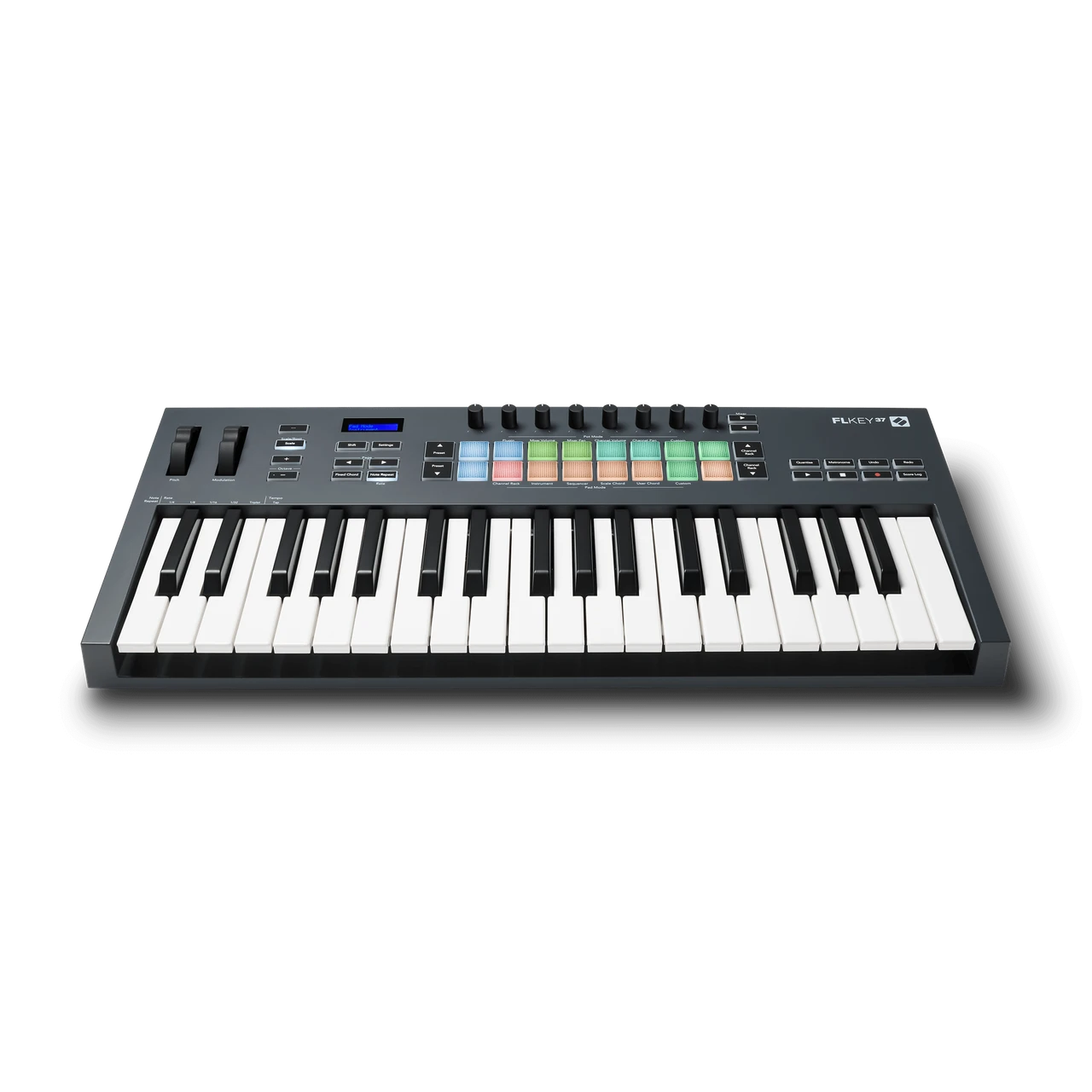
Explore this need in the finder →The first-generation Novation FLkey 37 MK1 is a full-size 37-key controller built around an FL Studio workflow. Its exact US configuration pairs a small 16-by-2-character display, eight knobs and sixteen pads with USB Type-B and a direct five-pin MIDI output. The version-4 guide also documents polyphonic pad aftertouch and a computer-free power plan. This is an evidence-based model assessment, not a hands-on test.
Three octaves and a compact control surface
Thirty-seven full-size keys offer more immediate reach than the 25-mini-key FLkey Mini while remaining shorter than a 49- or 61-note workstation. That makes the range a meaningful compromise for bass-plus-melody sketches, chord voicings, or parts that can be entered in layers. Octave controls expand the notes it can send, but do not provide more simultaneous key positions; a wide passage that needs low and high notes together may favor the larger models.
Novation's MK1 product page lists velocity-sensitive keys, two wheels and a small character screen. It does not establish a particular weighted action or keyboard-key aftertouch, so those are not claims to rely on. The sixteen RGB pads are different: the version-4 manual's settings table includes Pad Aftertouch options for Off, Channel and Poly, as well as an adjustable threshold. Pressure response belongs to the pad surface and should not be described as aftertouch on the keys.
Hands-on FL Studio control, not sound generation
The FLkey's pad modes address familiar production tasks: Channel Rack selection, instrument triggering and step-sequencer entry. Eight assignable knobs provide another route to mapped plugin or mixer parameters. Scale, Fixed Chord, User Chord, Scale Chord, Note Repeat and custom pad/knob modes give more ways to shape the control data without adding keys. Those facilities are useful when they match a specific software routine, but they are not a general-purpose hardware sequencer or a sound module. The reviewed sources specify no onboard audio engine or output; sound must come from a software instrument or external device and be monitored through its own route.
The manual specifies FL Studio 20.9.2 or later for the setup procedure in that guide edition. That should be treated as a documented baseline, not a promise about today's operating systems or every current application. The model's dedicated integration is described for FL Studio; the inspected MK1 material does not establish the current MK2's Mackie HUI claims. If another DAW is part of the plan, check its MIDI mapping and the current driver/firmware guidance rather than assuming every control surface feature will carry over.
USB Type-B and direct DIN can coexist
The computer port is USB Type-B. Novation's manual describes USB bus power and lists a 1.5-metre USB-A-to-Type-B cable in the box. This does not meet a USB-C-required finder choice, and a USB-C-only host would need a compatible replacement lead or adapter. The product's exact generation matters because the current FLkey 37 MK2 uses USB-C even though the model family name is similar.
For external gear, the MK1 has a full-size five-pin DIN MIDI Out. That can run alongside the USB host link, allowing the computer to receive the controller input while the MIDI output addresses an external device. The DIN connection sends notes and control information, not audio or instrument power. Novation also documents computer-free MIDI operation when the keyboard is powered by a separate standard USB supply rated at 5 V DC and at least 500 mA. The receiving synth still requires its own power and audio-monitoring plan. The 6.35 mm jack is a sustain input; confirm the pedal's function and the software or instrument that will interpret it.
Body width and support requirements
The exact US page lists a 555-by-258-by-77 mm chassis. The model manual gives a 21.85-inch width, 10.16-inch depth and 3.03-inch height including knob caps, with a listed mass of 2.18 kg (4.81 lb). At a 22-inch body cap the controller passes, but leaves 0.15 inches of nominal width. That number is not practical space for cables, hand movement, neighboring equipment or the support surface.
The small screen and the USB-B port are generation-specific buying checks, not minor naming differences. The FLkey 37 MK2 moves to USB-C and an OLED, while both use 37 keys and direct DIN. The exact control layout, display and computer cable should be checked against the unit and seller photos. On a desk, leave rear clearance for the USB, DIN and sustain cables; on a stand, check usable depth and support position rather than relying only on the key count.
How it compares with other FLkey sizes
Compared with the Mini MK1, the 37 changes to full-size keys, wheels, an LCD and a direct DIN output, while the Mini uses touch strips and TRS Type-A MIDI. Compared with the 49 MK1, the 37 is shorter, narrower and has no fader bank; the 49 adds nine faders and another octave of keys at a 31.06-inch width. The current 37 MK2 is the closer same-size alternative if USB-C and its later display matter, but its newer attributes do not retroactively apply to the earlier model.
This MK1 is worth comparing when its 37-key range, DIN output, pad aftertouch and dedicated FL Studio controls line up with the job, and USB Type-B is acceptable. Check the exact MK1 suffix, bundled cable, host version, firmware, software registration, pad function, return terms and current seller condition. A documented feature set cannot establish the wear or package of an individual unit.
Novation US FLkey 37 MK1 product page · Novation FLkey 37 downloads · FLkey 37 User Guide, version 4 · Novation FLkey MK1 family overview.
Key specifications
Key details at a glance
| Keys | 37 |
|---|---|
| Manufacturer's keybed description | Velocity sensitive full size keys |
| Width | 21.85 in |
| Pads | 16 |
| Velocity-sensitive pads | Yes |
| Pressure-sensitive pads | Yes |
| 5-pin MIDI Out | Yes |
| Computer connection | USB Type-B |
| USB bus-powered | Yes |
| Assignable pedal input | Yes |
| Depth | 10.16 in |
Use the exact model’s instructions for operating limits, supplied equipment and version differences.
Sources for this review
Sources for this assessment
- Novation US FLkey 37 MK1 exact product page and embedded product identity
- Novation FLkey 37 downloads and version-4 English guide index
- Novation FLkey 37 User Guide, version 4, English
- Novation FLkey MK1 family overview and generation-specific control comparison
- Novation FLkey range comparison including the later FLkey 2 generation
Start with your setup, not a headline feature
Use the finder to combine key-count, connection, control and desk-fit requirements. Unverified specifications are never treated as a match.