
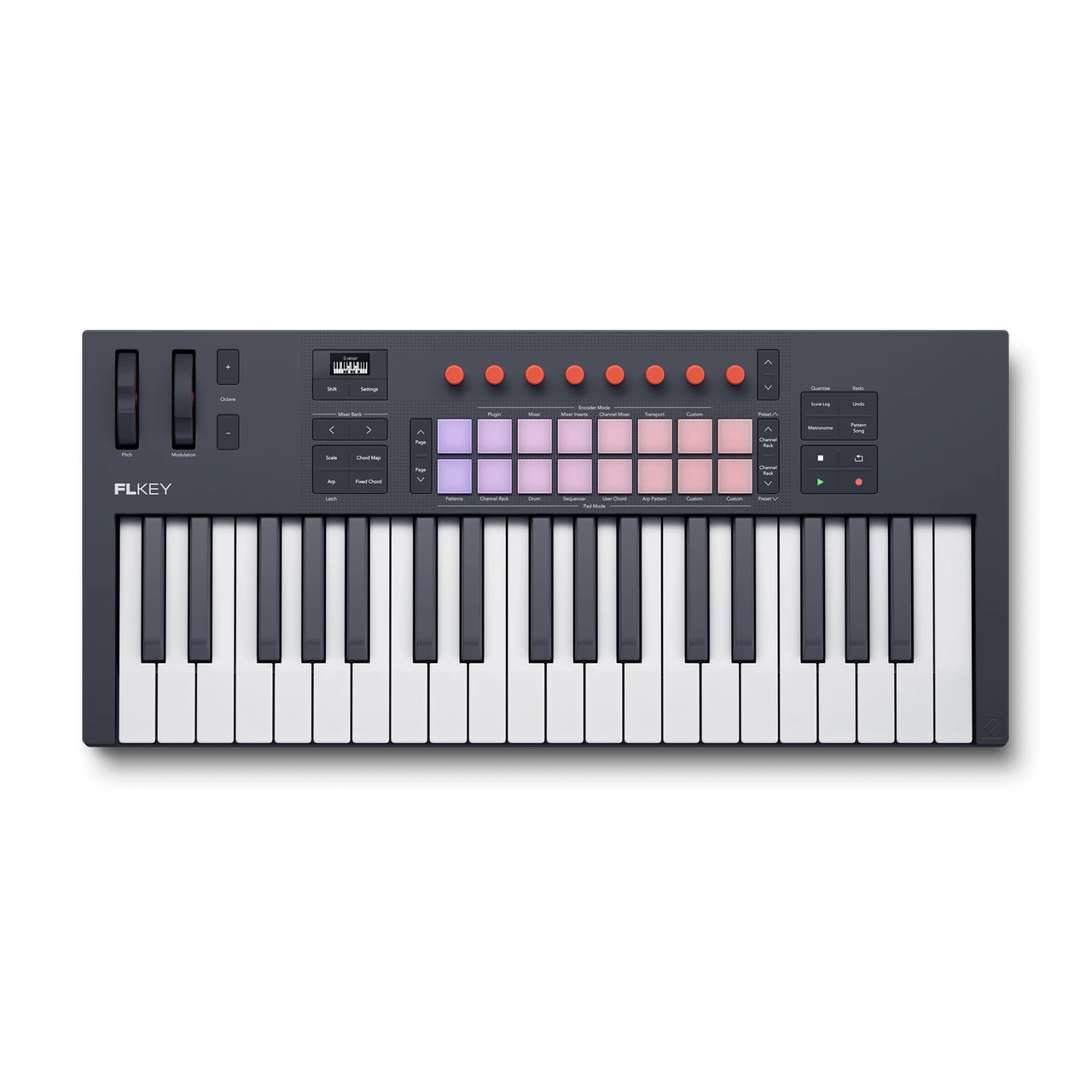
Your needs, this model
Does it fit your priorities?
Does FLkey 37 meet a 37-key USB-C, DIN and pressure-pad brief under 22 inches?
The exact current configuration documents 37 full-size synth-action keys, a 21.93-inch body, USB-C, direct five-pin MIDI Out and sixteen velocity-sensitive pads with polyphonic aftertouch in its supported computer arrangement. It matches a 22-inch body screen by only 0.07 inches, which is not cable, plug or hand clearance. If a firm 21.75-inch cap is necessary, this board does not pass it.
Explore this need in the finder →Can FLkey 37 send MIDI to a hardware synth without a computer?
Yes, Novation's version-5 guide describes using its five-pin MIDI output with or without a computer. The standalone plan still needs a standard 5 V DC USB supply rated at least 500 mA. A connected synth needs its own power and audio route; the FLkey is a controller, not the sound source.
Explore this need in the finder →How does FLkey 37 differ from the 25-key Mini version for hardware MIDI?
The current FLkey 37 has full-size keys and a direct five-pin DIN output; the Mini 25 uses mini keys and a 3.5 mm TRS Type-A MIDI jack. Both current models document USB-C and expressive pads, but only the 37's direct DIN socket meets a no-adapter five-pin-output requirement. Compare the exact body width and key span as well as the cable plan.
Explore this need in the finder →The current US Novation FLkey 37 (MPN NOVFLK37MK2) is a full-size 37-note controller whose current documentation combines USB-C, a direct five-pin MIDI output, sixteen pressure-responsive pads and controls tailored to FL Studio. It occupies a wider footprint than its Mini 25 sibling, but avoids a TRS-to-DIN adapter for standard hardware MIDI. This assessment uses Novation's current product page and FLkey 2 guide; it is not a hands-on test.
Three octaves, full-size synth-action keys
Thirty-seven full-size synth-action keys give more room for two-handed motifs or chord-plus-bass ideas than a 25-key mini controller, while octave buttons extend the register when a part moves beyond the immediate span. This is still a compact-range instrument compared with 49-, 61- or 88-key boards: a passage that needs a wide interval at once can outgrow it. Novation does not describe the keybed as weighted, and the reviewed sources do not give a measured key width or confirm aftertouch on the keys. Treat “full-size” and “synth-action” as the useful documented descriptions, not as a promise that it will feel like a particular piano.
The eight endless encoders, sixteen RGB pads, OLED and pitch/modulation wheels make the FLkey more than a simple note-entry keyboard. Its pads support velocity and polyphonic aftertouch, so pad pressure can add expression or help control supported software. That is distinct from keyboard aftertouch: the sources describe the pad response, but not pressure sensing on held keys. The 37-key version also has a wider control panel than the Mini 25, including dedicated workflow buttons for Score Log, metronome, pattern/song, undo and redo.
A focused FL Studio surface, with a broader fallback
Novation and Image-Line describe the FLkey as officially supported for FL Studio. The pad layout can trigger Channel Rack sounds and patterns; mapped encoders reach mixer and plugin parameters; and Scale, Chord Map, Fixed Chord, User Chord and arpeggiator tools provide ways to reshape note input. The display reports mode and parameter information. These controls address a DAW workflow rather than generating audio on their own, so a sound still comes from a software instrument or external device.
For other DAWs, Novation lists HUI support and user-created layouts through Components. This is more flexible than a controller locked to one application, but it is not equivalent to the dedicated FL Studio scripting path. The current US specification lists FL Studio custom scripts for version 26.1.1 or later. Check the version, firmware, operating system and exact mapping you need before treating the FL integration as plug-and-play. The current page also advertises a software bundle; registration and changing license terms are separate from the hardware specification.
Direct DIN and USB-C can serve one connected setup
The computer port is USB-C, with bus power from the host and a 1.5-metre USB-C-to-USB-A cable listed in the box. A USB-C-only computer may need another lead or an appropriate adapter. In the same supported arrangement, the full-size five-pin DIN MIDI Out can send notes and control data to a hardware instrument. MIDI does not carry audio or power for that instrument; plan the synth's own supply and audio monitoring independently. A 6.35 mm sustain input is also listed, and the guide says it supports sustain pedals and momentary foot switches.
Novation's guide describes MIDI output with or without a computer. For computer-free hardware control, it specifies powering the FLkey from a standard 5 V USB supply rated at least 500 mA. That can make a small hardware rig possible without a laptop, but the controller still is not a sound module. If the intended rig includes pedals, check the exact pedal type and map its signal in the software or instrument that will interpret it.
Body width, mass and support
The current US page gives a 557 mm body width, shown as 21.93 inches, with 251 mm depth and 79 mm height. The current version-5 manual rounds the weight to 2.2 kg (4.85 lb), while the US page lists 2.18 kg; the latter is a small rounding difference, but the available figures still do not justify a more precise claim than the current product page. The broad width and 37 full-size keys put this model between the short Mini 25 and the longer 49-key boards; it should be measured against the actual surface, not a desk's outside dimension.
A numerical pass at 22 inches leaves only 0.07 inches beyond the listed body. That is not space for cables, plugs, hands or an adjacent screen. Make sure the stand or shelf supports the keyboard across its base and leaves room to reach the wheels, pads and upper encoders. The size does not make this a piano-weighted instrument, and the source record does not include tactile testing.
How it differs from the Mini 25
The Mini 25 is the narrower choice when a 25-note span, mini keys and touch strips suit the session; its external MIDI socket is 3.5 mm TRS Type-A. The FLkey 37 moves to full-size keys and pitch/modulation wheels, adds a direct five-pin DIN output and takes up a 21.93-inch body. Both current models have USB-C, sixteen pads with polyphonic aftertouch, eight encoders and FL Studio-focused controls, but the connector and key format materially change the setup. Choose the 37 when those full-size keys or direct DIN matter, and confirm the DAW, firmware, supply and support footprint before ordering.
Novation US FLkey 37 product page · Novation FLkey 2 37 downloads and documentation · FLkey 2 37 User Guide, version 5.
Key specifications
Key details at a glance
| Keys | 37 |
|---|---|
| Manufacturer's keybed description | Velocity sensitive synth action full size keys |
| Width | 21.93 in |
| Pads | 16 |
| Velocity-sensitive pads | Yes |
| Pressure-sensitive pads | Yes |
| 5-pin MIDI Out | Yes |
| Computer connection | USB-C |
| USB bus-powered | Yes |
| Assignable pedal input | Yes |
| Depth | 9.88 in |
Use the exact model’s instructions for operating limits, supplied equipment and version differences.
Sources for this review
Sources for this assessment
Start with your setup, not a headline feature
Use the finder to combine key-count, connection, control and desk-fit requirements. Unverified specifications are never treated as a match.