
Your needs, this model
Does it fit your priorities?
Does FLkey 49 MK1 meet a 49-key MIDI controller brief under 31.25 inches?
The earlier 49-key model is listed at 789 mm, or 31.06 inches, and has a full-size velocity-sensitive range. It fits a 31.25-inch body cap but does not fit a 31-inch cap. Its nine faders, eight knobs, LCD, pressure-responsive pads and direct DIN remain distinct from the same-generation 61-key version.
Explore this need in the finder →Can FLkey 49 MK1 send DIN MIDI to a hardware synth?
Yes. Novation's version-2 guide identifies a direct five-pin DIN MIDI Out, including a computer-free arrangement when the keyboard is powered separately from a standard USB supply rated 5 V DC and at least 500 mA. The synth needs its own power and audio route; DIN sends MIDI control rather than sound.
Explore this need in the finder →What is different from the current FLkey 49 MK2?
The earlier exact model uses USB Type-B, a 16-by-2 character screen and a documented non-weighted-action description; the later family page describes the 49-key MK2 as semi-weighted, with USB-C and OLED. Both versions have nine faders, eight knobs and a DIN output, so suffix, host cable and keybed description should be checked rather than inferred from the FLkey 49 name alone.
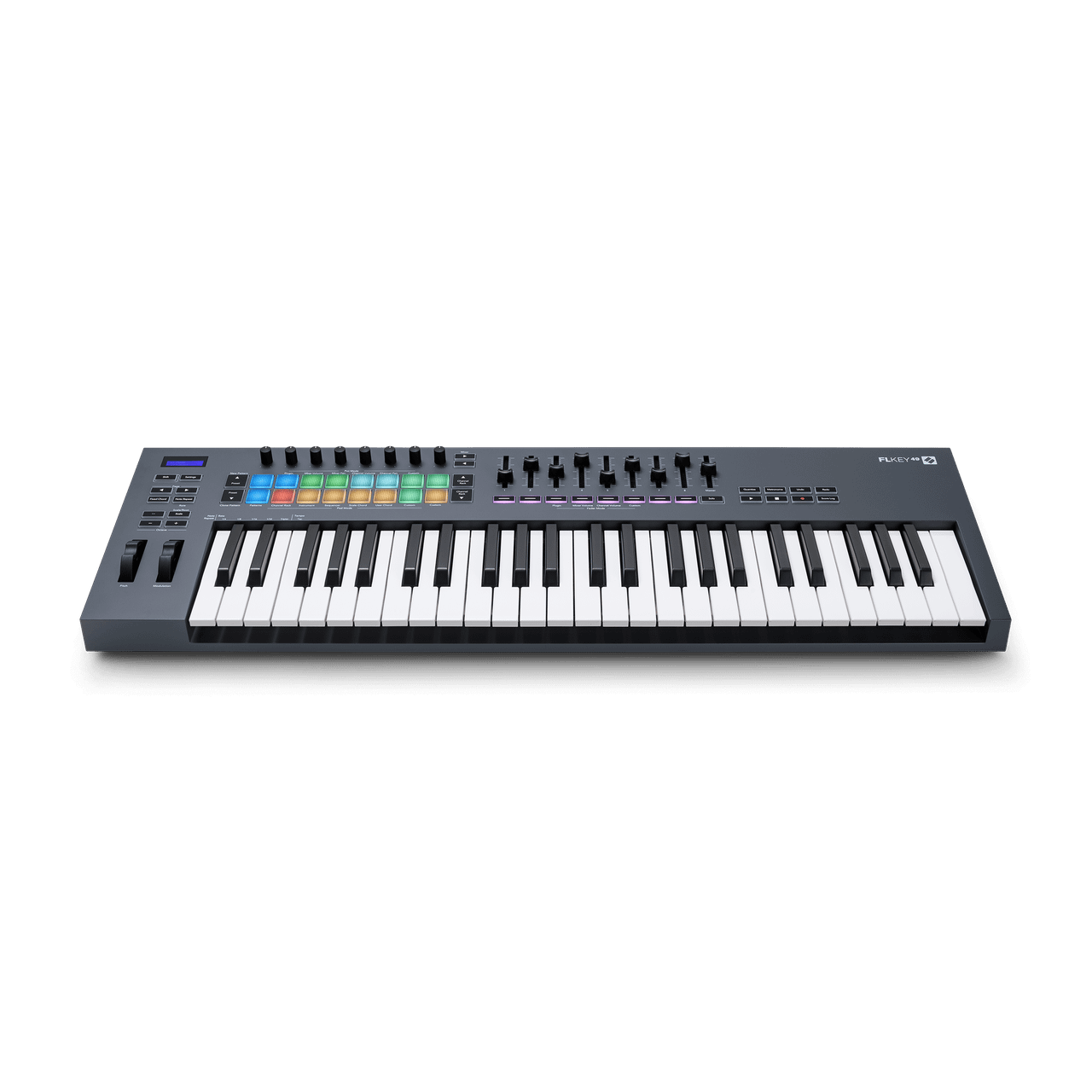
Explore this need in the finder →The Novation FLkey 49 MK1 is the first-generation, four-octave member of a controller family designed around FL Studio. The exact US model combines 49 full-size velocity-sensitive keys with eight knobs, nine faders, sixteen pads, USB Type-B and direct five-pin DIN MIDI Out. Its pads support pressure settings, but the inspected first-generation evidence does not establish a weighted keyboard action or keyboard-key aftertouch. This is a source-based assessment, not a hands-on review.
Four octaves with a fader bank
Forty-nine full-size keys give more simultaneous reach than the 37-key model without occupying the space of the 61-key version. That can be a useful middle size for two-handed chord work, bass-and-melody sketches, and parts where octave-shifting alone would be limiting. It remains a controller: octave controls can move the transmitted notes, but cannot add physical key positions for a wide passage played at once.
The product page specifies velocity-sensitive keys and the version-2 English guide identifies pitch-bend and modulation wheels. Neither the exact MK1 page nor that manual specifies a weighted key action or confirms aftertouch on the keys. Do not import the later MK2's semi-weighted description based on the shared “FLkey 49” name. If key resistance or key aftertouch is central to the decision, the evidence gap is material and the exact suffix should be confirmed from the unit itself.
Above the keys, the 49 has eight rotary controls and nine 45 mm faders with associated buttons. The larger control surface is an important difference from the FLkey 37 MK1, which has knobs but no fader bank. Sixteen velocity-sensitive RGB pads support Channel Rack, instrument and sequencer tasks. The manual also documents Pad Aftertouch modes—Off, Channel and Polyphonic—and a pressure threshold. That pressure feature applies to the pads, not the keyboard keys.
DAW integration is not an instrument
Novation describes dedicated FL Studio integration, and the manual covers pad modes, Scale, Fixed Chord, User Chord, Scale Chord, Note Repeat and custom pad or encoder assignments. These controls can make editing, triggering and parameter changes more immediate if FL Studio is the intended host. The inspected MK1 evidence does not establish that its full feature set transfers to every DAW, so another host should be checked for its MIDI mapping and control-surface support before relying on a specific workflow.
The reviewed sources describe control messages, not an onboard sound engine or audio output. A software instrument or external synth must create the sound, and a separate monitoring route is needed to hear it. Likewise, DIN MIDI carries performance/control data but no audio. Do not confuse the piano-style layout or dedicated DAW controls with a self-contained keyboard instrument.
The version-2 guide states FL Studio 21.0.3 or later for its setup procedure. That is a minimum stated in that edition, not a universal compatibility guarantee for present operating systems, computer hardware or future host releases. Check the current support instructions for the intended computer and software. The product page also describes an FL Studio Producer Edition trial offer; with an earlier or used unit, verify whether registration, activation and account eligibility still allow that offer before assigning it value.
USB-B for the host, DIN for external gear
The computer connection is USB Type-B, with USB bus power and a listed 1.5-metre USB-A-to-Type-B cable. A USB-C-only computer can still be part of a setup with a suitable cable or adapter, but the MK1 itself is not the USB-C model. The later FLkey 49 MK2 uses USB-C and an OLED display; its specification should not be projected onto this older unit, whose small 16-by-2 character LCD and port are generation-specific.
For hardware MIDI, a standard five-pin DIN Out is built in. A connected computer can power the board over USB while DIN sends data to a synth or other MIDI device. The manual also documents a computer-free setup powered from a separate standard USB supply rated 5 V DC and at least 500 mA. In either arrangement the receiving instrument needs its own power and audio route. The 6.35 mm pedal socket is documented for sustain; check pedal function and polarity if using an existing pedal, and do not assume it supports every expression function.
Measure the working space, not only the chassis
The model-specific guide gives a width of 789 mm (31.06 inches), depth of 258 mm (10.16 inches), height of 77 mm (3.03 inches, including knob caps) and listed mass of 3.03 kg (6.68 lb). It passes a 31.25-inch body cap but fails a 31-inch cap. The nominal 0.19-inch margin under 31.25 inches is not usable clearance for plugs, cable bends, hands or the edges of a stand. Check both support depth and connection space at the actual playing position.
Compared with the 61 MK1, this board gives up twelve keys while saving 6.42 inches of listed width and 0.88 pounds. Compared with the 37 MK1, it adds twelve keys and nine faders at a wider footprint. These published differences can help narrow a shortlist, but they do not predict comfort or stability on a particular furniture surface.
Who should compare this MK1
The 49 MK1 merits comparison when four octaves, FL Studio controls, nine faders, pad aftertouch and direct DIN are useful, while USB Type-B and a 31.06-inch body are acceptable. It is a weaker fit if USB-C without an adapter or a documented weighted action is essential, or if sound generation must be onboard. The current 49 MK2 is a distinct alternative with USB-C and a newer display/keybed description.
For an older unit, confirm the MK1 marking, cable contents, working faders, buttons, encoders, wheels and pads, current support, license eligibility and seller return terms. Verify the DIN path independently. Manufacturer specifications describe the model, not a used unit's condition, bundle or availability.
Novation US FLkey 49 MK1 product page · Novation FLkey 49 downloads · FLkey 49 and 61 User Guide, version 2 · Novation FLkey MK1 family overview.
Key specifications
Key details at a glance
| Keys | 49 |
|---|---|
| Manufacturer's keybed description | Velocity sensitive full size keys |
| Width | 31.06 in |
| Pads | 16 |
| Velocity-sensitive pads | Yes |
| Pressure-sensitive pads | Yes |
| 5-pin MIDI Out | Yes |
| Computer connection | USB Type-B |
| USB bus-powered | Yes |
| Assignable pedal input | Yes |
| Depth | 10.16 in |
Use the exact model’s instructions for operating limits, supplied equipment and version differences.
Sources for this review
Sources for this assessment
- Novation US FLkey 49 MK1 exact product page and embedded product identity
- Novation FLkey 49 downloads and version-2 English guide index
- Novation FLkey 49 and 61 User Guide, version 2, English
- Novation FLkey MK1 family overview and generation-specific control comparison
- Novation FLkey range comparison including the later FLkey 2 generation
Start with your setup, not a headline feature
Use the finder to combine key-count, connection, control and desk-fit requirements. Unverified specifications are never treated as a match.