
Your needs, this model
Does it fit your priorities?
Does FLkey 61 meet a 61-key USB-C, DIN and pad-pressure setup with a 35.25-inch width screen?
The exact FLkey 61 MK2 is documented with 61 full-size semi-weighted keys, sixteen pads with aftertouch, USB-C, direct five-pin DIN and a 35.24-inch body. It passes the next quarter-inch number at 35.25 by just 0.01 inch; leave additional room for connectors, cable bends, hands, the sustain lead and stand support.
Explore this need in the finder →Can FLkey 61 control a hardware instrument over DIN without a computer?
Yes, the exact version-5 guide describes its five-pin output with or without a computer. A computer-free setup still requires a separate standard USB supply rated 5 V DC and at least 500 mA for the FLkey. The receiving synth needs its own power and sound-monitoring plan because MIDI Out carries control data rather than audio.
Explore this need in the finder →Is the FLkey 61's extra octave over the 49 worth its wider footprint?
The 61 adds twelve keys but grows by 6.50 inches and 1.54 lb from the 49. The two retain the listed eight encoders, nine faders, sixteen aftertouch-enabled pads, USB-C and DIN output. The larger span can reduce octave changes in one performance, while the 35.24-inch width can be a real constraint on a compact stand or desk.
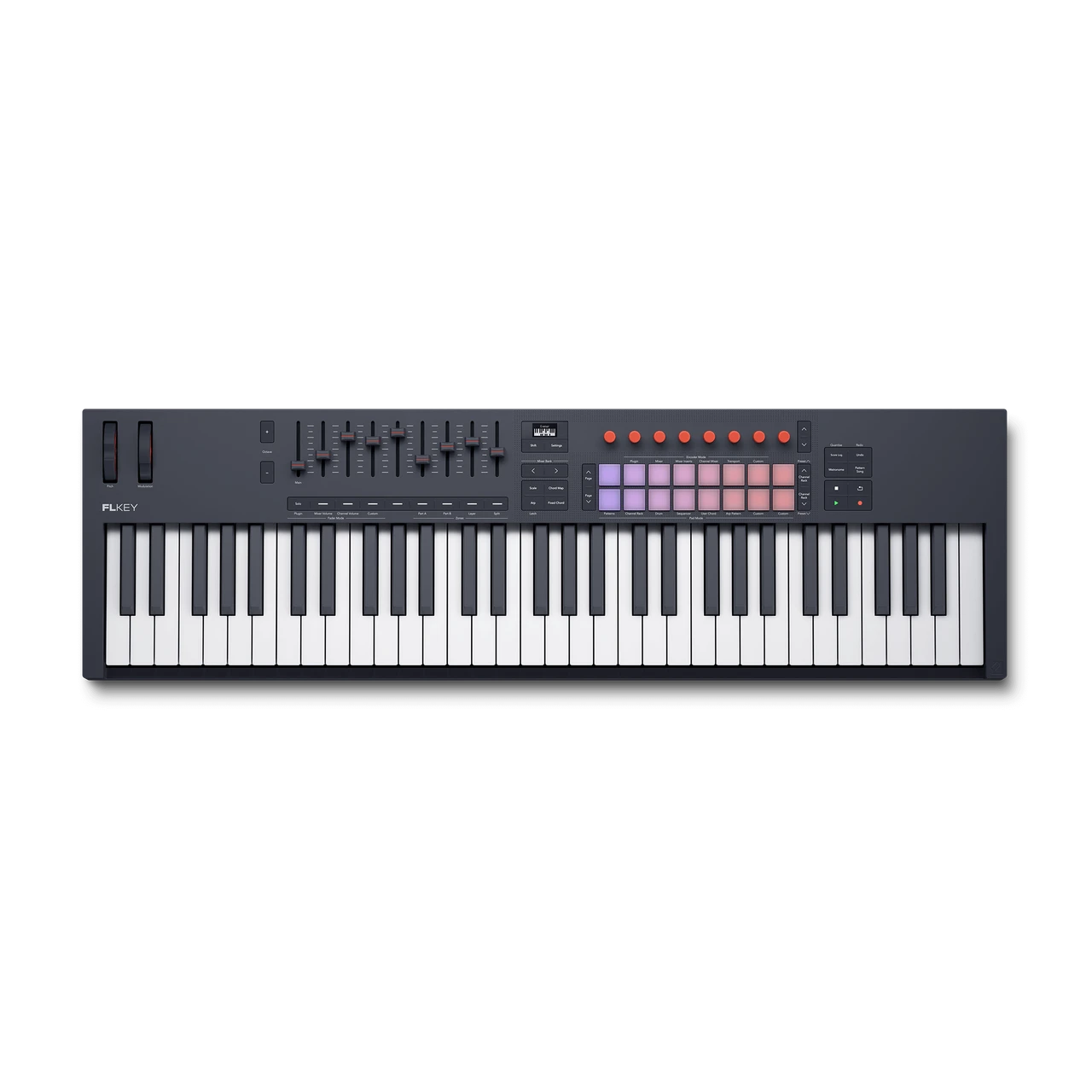
Explore this need in the finder →Novation's current US FLkey 61 is the five-octave member of the second-generation FLkey family, identified in the exact store data as SKU/MPN NOVFLK61MK2. Its user guide is titled FLkey 2 61. The value here is not simply a larger key count: the model keeps the family's FL Studio surface and direct MIDI connections while asking for a substantially longer desk or stand. This is a source-based review, not a hands-on test.
Five octaves with the larger FLkey control bank
The 61-note keybed is full-size and semi-weighted, and Novation describes the current 49- and 61-key beds as waterfall-style. These descriptions separate it from mini-key or synth-action boards, but they do not quantify key force, travel or personal playing comfort. The inspected product page and guide do not document aftertouch on the keyboard keys. If keyboard aftertouch is essential, do not infer it from the pads' aftertouch feature.
Above the keybed sit pitch and modulation wheels, 16 RGB pads, eight endless encoders, nine faders with buttons, and a 128-by-64 monochrome OLED. The extended layout maps into FL Studio's mixer, Channel Rack, patterns, plugins and transport, with an arpeggiator and scale/chord tools. The 61-key version supports keyboard splits and layers according to the current product and family documentation, letting the keybed address two software or external parts. That flexibility is still a MIDI-control function: no onboard sound engine or audio output is specified, so the receiving software or instrument creates sound and must be monitored separately.
Pressure-enabled pads, with the right caveat
The exact English guide identifies 16 velocity-sensitive pads with aftertouch; the current range page specifies the family pads use force-sensitive technology and support polyphonic aftertouch in compatible hosts. This means the pad surface can send expressive pressure data. It does not establish pressure sensitivity on the keys themselves, and a target DAW or plugin must support the relevant messages. If the pads are being bought for finger drumming or pattern selection, confirm that the desired instrument interprets their output and that the custom mode can be configured as expected.
Separate host and hardware paths
A USB-C connection carries computer data and bus power in the documented computer setup. Novation lists a 1.5-metre USB-C-to-A cable in the box, which may not be the right lead for every modern host. The five-pin DIN MIDI Out is a second route that can send notes and control changes to an external synthesizer or drum machine. DIN MIDI is not audio and does not power that receiving device; plan the instrument's supply, audio output and monitoring separately.
The version-5 manual describes DIN operation with or without a computer. In standalone use, it calls for a standard USB supply rated 5 V DC and at least 500 mA to power the FLkey. The separate 6.35 mm sustain input accepts a standard sustain pedal; Novation says the pedal signal may need mapping in a plugin and does not support soft, sostenuto or volume pedals. Confirm the exact pedal and the space needed for its cable alongside the wider keyboard. A port's presence does not guarantee that every pedal action is automatically recognized.
Dedicated FL Studio control is the reason to choose it
The current product page identifies custom FL Studio scripts for version 26.1.1 or later; its current software section is a better forward-looking check than the version-5 guide's statement that FL Studio 25 or later is needed. Check the current host requirement again before ordering. Novation lists Mackie HUI for other DAWs, which is a broader control route but not the same tailored scripting relationship. The guide includes setup steps, and notes that some HUI connections require manual configuration. A buyer alternating among DAWs should compare those workflows rather than treating “compatible” as identical feature depth.
Scale and chord modes, the step-editable arpeggiator, dedicated transport buttons and the screen add control options without changing the role of the hardware. The included-software offer depends on registration and current terms, and is not an inherent guarantee that a specific software license is available to every buyer. The manual directs owners to Novation Components for firmware updates; check current downloads and account registration as part of ownership planning.
Footprint, range and the FLkey 49 comparison
The exact page and version-5 guide list a 895 mm (35.24-inch) width, 263.5 mm (10.37-inch) depth and 93 mm (3.66-inch) height. Its published weight is 4.78 kg (10.54 lb). It needs more than a 35-inch usable shelf: the body itself exceeds that limit, and at 35.25 inches it passes the finder's next quarter-inch setting with only 0.01 inch of nominal margin. That screen ignores cable exits, wall clearance, hands, pedal placement and the width of the support. Measure the actual playing surface and leave room to operate the wheels and upper controls.
Against the FLkey 49, this model adds twelve keys—one octave—at a cost of 6.50 inches of width and 1.54 pounds. The 49 and 61 share eight encoders, nine faders, 16 expressive pads, USB-C and DIN, and both offer the larger-keyboard split/layer workflow. The extra span matters if a two-handed passage or a single take across more notes is important; it can be unnecessary if the player records parts separately or has a narrow desk. The 37-key FLkey is narrower and full-size synth action but sacrifices the semi-weighted keybed, twelve notes versus 49 and the faders. Choose based on the written part and available support, not an assumed skill tier.
Novation US FLkey 61 product page · FLkey 2 61 downloads and English guide · Novation FLkey range comparison.
Key specifications
Key details at a glance
| Keys | 61 |
|---|---|
| Manufacturer's keybed description | Semi-weighted waterfall keys |
| Width | 35.24 in |
| Pads | 16 |
| Velocity-sensitive pads | Yes |
| Pressure-sensitive pads | Yes |
| 5-pin MIDI Out | Yes |
| Computer connection | USB-C |
| USB bus-powered | Yes |
| Assignable pedal input | Yes |
| Depth | 10.37 in |
Use the exact model’s instructions for operating limits, supplied equipment and version differences.
Sources for this review
Sources for this assessment
Start with your setup, not a headline feature
Use the finder to combine key-count, connection, control and desk-fit requirements. Unverified specifications are never treated as a match.