
Your needs, this model
Does it fit your priorities?
Does Launchkey 25 MK3 provide full-size keys in a compact four-octave?
Novation specifies 25 full-size velocity-sensitive synth-action keys in an 18.23-inch-wide body. The octave buttons extend the transmitted range, but they do not add simultaneous physical keys; compare with the smaller 12.99-inch Launchkey Mini 25 if mini keys are acceptable.
Explore this need in the finder →Can Launchkey 25 MK3 control external MIDI gear without a computer?
The version-6 guide describes the five-pin MIDI Out in standalone use. Supply the controller separately with a standard 5 V USB source rated at least 500 mA; the external instrument still needs its own power and audio-monitoring path.
Explore this need in the finder →Is Launchkey 25 MK3 a USB-C controller with pressure-sensitive pads?
The package and guide identify a USB Type-A-to-B lead, not a USB-C device connector. Novation documents 16 velocity-sensitive pads but does not establish pad-pressure sensitivity for this model in the reviewed materials; do not treat those as verified requirements.
Explore this need in the finder →Launchkey 25 MK3 is the full-size-key, 25-note member of Novation's earlier Launchkey MK3 family. Its reviewed US edition is SKU/MPN NOVLKE25MK3. This assessment interprets Novation's product page and version-6 guide; it does not report a unit used or tested by the author.
Full-size keys in a short span
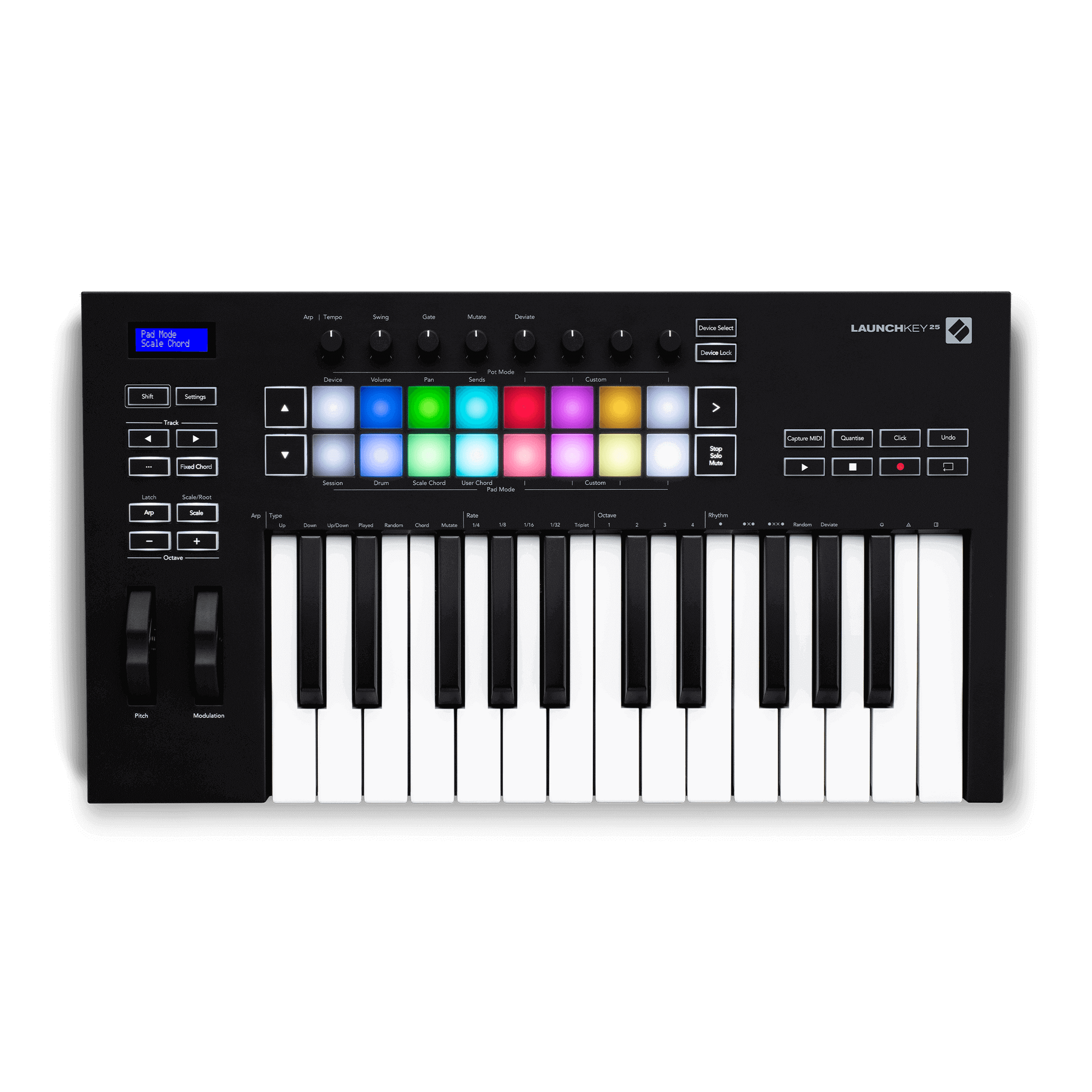
The first distinction to settle is the word “25.” This model has 25 full-size velocity-sensitive synth-action keys, not the narrower mini-key bed found on Launchkey Mini MK3. That can make the notes themselves feel more familiar to a player with conventional keyboard technique, but 25 physical notes still cover only a little over two octaves. Octave controls move the transmitted range; they do not put more keys under the hands at once. For bass lines, short motifs, one-handed parts or entering notes in layers, that may be adequate. For broad chords and a bass part played simultaneously with a high melody, a 37- or 49-key model avoids more register changes.
The model is 18.23 inches wide according to Novation's guide, a little over five inches wider than the 12.99-inch Mini 25 body. That difference is not merely empty space: the full-size keys are the central alternative to the Mini's smaller playing surface. The chassis still needs room beyond its published width for cable plugs, the DIN lead, hands and a stable support area.
What the control surface does—and does not—add
The MK3 25 has sixteen velocity-sensitive RGB pads, eight knobs, pitch and modulation wheels, transport controls, octave buttons, and a sustain-pedal jack. Novation documents Scale, chord and arpeggiator functions, plus user Custom Modes. Those are ways to shape or direct MIDI messages, not evidence of sounds built into the keyboard. Its product page and guide do not identify an onboard sound engine or audio output, so plan to hear software instruments through a computer or connect an external sound module and separate monitoring equipment.
There is no fader bank on this 25-note version; the family guide reserves its nine faders and buttons for the 49- and 61-key models. The manual calls the pads velocity-sensitive, but the materials checked for this exact model do not establish pressure-sensitive pad aftertouch. That is materially different from the 88-key MK3's pad description. The same caution applies to keyboard-key aftertouch: the reviewed documentation says velocity-sensitive keys, not that pressure after a note attack is sent from the keybed. If either kind of aftertouch is essential, do not infer it from the presence of pads or from another size in the family.
USB Type-B and a separate DIN path
The device's computer connector is USB Type-B; the included cable is 1.5 metres long with USB-A on the host end. It is USB bus-powered in the documented computer arrangement. A newer computer with only USB-C ports will need a compatible cable or adapter, and that changes the host-side connection—not the controller's USB port type. Novation also provides a separate full-size five-pin DIN MIDI Out. In a DAW setup, USB can serve the host connection and power while DIN sends note and control data to external hardware at the same time.
The v6 manual describes standalone DIN operation with the controller powered from a standard USB supply rated 5 V DC and at least 500 mA. That is useful for hardware-focused rigs, but DIN carries MIDI data rather than instrument audio or power. The receiving synthesizer needs its own supply and an audio route to headphones, monitors or a mixer. A 6.35 mm sustain input is documented; the sustain pedal itself is not part of the product specification's box list.
How it fits a DAW workflow
Novation presents the MK3 family around Ableton Live, with other out-of-box or script support listed for Cubase, Logic and Reason and a HUI route for other compatible DAWs. The guide's setup is version-specific and software changes; check the present downloads page for the host, operating system and exact control mapping you rely on. A general HUI connection is not the same thing as dedicated control over every instrument or plug-in. If the purpose is to adjust an external module directly, focus on its MIDI channel, response and audio path rather than expecting the DAW integration to apply to it.
Choosing between the three compact ranges
Against the newer Launchkey 25 MK4, the older MK3 keeps full-size keys and a direct DIN socket but uses USB Type-B rather than USB-C; the current generation also documents pressure-responsive pads. Against the Mini MK3, it offers a full-size keybed and direct DIN but takes more room; Mini MK3 is far narrower, uses mini keys and has a 3.5 mm TRS Type-A output that requires the right cable for DIN equipment. A buyer should compare those differences with an actual desk and hardware chain, not assume the similar model names denote one product.
The 25 MK3 makes most sense when full-size keys are non-negotiable, two-plus octaves are enough for the way parts are recorded, and direct 5-pin MIDI is useful. It is less suited to a USB-C-only requirement, a strict sub-18.23-inch keyboard shelf, or a confirmed pad-pressure requirement. Its body, control assignments, pad limits and software support should all be checked before comparing any current offer. The range guide explains what key-count floors do and do not establish.
Novation's US Launchkey 25 MK3 page · official Launchkey 25 downloads and guide · Launchkey MK3 family page.
Key specifications
Key details at a glance
| Keys | 25 |
|---|---|
| Manufacturer's keybed description | Synth action |
| Width | 18.23 in |
| Pads | 16 |
| Velocity-sensitive pads | Yes |
| 5-pin MIDI Out | Yes |
| Computer connection | USB Type-B |
| USB bus-powered | Yes |
| Assignable pedal input | Yes |
| Depth | 10.16 in |
Use the exact model’s instructions for operating limits, supplied equipment and version differences.
Sources for this review
Sources for this assessment
Start with your setup, not a headline feature
Use the finder to combine key-count, connection, control and desk-fit requirements. Unverified specifications are never treated as a match.