
Your needs, this model
Does it fit your priorities?
What does Launchkey 37 MK3 add over the 25-key model?
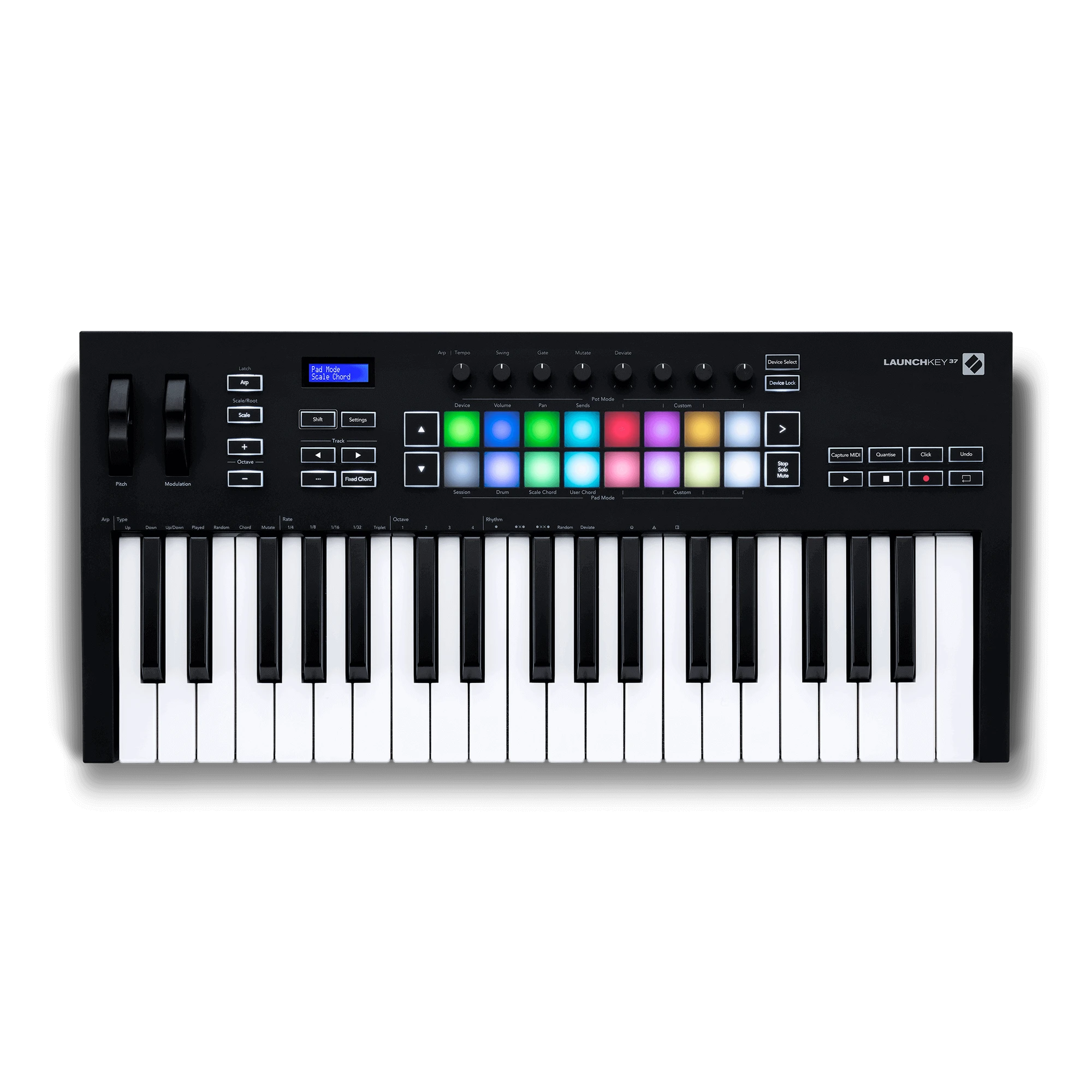
It extends the physical keyboard to 37 full-size synth-action keys and a 21.85-inch body, reducing octave shifts compared with the 25-key model. Both MK3 models retain eight knobs, 16 velocity-sensitive pads, USB Type-B and five-pin DIN; the 37 is not a 49-key fader model.
Explore this need in the finder →Can Launchkey 37 MK3 send notes to an external DIN instrument without a DAW?
Yes, the version-6 manual documents standalone use through its five-pin MIDI Out. It still needs a separate 5 V USB supply rated at least 500 mA, while the receiving instrument needs its own power and audio chain.
Explore this need in the finder →Are Launchkey 37 MK3 pads pressure-sensitive?
The exact guide and product description confirm sixteen velocity-sensitive pads; they do not establish pressure-sensitive pad output for this configuration. Leave that need open unless you can verify a specific unit and documentation.
Explore this need in the finder →Launchkey 37 MK3 is an earlier full-size three-octave controller, not the 37-mini-key Launchkey Mini MK4 and not the current standard Launchkey 37 MK4. The exact US MK3 SKU/MPN is NOVLKE37MK3. The analysis below is based on Novation's own page and MK3 guide, not a hands-on test.
A useful middle range, with full-size synth action
At 37 velocity-sensitive full-size synth-action keys, this model offers twelve more physical notes than the 25-key MK3 without growing to the 49-key surface. Novation publishes a width of 21.85 inches. That three-octave span is often a practical step up when an octave-shift button interrupts a repeated phrase or a left-hand note must stay near a right-hand part. It is not a miniature 49: some wide voicings and simultaneous bass-plus-lead parts still exceed the keys physically present. The octave buttons can transpose the range, but not extend simultaneous reach.
Do not confuse it with the 37-key Launchkey Mini MK4. The latter is narrower and uses mini keys plus a TRS MIDI output; this MK3 has full-size keys and a five-pin DIN socket. Compare the playing surface, the target instrument's connector, and the workspace together rather than selecting only by key count.
Controls shared with the smaller board
The 37 MK3 keeps the 25 model's eight knobs, sixteen velocity-sensitive pads, pitch/modulation wheels, transport, arpeggiator and chord/scale functions. It does not have the nine faders and fader buttons listed for the 49- and 61-key MK3s. That means the extra octave changes note range, not the type of mixer surface available. If hands-on fader travel is a core requirement, compare the wider 49 and 61 assessments; if not, the 37 keeps the dedicated keyboard controls in a more modest body.
Novation's wording for this model's pads is velocity-sensitive. The sources reviewed here do not document pressure-sensitive pad aftertouch for the 37. Its keys are described as velocity-sensitive synth action, with no keyboard-key aftertouch established in the materials checked. Those are important unknowns for an expressive-control brief: do not treat the fact that the 88-key family member has pressure-responsive pads as proof that the 37 does too. No sound engine or audio output is specified. Its pads and keys send control data, so a software instrument or external sound source and separate listening path remain necessary.
USB to a computer, DIN to external hardware
The documented computer connection is USB Type-B, with a 1.5-metre USB-A-to-B cable in the box and USB bus power from the host. A USB-C computer may need a different lead or adapter. The controller also has a distinct 5-pin DIN MIDI Out, so the computer link and a hardware MIDI connection can coexist. The DIN output sends MIDI data only; it does not provide audio or power to a receiving synthesizer.
The version-6 manual gives a standalone route as well: power the controller from a standard USB supply rated at least 5 V DC and 500 mA, then connect the DIN output to the target gear. That avoids a computer, not the need to power the sound source or monitor its audio. The sustain input is a 6.35 mm jack. Check the pedal's intended function, cable exits and desk space before treating the 21.85-inch body width as the whole footprint.
DAW support is a workflow, not a compatibility guarantee
Novation's family documentation provides the MK3 integration path for Ableton Live and lists integrations or scripts for Cubase, Logic and Reason; other compatible DAWs may use Mackie HUI. The setup instructions in an older guide reflect specific historical software versions, so visit the exact model's current downloads page before relying on a particular host, operating system or script. HUI exposes common control actions but does not automatically mean that every plug-in parameter or workflow is mapped as desired. If the keyboard will be used mainly with hardware, verify the sound module responds on the intended MIDI channel and plan the module's audio output separately.
Where the 37 sits among the MK3 sizes
The 25 is narrower at 18.23 inches and has the same documented pad/knob family, so it is the smaller option if full-size keys matter more than range. The 49 expands to 49 notes and adds the nine-fader bank at 31.06 inches; the 61 keeps that control surface while reaching 61 keys at 37.48 inches. All three use USB Type-B and direct DIN in the reviewed MK3 specification. The 88 is another distinct change: a semi-weighted 88-note bed with a pressure-responsive pad description, and a 50-inch body. Do not assume the most notes are useful if the shelf is short or the supported surface is limited.
This earlier 37 is a reasonable shortlist candidate when three octaves of full-size keys and simple computer-plus-hardware MIDI routing match the brief. It is not the right answer to a verified USB-C requirement or pressure-sensitive-pad requirement, and its 21.85-inch measurement excludes clearance for cable bends, hands and the sustain pedal. Check the exact MK3 suffix, host documentation, and receiving hardware before selecting a used or remaining-stock unit. The MIDI connection guide explains why a five-pin output is not an audio connection.
Novation US Launchkey 37 MK3 page · official 37 MK3 downloads and guide · Launchkey MK3 family page.
Key specifications
Key details at a glance
| Keys | 37 |
|---|---|
| Manufacturer's keybed description | Synth action |
| Width | 21.85 in |
| Pads | 16 |
| Velocity-sensitive pads | Yes |
| 5-pin MIDI Out | Yes |
| Computer connection | USB Type-B |
| USB bus-powered | Yes |
| Assignable pedal input | Yes |
| Depth | 10.16 in |
Use the exact model’s instructions for operating limits, supplied equipment and version differences.
Sources for this review
Sources for this assessment
Start with your setup, not a headline feature
Use the finder to combine key-count, connection, control and desk-fit requirements. Unverified specifications are never treated as a match.