
Your needs, this model
Does it fit your priorities?
Can the Launchkey 49 MK4 cover a 49-key USB-C-to-computer setup with direct DIN and pressure-sensitive pads under 28.75 inches?
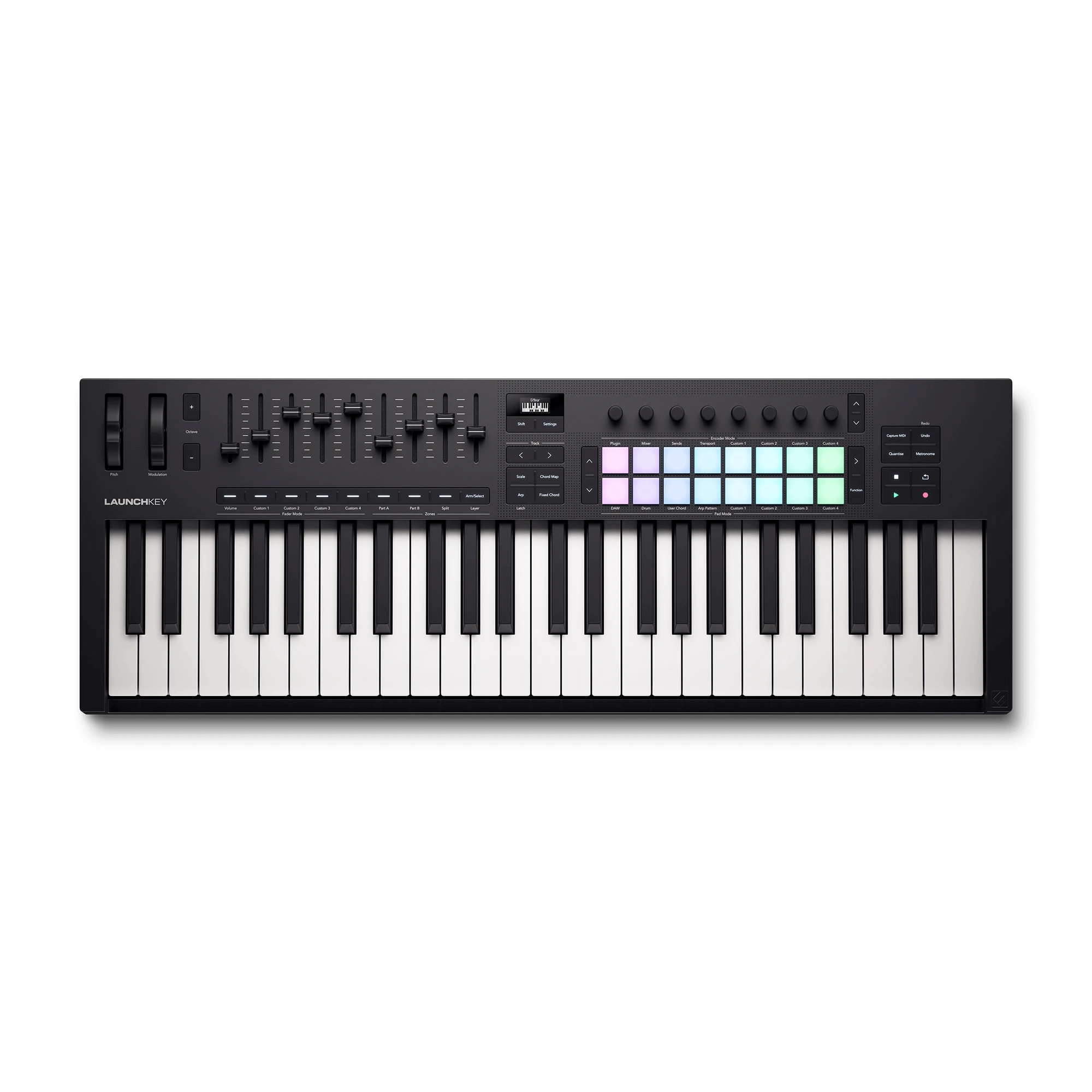
The exact dark US model page and English User Guide v3 identify 49 semi-weighted waterfall-style keys, a USB-C socket, computer-supplied USB bus power, sixteen velocity-sensitive pads with polyphonic aftertouch, and a separate five-pin DIN MIDI Out. The guide gives a 730 mm / 28.74-inch body width, so it passes a 28.75-inch bare-body cap by only 0.01 inch. That margin does not include plugs, cable bends, hands or neighboring equipment. The manual lists a USB-C-to-A lead, not a sustain pedal or a separate power supply; MIDI Out carries control data rather than instrument audio.
Explore this need in the finder →Does the Launchkey 49 MK4's pad aftertouch prove its keys have aftertouch?
No. Novation's product page and version-3 manual explicitly describe polyphonic aftertouch for the sixteen velocity-sensitive pads, while identifying the keyboard separately as a semi-weighted 49-note bed. The reviewed sources do not specify keyboard-key aftertouch, so do not treat pad pressure as evidence of key aftertouch.
Explore this need in the finder →How does the standard dark Launchkey 49 MK4 differ from the White Launchkey 49 listed alongside it?
Novation assigns separate US product pages and SKUs/MPNs to the dark NOVLKE49MK4 and White NOVLKE49MK4WHT versions. The exact White page repeats the 49-key semi-weighted layout, eight encoders, nine faders, sixteen pads, USB-C, five-pin MIDI Out, dimensions and supplied USB-C-to-A lead; no different control, connection, key range or operating plan is documented. The White finish is therefore recorded as a covered finish variant of the reviewed dark configuration, with its own exact image evidence rather than a second hardware review.
Explore this need in the finder →The Launchkey 49 MK4 is Novation's fuller-range computer-oriented controller in its current 49-key group: a semi-weighted waterfall-style keybed, a row of encoders, a bank of pressure-responsive pads, nine faders and a 128-by-64 monochrome OLED. Its appeal is not simply that it has more notes than the 25- and 37-key Launchkeys. It combines a wider playing range with DAW-facing controls and a five-pin DIN output, while still relying on a USB-connected computer for its documented bus-power setup. This is a source-based assessment of the exact dark US configuration, not a hands-on review or a claim about how the keys feel in a room.
Range and keybed are the main distinction
Novation identifies 49 semi-weighted keys with a waterfall profile. That documented mechanism separates this model from the synth-action Launchkey 25 and 37, and from the mini-key Launchkey Mini 37; it is a category difference, not a promise that one action is better for every player's technique. A 49-note span gives more room for divided parts and two-handed ideas than the shorter boards, but it is still short of the range of 61- and 88-key controllers. If you routinely need a low bass part and a distant upper register without changing octaves or splitting a keyboard, consider whether a larger model better fits that work before treating 49 as a default.
Novation's current range comparison also lists zones on the 49 and 61-key versions, alongside the shared Scale and Chord modes. The page and version-3 guide document a 128-by-64 OLED, pitch and modulation wheels, and eight endless encoders. These are useful distinctions when translating a session layout into hardware controls: count the controls you will actually map, rather than assuming a larger keybed alone makes a better DAW surface.
A substantial control surface, with a setup cost
The 49 MK4 adds nine faders and buttons to the eight encoders and sixteen velocity-sensitive pads. The manual describes the pads as supporting polyphonic aftertouch; that is pad behavior, not evidence that pressure on the keyboard keys is sensed. The display can show parameter and chord information, while the documented controls cover navigation, transport and software instruments. Novation lists integration for several DAWs and offers configuration software, but “works with” does not mean every control has identical behavior in every version. Verify the script, host operating system and DAW release that matter to your project.
This many controls can be productive when mixer levels, plug-in parameters and performance gestures have named jobs. It can be unnecessary bulk if the keyboard mostly serves as a note-entry device, or if your desk does not leave space to reach the faders comfortably. Build a short map of the moves you expect to make—transport, track selection, mixer level, instrument parameters, pads—and compare that map with the published control layout. The source material documents what is present; it cannot tell whether a particular user's workflow will make every control worthwhile.
Trace USB power and MIDI separately
The manual says the Launchkey is USB bus-powered when connected to a computer, and its box list names a 1.5-metre USB-C-to-A cable. The hardware also has a separate five-pin MIDI Out, plus a 6.35 mm sustain input. In one documented arrangement, the USB connection sends and receives computer MIDI while supplying the controller's power, and the DIN port sends MIDI to external equipment. That does not make the keyboard a sound module: the reviewed product page and manual do not specify an onboard sound engine or audio output. A receiving synth still needs its own power and audio-monitoring route. A pedal and its cable are not listed in the box, so check what is actually included in the package you are considering.
If your host has USB-C rather than USB-A, check whether the included lead works for your port arrangement or whether a suitable cable or adapter is needed. Also plan for the DIN plug and cable bend behind the chassis. A direct DIN connection avoids the Mini models' 3.5 mm TRS Type-A output and the associated breakout-cable question, but it is MIDI data only—not a substitute for audio cabling.
Desk width is a real filter, not a full fit test
Novation publishes the body as 730 mm wide, which its version-3 guide expresses as 28.74 inches, with a depth of about 10.37 inches. The numeric finder takes quarter-inch steps: a strict 28.5-inch cap excludes the keyboard, while 28.75 inches technically admits the 28.74-inch body. That one-hundredth-inch difference is nominal chassis math, not practical clearance. Leave room for the USB and DIN leads, the sustain jack, hands, adjacent gear and the support surface. Measure the space where the instrument will actually sit instead of treating the chassis number as a desk-layout guarantee.
How it compares inside the range
The standard Launchkey 37 MK4 is narrower at a published 21.93 inches and uses 37 full-size synth-action keys without the 49's nine-fader bank. The Launchkey Mini 37 is narrower still but uses mini keys, touch strips and a TRS Type-A MIDI output. Those are not equivalent alternatives simply because both name a 37-key count. The 49's semi-weighted bed, larger panel and direct DIN jack are the specific reasons to choose it when the desk and host setup support them. Novation also lists a White 49 MK4 under a separate US SKU; its page repeats the same key range, controls, ports, dimensions and USB cable. This review covers the standard dark product, while the White finish remains an exact, separately recorded variant rather than a second set of hardware specifications.
For an exact fit, compare the full key-count guide with the workspace measurement guide, then trace the computer, external instrument and audio route in our MIDI connections guide. The practical choice is a 49-key semi-weighted controller for a computer-led workflow that can use its faders and pads, has room for the larger chassis, and benefits from DIN output. If one of those conditions is missing, the smaller standard Launchkeys or a longer keyboard may be a better comparison point.
Key specifications
Key details at a glance
| Keys | 49 |
|---|---|
| Manufacturer's keybed description | Semi-weighted waterfall keys |
| Width | 28.74 in |
| Pads | 16 |
| Velocity-sensitive pads | Yes |
| Pressure-sensitive pads | Yes |
| 5-pin MIDI Out | Yes |
| Computer connection | USB-C |
| USB bus-powered | Yes |
| Assignable pedal input | Yes |
| Depth | 10.37 in |
Use the exact model’s instructions for operating limits, supplied equipment and version differences.
Sources for this review
Sources for this assessment
- Novation US Launchkey 49 MK4 exact product page and specifications
- Novation US Launchkey 49 White MK4 exact product page and specifications
- Novation US MIDI Keyboards category and two-page product listing
- Novation Launchkey MK4 49 software and documentation index
- Novation Launchkey 49 English User Guide, version 3
- Novation US Launchkey family and model-comparison page
Start with your setup, not a headline feature
Use the finder to combine key-count, connection, control and desk-fit requirements. Unverified specifications are never treated as a match.