
Your needs, this model
Does it fit your priorities?
Does Launchkey 61 MK3 keep the 49-key control layout while adding an octave?
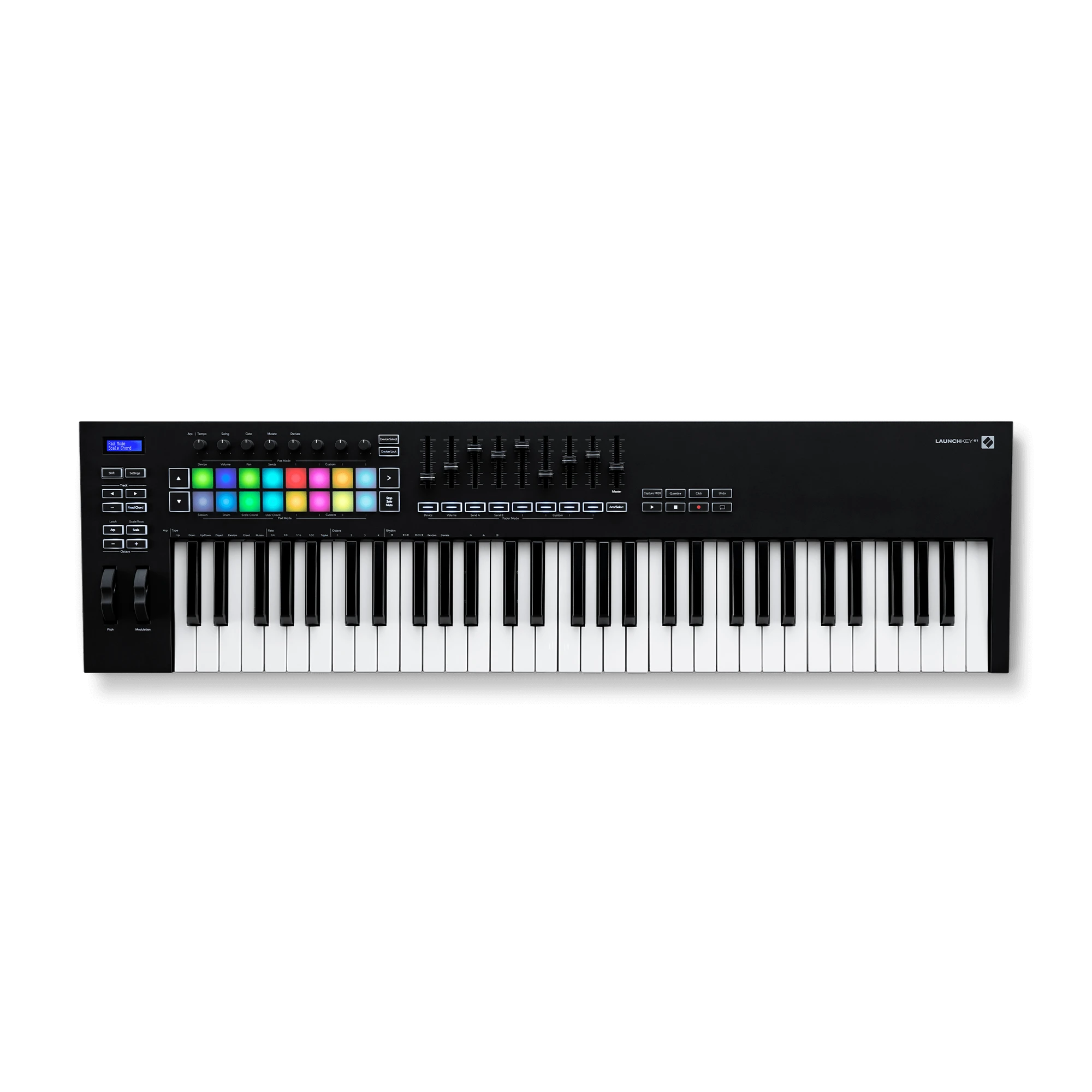
The manual lists nine faders and buttons for both the 49- and 61-key boards, while the 61 adds twelve full-size keys. The body widens from 31.06 to 37.48 inches and rises from a listed 6.84 to 7.72 lb, so measure the stand and desk before choosing the extra range.
Explore this need in the finder →Can the 61-key MK3 send MIDI to hardware independently of a computer?
Novation's version-6 manual documents the five-pin MIDI Out operating without a computer when the controller receives a separate standard 5 V, at least 500 mA USB supply. The receiving synthesizer still needs its own power and an audio connection to speakers or headphones.
Explore this need in the finder →Does the 61-key MK3 require USB-C or pressure-sensitive pads?
The 61-key MK3 is documented with USB Type-B and a Type-A-to-B package cable, not USB-C. Its sixteen pads are documented as velocity-sensitive; pressure response is not verified for this model in the reviewed sources.
Explore this need in the finder →Launchkey 61 MK3 is an earlier five-octave controller with full-size synth-action keys, a nine-fader control bank and separate DIN MIDI Out. The exact US model identifier is NOVLKE61MK3. This review is based on Novation's model page and version-6 manual, not hands-on testing.
Physical range and desk footprint
Sixty-one full-size velocity-sensitive keys cover five octaves. That can reduce the need to shift the range while playing two-handed parts or moving across a broad patch, compared with 25, 37 or 49 physical keys. It is still not an 88-note layout, and an octave control only moves the span transmitted; it does not add physical notes. The keys use synth action, not a documented weighted piano mechanism. Velocity describes how the key strike is represented; the sources inspected for this model do not establish keyboard-key aftertouch.
Novation lists a 952 mm (37.48-inch) body width, 258 mm depth and 77 mm height. Its listed mass is 3.5 kg (7.72 lb). The 49-key MK3 is 31.06 inches and 6.84 pounds, so moving to 61 adds an octave at the cost of 6.42 inches and 0.88 pound according to those guide values. Those measurements do not account for the USB, DIN and sustain cable exits, hands or nearby equipment. Confirm a stand's usable top surface and support rating rather than relying on its outside dimension.
A mixer-oriented control layout
The control layout pairs pitch and modulation wheels with sixteen velocity-sensitive pads, eight knobs, nine faders and buttons, and transport and navigation controls. The pads can trigger DAW functions or mapped note events, and Novation provides arpeggiator, scale and chord-related functions. A DAW can use the faders and knobs for the tasks its script or MIDI mapping assigns. These are functional possibilities described in the documentation, not claims that a particular plug-in's controls are mapped by default.
It matters that the MK3 61's reviewed sources document velocity-sensitive pads but do not establish pressure-sensitive pad response. Nor do they state keyboard-key aftertouch. The 88-key MK3 is the one Launchkey MK3 configuration that has a specific pressure-responsive pad description in its individual sources. If pressure is an essential gesture, compare the exact 88 or another individually documented model instead of inferring it from the shared family layout. The keyboard itself is a MIDI controller; Novation does not list a built-in sound engine or audio output in the inspected product materials.
Computer control plus external hardware
The 61 connects to a computer over USB Type-B, is USB bus-powered in that arrangement and ships with a 1.5-metre USB-A-to-B cable according to Novation's manual. Its direct five-pin MIDI Out is separate from the computer connector, allowing a computer/DAW path and external MIDI hardware to be used together. A USB-C-only host needs a suitable cable or adapter, but the controller's connector should not be called USB-C. DIN sends notes and other MIDI messages, not sound or power.
The manual also documents using the DIN output without a computer by providing a standard USB power supply rated 5 V DC and at least 500 mA. That allows a compact hardware-control setup, but does not make the controller battery-powered or provide audio from a connected synth. Budget separate power and monitoring for the receiving instrument. The manual lists a 6.35 mm sustain input; a pedal may change how the layout fits and should be included in the installation check.
DAW requirements and current support
Novation's MK3 family documentation centers its integration around Ableton Live and describes support for other DAWs through dedicated scripts or Mackie HUI. Compatibility labels alone do not confirm a current operating system, the exact host version or the control surface behavior expected by a particular session. The version-6 guide and current downloads pages should be checked before purchase, especially for software that has changed since the controller's launch. In HUI mode, generic mixer and transport functions may be available while some product-specific mappings remain different.
Comparison and best-use judgment
The standard Launchkey 61 MK4 occupies a similar five-octave role but documents USB-C and pressure-responsive pads and is part of a newer hardware revision. The current FLkey 61 MK2 also combines USB-C, DIN and pads described with aftertouch, but emphasizes FL Studio-specific integration rather than the Launchkey's broader Ableton-centered operation. The 61 MK3 can remain relevant when its own layout and exact offer matter, but it does not satisfy a verified USB-C or pressure-pad brief in this review. The smaller 49 MK3 saves meaningful width and mass while retaining the nine-fader surface; the 88 MK3 provides full range and the documented pressure-sensitive pads but is 50 inches wide.
Use this earlier 61 only when five-octave full-size keys, nine faders and direct DIN output solve the actual setup, and when the 37.48-inch body can be supported with extra clearance. A strict 37.25-inch cap excludes it, while 37.5 inches lets the bare body through with just 0.02 inch nominal margin. That numerical filter cannot answer connector clearance, posture, stand support or DAW compatibility. Verify exact generation, manual and return terms before making a purchase decision.
Novation US Launchkey 61 MK3 page · official 61 MK3 downloads and guide · Launchkey MK3 family page.
Key specifications
Key details at a glance
| Keys | 61 |
|---|---|
| Manufacturer's keybed description | Synth action |
| Width | 37.48 in |
| Pads | 16 |
| Velocity-sensitive pads | Yes |
| 5-pin MIDI Out | Yes |
| Computer connection | USB Type-B |
| USB bus-powered | Yes |
| Assignable pedal input | Yes |
| Depth | 10.16 in |
Use the exact model’s instructions for operating limits, supplied equipment and version differences.
Sources for this review
Sources for this assessment
Start with your setup, not a headline feature
Use the finder to combine key-count, connection, control and desk-fit requirements. Unverified specifications are never treated as a match.