
Your needs, this model
Does it fit your priorities?
Can the Launchkey 61 MK4 meet a 61-key USB-C and direct-DIN requirement on a 35.5-inch surface?
Novation's exact US page identifies the standard dark Launchkey 61 MK4 as SKU/MPN NOVLKE61MK4 and documents 61 semi-weighted waterfall-style keys, sixteen velocity-sensitive pads with polyphonic aftertouch, eight encoders, nine faders, USB-C bus power and a five-pin MIDI Out. The manufacturer guide gives a published body width of 895 mm, rounded to 35.24 inches, so it clears a 35.5-inch bare-body cap. That leaves only about a quarter inch before plugs, cable bends, hands or nearby gear are considered. The listed USB-C-to-A cable is not a sustain pedal or separate power supply, and DIN carries MIDI data rather than audio.
Explore this need in the finder →What does moving from Launchkey 61 to Launchkey 88 buy, and cost in space?
Both documented models pair semi-weighted keys with eight encoders, nine faders, sixteen velocity-sensitive pads with polyphonic aftertouch, USB-C bus power, direct five-pin MIDI Out and a sustain jack. Launchkey 61 is 61 notes and 895 mm (35.24 inches) wide; Launchkey 88 expands the range to 88 notes but its guide lists 1274 mm (50.16 inches) of body width and 8.04 kg. The control plan is familiar, but the extra range brings a much larger and heavier chassis. Compare the exact keybed wording and measure the full stand or desk route, not just the board's bare width.
Explore this need in the finder →Does aftertouch on the Launchkey 61 pads establish aftertouch on its keys?
No. Novation separately describes sixteen velocity-sensitive FSR pads with polyphonic aftertouch and a 61-key semi-weighted waterfall keyboard. The reviewed keybed and specification passages do not state keyboard-key aftertouch. Pad pressure is a documented pad capability, not evidence that the keys transmit aftertouch; confirm the exact key action and supported MIDI behavior if that is essential.
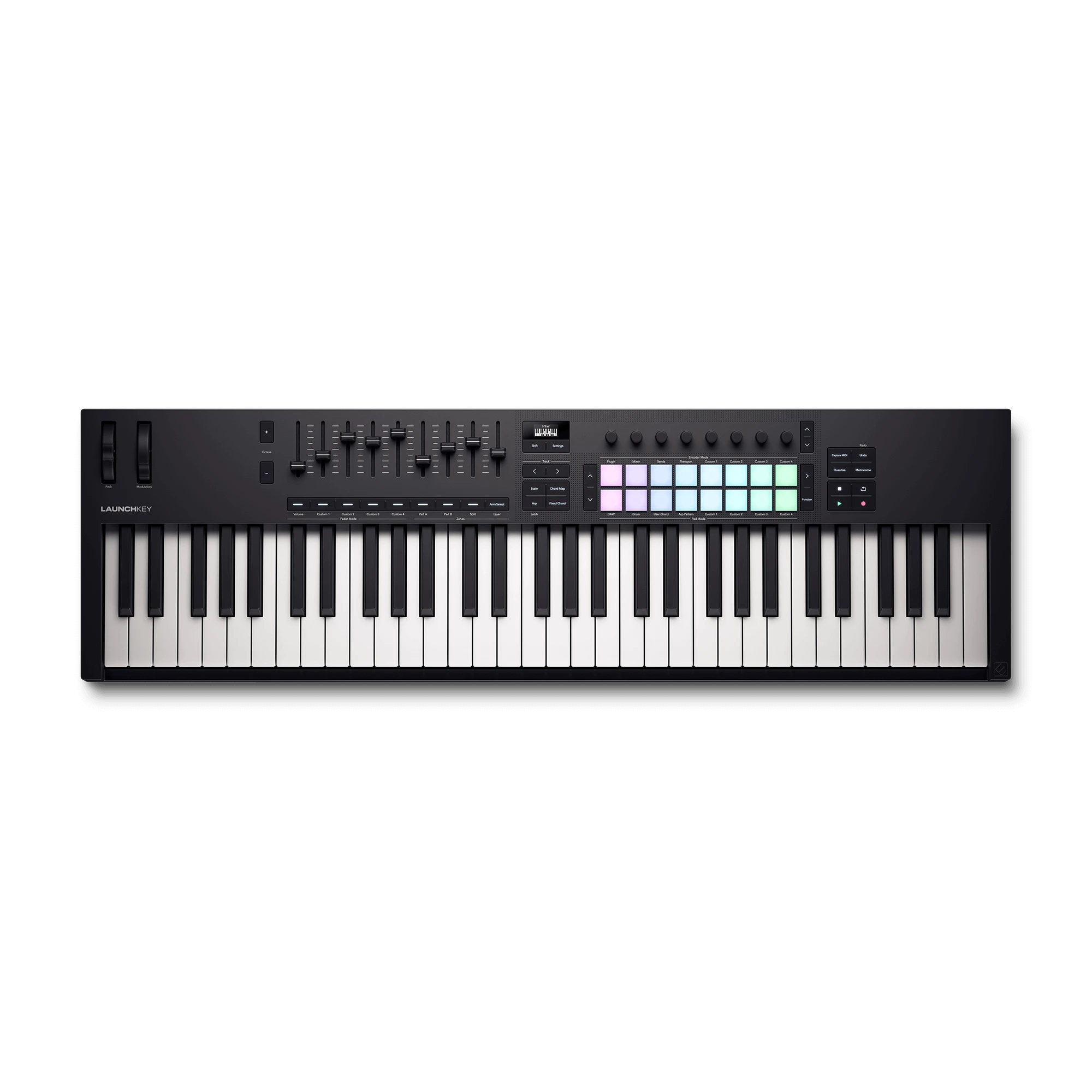
Explore this need in the finder →The Launchkey 61 MK4 is Novation's five-octave middle board for people who want a semi-weighted keybed and a full DAW-control surface without moving all the way to an 88-note chassis. This is a source-based assessment of the current US standard dark model, SKU/MPN NOVLKE61MK4; I have not tested or used the keyboard.
Why 61 keys changes the playing brief
Sixty-one keys give a player five octaves on the physical keybed. That extra range over a 49-key controller can reduce octave switching during a two-handed phrase, a part with a sustained lower note, or a passage that moves between registers. It is still a controller, not a self-contained piano: the reviewed Novation pages describe a MIDI/DAW workflow and included software, but do not document an onboard sound engine, speaker or audio output. A software instrument or external sound source and a separate monitoring route are part of the setup.
Novation describes this version as semi-weighted, piano-style waterfall keys and presents 49- and 61-key MK4 models as the semi-weighted end of the family; the smaller standard 25/37 models use synth-action keys, and the Mini versions use mini keys. That distinction is more useful than treating key count as a proxy for touch. “Semi-weighted” is the maker's product description, not a measured force curve or a guarantee that a particular player will like the feel. The published 61-key specifications do not confirm aftertouch on the keys, so the pads' aftertouch should not be mistaken for a keybed feature.
A broad set of hands-on controls
The feature mix is the same kind of surface the Launchkey 49 buyer may be looking for: eight endless encoders, nine faders with buttons, sixteen velocity-sensitive pads, pitch and modulation wheels, a 128-by-64 monochrome OLED, and navigation, transport and workflow buttons. Novation says the pads use FSR sensing and support polyphonic aftertouch. For a DAW session, the extra faders and encoders are more significant than the key-count jump alone; they create direct controls for mixer levels, plug-ins, effects and custom MIDI mappings instead of leaving every adjustment to a mouse.
Built-in Scale, Chord and arpeggiator features can shape note data before it reaches a software instrument. The product page describes a 30-scale mode, Chord Map/Fixed Chord/User Chord tools, a generative arpeggiator with an eight-step editor, and split/layer zones. They are control and composition features, not evidence of independent keyboard audio. A buyer choosing a controller for a particular DAW should still check that program's supported version and the current Novation integration material before relying on a particular script or shortcut.
Two separate data paths, plus a pedal jack
Novation lists a USB-C port for the computer connection and USB bus power, as well as a full-size five-pin MIDI Out for external MIDI gear. The hardware guide describes USB as both data and power, and DIN Out as sending MIDI from the keyboard to an external device. Those are different routes: the DIN connection sends control messages, not audio or USB power. If the target synth or sound module is the audio source, it needs its own power and an audio path to headphones, an interface, mixer or amplifier. The board also has a 6.35 mm sustain input; the guide says that input is for a sustain pedal and specifically rules out expression, soft and sostenuto pedals.
The product listing names a USB-C-to-A cable in the box, not a separate power adapter or sustain pedal. Check the host's port and the seller's package rather than assuming that a USB-C-shaped port means a USB-C-to-C lead is supplied. The listed integrations include Ableton Live 11 or later, Logic Pro X and 11, Cubase 11 and 12, Reason Studios, FL Studio and Ardour, with HUI support for other DAWs. That is a useful shortlist, not a guarantee that every feature behaves identically across operating systems and versions.
The size tradeoff against 49 and 88 keys
The user-guide specification gives the 61-key body as 895 mm wide (35.24 inches), 264 mm deep (10.39 inches), 93 mm high (3.66 inches) and 4.78 kg (10.54 pounds). The current US page separately lists 263.5 mm depth; the guide rounds depth to 264 mm. Neither figure is a clearance measurement. A 35.5-inch space leaves little margin after the bare chassis, and the connectors, plug length, cable bend, stand lip and hand position still need room.
Against the 49-key Launchkey, the 61 adds an octave and is roughly 6.5 inches wider while retaining the same core pads, faders, encoders and direct DIN route. The 88-key model extends to the full 88-note range, but its documented 50.16-inch width and 17.73-pound weight make it a different desk and support decision. If 61 notes are enough for the actual parts, the 88's extra reach may not justify that additional footprint; if a score or two-handed performance routinely needs the full span, the shorter models ask for more octave shifts.
Who should shortlist it?
This model is a strong specification match for a player who has space for a 35.24-inch controller and specifically wants 61 semi-weighted keys, substantial DAW controls, pressure-sensitive pads, USB-C computer operation and direct five-pin MIDI Out in one documented arrangement. It is less persuasive for a tightly packed desk, a player who wants a verified keyboard-key aftertouch specification, or a standalone instrument with audio outputs. The listing's bundle of software may be useful, but installation, account, operating-system and license requirements should be verified before purchase.
Before choosing a seller offer, confirm the exact dark or White MK4 suffix, the supplied cable, your preferred pedal type, the receiving instrument's MIDI channel and the complete physical space available. The White Launchkey 61 has its own US SKU/MPN and image, but the reviewed product pages show the same functional arrangement; the finish is not a second keybed or control configuration. Use the exact review and source pages as a specification check, then decide from the playing range and fit you actually need.
Key specifications
Key details at a glance
| Keys | 61 |
|---|---|
| Manufacturer's keybed description | Semi-weighted waterfall keys |
| Width | 35.24 in |
| Pads | 16 |
| Velocity-sensitive pads | Yes |
| Pressure-sensitive pads | Yes |
| 5-pin MIDI Out | Yes |
| Computer connection | USB-C |
| USB bus-powered | Yes |
| Assignable pedal input | Yes |
| Depth | 10.39 in |
Use the exact model’s instructions for operating limits, supplied equipment and version differences.
Sources for this review
Sources for this assessment
- Novation US Launchkey 61 MK4 exact product page and specifications
- Novation US Launchkey 61 White MK4 exact product page and specifications
- Novation US MIDI Keyboards category and two-page product listing
- Novation Launchkey MK4 61 software and documentation index
- Novation Launchkey 61 user-guide index
- Novation Launchkey 61 hardware overview and connector guide
- Novation Launchkey 61 specifications and dimensions
- Novation Launchkey MK4 family comparison
Start with your setup, not a headline feature
Use the finder to combine key-count, connection, control and desk-fit requirements. Unverified specifications are never treated as a match.