
Your needs, this model
Does it fit your priorities?
Can Launchkey 88 MK4 fit a full-range 88-key, USB-C and direct-DIN brief under 50.25 inches?
Novation's exact US page identifies SKU/MPN NOVLKE88MK4 and documents 88 semi-weighted piano-style keys, sixteen velocity-sensitive pads with polyphonic aftertouch, eight encoders, nine faders, USB-C bus power and a five-pin MIDI Out. Its user-guide specification lists a 1274 mm (50.16-inch) body, so it crosses a 50.25-inch bare-body limit by less than a tenth of an inch. That does not allow for cables, plugs, hands, a stand lip or neighboring equipment. The board does not document its own audio output in the reviewed sources, and the MIDI DIN connection carries control messages rather than sound.
Explore this need in the finder →What is the practical range-and-footprint change between the 61- and 88-key MK4 boards?
The Launchkey 61 is 895 mm (35.24 inches) wide and weighs 4.78 kg (10.54 pounds); the Launchkey 88 grows to 1274 mm (50.16 inches) and 8.04 kg (17.73 pounds). Both are semi-weighted controller designs with the same published eight encoders, nine faders, sixteen pads, USB-C, five-pin MIDI Out and sustain input, but the 88 provides 27 more keys and a custom-designed keybed. The larger unit requires a genuinely longer support surface and a separate check of its stand's load rating; the published body width is not an installation-clearance figure.
Explore this need in the finder →Does Launchkey 88's pad polyphonic aftertouch document aftertouch on the keybed?
No. Novation explicitly specifies polyphonic aftertouch for the sixteen pads, while the keyboard itself is described as 88 semi-weighted keys on a custom-designed keybed. The reviewed product and guide specifications do not say that the keys send aftertouch. Do not infer a keybed feature from a pad specification; verify the exact documentation if keyboard-key aftertouch is a required control signal.
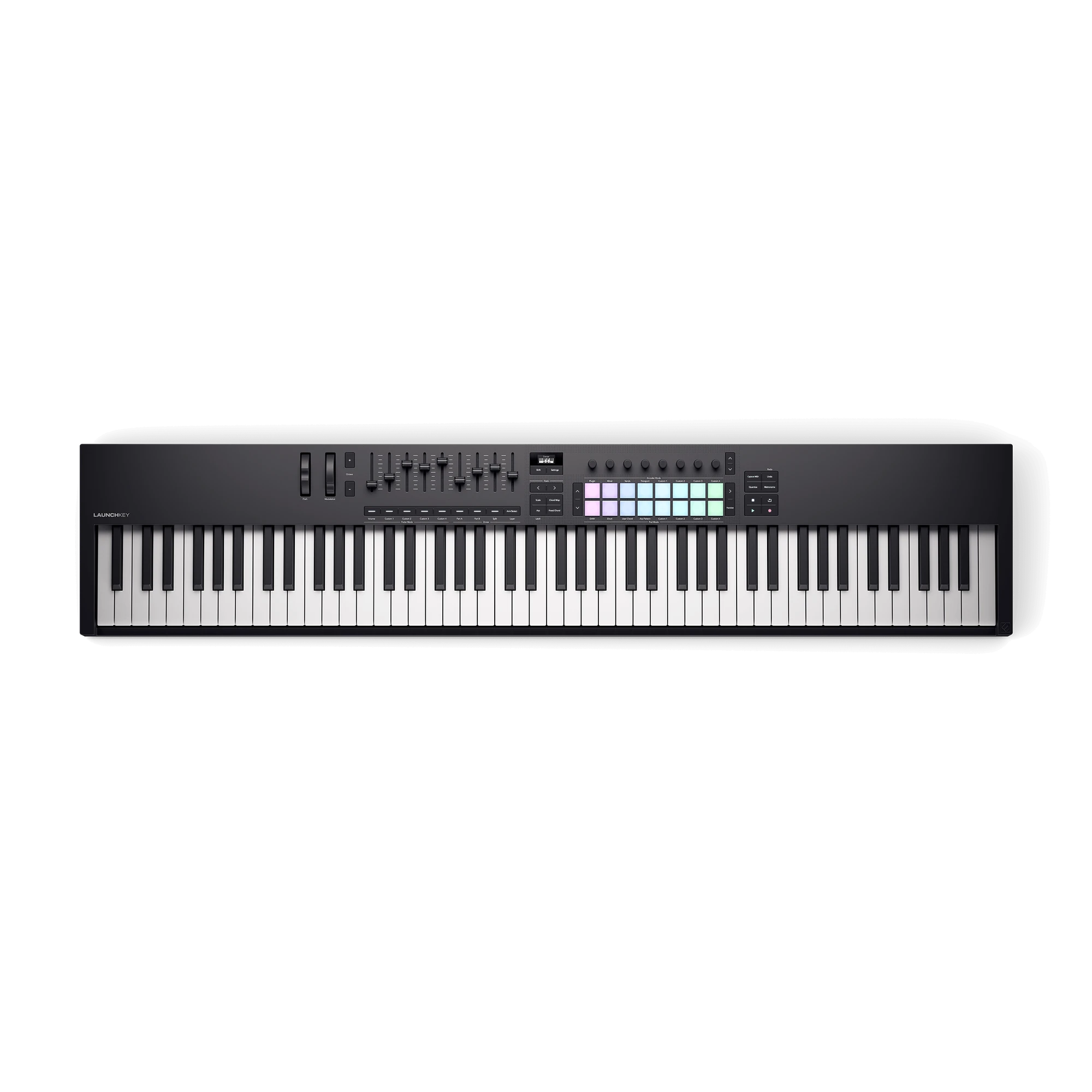
Explore this need in the finder →Launchkey 88 MK4 pairs a long, custom-designed semi-weighted keybed with the same DAW-oriented control layout found on the shorter Launchkey MK4 boards. This review covers the current US standard dark SKU/MPN NOVLKE88MK4 from manufacturer pages and user-guide specifications; it is not a hands-on test or a claim about subjective key feel.
The full range is the main reason to choose it
An 88-key layout puts the conventional full piano note span under the hands, reducing the need to use octave buttons for parts that move widely between low and high registers. Novation calls this a seven-plus-octave, semi-weighted piano-style keyboard with a custom-designed keybed. That makes it a different physical proposition from the 49- and 61-note Launchkeys, both of which are also semi-weighted but occupy much smaller spans. “Custom-designed” and “semi-weighted” remain the manufacturer's descriptions: the spec sheet does not provide a measured action curve or a promise that a pianist will prefer it over an acoustic-style hammer-action controller.
Do not buy the 88 simply because more keys sound like a safer choice. If the music is recorded in separate takes or your routine uses octave shifting, a 49- or 61-key model can leave more working room and be easier to position. If simultaneous bass, chord and upper-line work is a real requirement, the extra physical range can remove a practical limitation. The important question is the part you need to play without moving octaves, not a beginner-versus-professional label.
DAW controls remain central
Despite its length, this is not just a keyboard with a computer socket. The published surface includes sixteen RGB velocity-sensitive pads with polyphonic aftertouch, eight endless encoders, nine faders and buttons, pitch and modulation wheels, a 128-by-64 monochrome OLED, transport controls, track navigation and workflow buttons. The pads are documented as pressure-responsive; the keybed itself is described as semi-weighted, but the reviewed passages do not state that the keys send aftertouch. Pad aftertouch is not keyboard-key aftertouch.
Scale and chord modes, a generative arpeggiator, and split/layer operation broaden how the instrument can send notes to a DAW or external MIDI device. Novation lists thirty scales, Chord Map/Fixed Chord/User Chord modes, and an eight-step editor for the arpeggiator. These functions alter or organize controller data; the product page and guide do not document an onboard sound engine or an audio output. Any included virtual instruments run as software, and an external module needs its own audio and monitoring chain.
USB-C power does not replace the MIDI Out
The exact US listing specifies USB-C, USB bus power, a five-pin MIDI Out and a 6.35 mm sustain-pedal jack. In the documented computer arrangement, USB carries communication to the computer and powers the keyboard; the separate DIN output sends MIDI data to external hardware. MIDI Out is not an audio connector and does not power the receiving instrument. Plan its power and audio path independently. The included package list names a USB-C-to-A cable, not a separate supply or sustain pedal.
The support page and model guide are also useful before committing to a DAW workflow. Novation lists custom integrations for Ableton Live 11 or later, Logic Pro X and 11, Cubase 11 and 12, Reason Studios, FL Studio and Ardour, plus HUI compatibility for other DAWs. Those labels do not guarantee that every command or bundled license is current for each system; check the exact computer, DAW version, software account and any setup steps you need. The physical controls can be assigned in Novation Components, but that flexibility does not turn the board into a self-contained synth.
Measure the whole installation
The manufacturer gives the body as 1274 mm wide (50.16 inches), 264 mm deep (10.39 inches), 93 mm high (3.66 inches) and 8.04 kg (17.73 pounds). It is approximately 14.9 inches wider and 7.2 pounds heavier than the 61-key version in Novation's published specs. That is not a small step up: check the usable stand or desk width, depth, support rating, lip clearance, connector space and the route for cables before buying. A 50.25-inch body cap technically clears the stated chassis by about 0.09 inch, which is not practical room for plugs, cable bends, hands or neighboring gear.
The fixed controllers remain side by side with the keys, so confirm both the keyboard span and the surrounding surface will stay usable in your room. The published dimensions describe the bare instrument, not the space required to connect and play it. If the stand is narrow or has a raised edge, compare the stand's usable top surface—not its advertised exterior width—to the instrument measurements.
Who should shortlist Launchkey 88?
It fits a player who can support a long, nearly 50-inch chassis and needs 88 notes together with faders, encoders, pressure-sensitive pads, USB-C computer operation and direct five-pin MIDI Out. It is less appropriate when portability, limited desk width, independently powered operation or a verified keyboard-key aftertouch capability is essential. The manufacturer provides the dimensions and connector plan, but the spec does not answer every compatibility or ergonomic question.
Compare it with Launchkey 61 if the latter's five-octave span already covers your repertoire: both list the same main controller sections, while the 61 is 35.24 inches wide and about 10.54 pounds. Compare the exact buyer offer and package suffix, inspect support requirements for your DAW, and check the return terms if touch preference is uncertain. Choose the 88 for the documented range it adds—not because a longer keyboard automatically improves every setup.
Key specifications
Key details at a glance
| Keys | 88 |
|---|---|
| Manufacturer's keybed description | Custom semi-weighted keybed |
| Width | 50.16 in |
| Pads | 16 |
| Velocity-sensitive pads | Yes |
| Pressure-sensitive pads | Yes |
| 5-pin MIDI Out | Yes |
| Computer connection | USB-C |
| USB bus-powered | Yes |
| Assignable pedal input | Yes |
| Depth | 10.39 in |
Use the exact model’s instructions for operating limits, supplied equipment and version differences.
Sources for this review
Sources for this assessment
- Novation US Launchkey 88 MK4 exact product page and specifications
- Novation US MIDI Keyboards category and two-page product listing
- Novation Launchkey MK4 88 software and documentation index
- Novation Launchkey 88 MK4 user-guide index
- Novation Launchkey 88 MK4 hardware overview and connector guide
- Novation Launchkey 88 MK4 specifications and dimensions
- Novation Launchkey MK4 family comparison
Start with your setup, not a headline feature
Use the finder to combine key-count, connection, control and desk-fit requirements. Unverified specifications are never treated as a match.