
Your needs, this model
Does it fit your priorities?
Is Launchkey Mini MK3 a full-size 25-key keyboard?
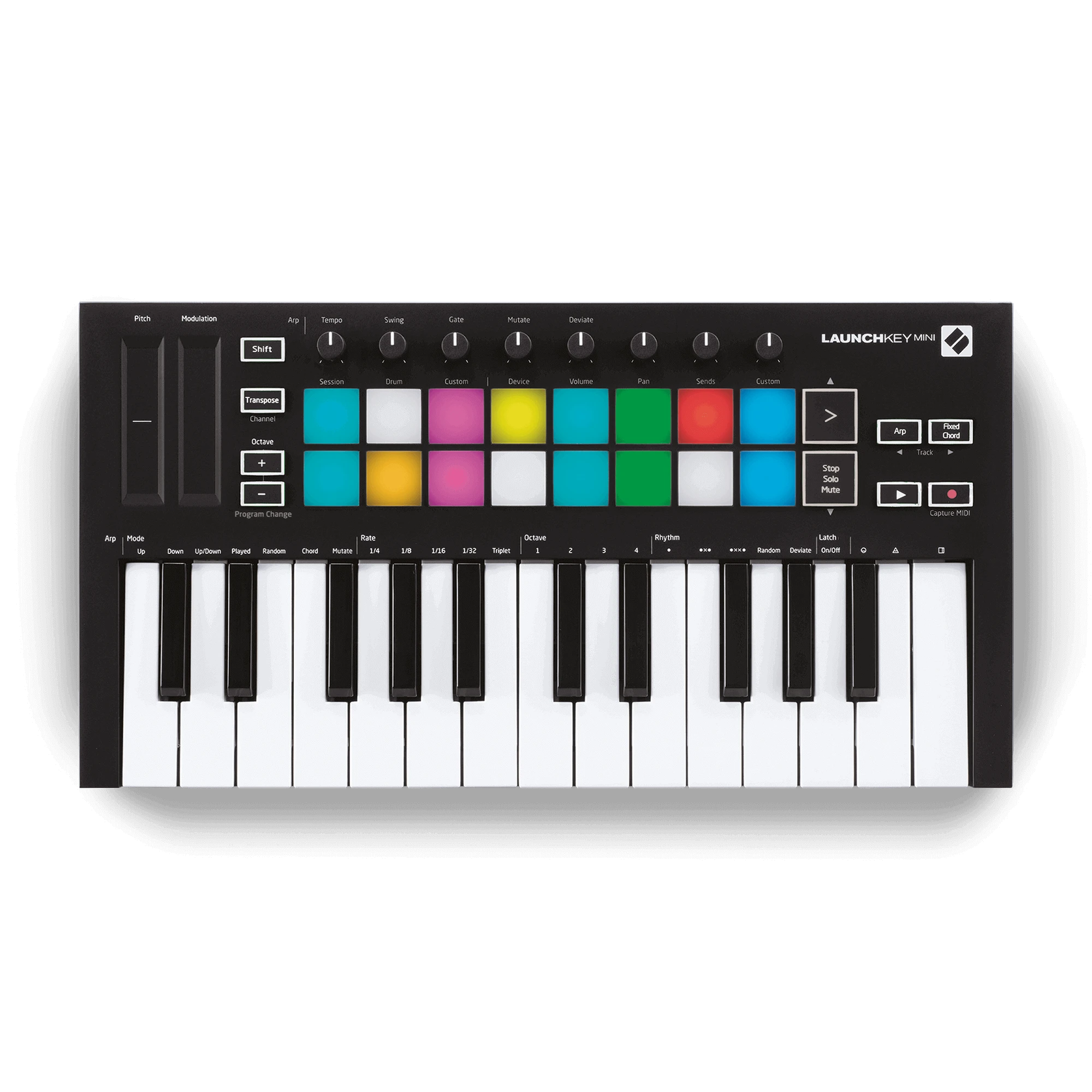
No. Novation documents 25 velocity-sensitive mini keys in a 12.99-inch-wide chassis. It offers touch strips, eight knobs and sixteen velocity pads in much less body space than the standard 18.23-inch full-size Launchkey 25, but the narrower key size is an important playing tradeoff.
Explore this need in the finder →Can the Mini send MIDI to 5-pin DIN gear?
It has a 3.5 mm TRS MIDI Type-A output rather than a built-in five-pin DIN socket. Use a correctly wired Type-A adapter or cable for compatible hardware; the manual notes that the adapter is not included, and Type-A/Type-B wiring is not interchangeable.
Explore this need in the finder →Can Launchkey Mini MK3 run without a computer?
The version-1.1 Mini manual describes standalone operation through its TRS MIDI output when powered by a separate standard USB supply rated at least 5 V DC and 500 mA. The destination instrument needs its own power and sound path; DIN itself is not audio.
Explore this need in the finder →Launchkey Mini MK3 is an earlier compact 25-mini-key controller, exact US SKU/MPN NOVLKMIN3. Despite the familiar “25” count, it is a different playing and hardware-connection choice from the full-size Launchkey 25 MK3. This assessment is based on Novation's product page and version-1.1 guide, not a hands-on evaluation.
Mini keys and a genuinely small chassis
Novation lists 25 velocity-sensitive mini keys and a body 330 mm (12.99 inches) wide, 172 mm (6.77 inches) deep and 40 mm (1.57 inches) high to the top of the controls. The physical key size is the main compromise: a player comfortable with compact keys may value the board's small footprint, while someone relying on full-size spacing should compare the standard Launchkey 25 MK3 at 18.23 inches wide. The octave and transpose controls can extend the notes sent, but there are still only 25 small physical keys available at once. Keybed feel is personal, and the guide's feature list does not provide an objective action or key-width measurement.
The face includes pitch and modulation touch strips, eight knobs, sixteen velocity-sensitive pads, transport controls and octave/transpose buttons. Novation describes arpeggiator, Fixed Chord and user Custom Modes. These functions give a compact surface different ways to send MIDI information, but the manufacturer materials checked do not establish pressure-sensitive pad aftertouch or keyboard-key aftertouch for this exact Mini. Its pages also do not specify onboard sounds or an audio output. Plan a software instrument or external sound module and the audio route required to hear it.
USB Type-B to the host, TRS Type-A to hardware
The user guide's included package lists a 1.5-metre USB Type-A-to-B cable, and the Mini can run from computer USB bus power. A USB-C-only computer will need an appropriate cable or adapter; the controller port should not be called USB-C. Unlike the standard Launchkey 25 MK3, this Mini does not have a built-in five-pin DIN socket. Instead, a 3.5 mm TRS MIDI Type-A jack provides MIDI output.
The manual explains that a Type-A-compatible converter may be needed for ordinary DIN hardware and that the converter is not in the box. It also notes that some Novation devices expect Type-B adapter wiring, so the correct TRS standard matters. A 3.5 mm TRS socket is not a headphone output and does not carry synth audio. The separate instrument needs its own power and monitoring route.
Standalone TRS MIDI operation is documented with a standard USB supply rated at 5 V DC and at least 500 mA. That enables the controller to transmit notes without a computer, but does not make it a battery-powered sound source. Check the destination device's input type and whether a Type-A adapter or cable is required before assembling the signal path.
Small control surface, host-dependent behavior
Novation's Mini guide gives detailed setups for Ableton Live and named scripts or control-surface procedures for Logic, Reason and Cubase; other compatible hosts can use HUI. Those instructions are a useful map, but they are version-specific. Check the current downloads page and the software versions actually installed, especially if a DAW has changed its control-surface setup. In Reason, for example, the guide explains that which instrument parameters the knobs address varies with the selected instrument; the presence of eight knobs does not promise one universal assignment.
Fixed Chord and arpeggiator functions can help enter or vary a part, and the touch strips replace the full-size model's wheels. The cost of that smaller surface is limited physical range, a different playing feel, fewer controls than the fader-bearing 49/61 boards, and a TRS adapter question that direct-DIN users do not face. Decide whether you need live performance gestures, note entry, transport and mapped control, rather than assuming a smaller keyboard duplicates the larger controller.
What to compare before choosing
Launchkey Mini 25 MK4 is a later-generation mini alternative with a somewhat larger published body, USB-C and pressure-responsive pads; its exact TRS output remains distinct from direct five-pin DIN. The current FLkey Mini 25 MK2 is also a mini-key USB-C option but focuses on FL Studio. The full-size Launchkey 25 MK3 is wider and has direct DIN, while its pad-pressure behavior is not verified in the reviewed sources. Those aren't interchangeable versions: the keyboard size, host connector, pad behavior and hardware cabling change across them.
The MK3 Mini is most plausible when the 12.99-inch chassis, mini-key format, knob/pad layout and TRS Type-A MIDI route suit the setup. It is not a safe fit for a requirement of USB-C, five-pin DIN without an adapter, full-size keys, pressure-sensitive pads or a built-in sound engine. Measure the working surface even for a small board, verify the exact SKU and cable, and read the current host support page before selecting an older configuration. The connection guide covers the difference between direct DIN, USB MIDI and TRS MIDI adapters.
Novation US Launchkey Mini MK3 page · official Mini MK3 downloads and guide · Launchkey MK3 family page.
Key specifications
Key details at a glance
| Keys | 25 |
|---|---|
| Manufacturer's keybed description | Mini synth action |
| Width | 12.99 in |
| Pads | 16 |
| Velocity-sensitive pads | Yes |
| 5-pin MIDI Out | No |
| Computer connection | USB Type-B |
| USB bus-powered | Yes |
| Assignable pedal input | No |
| Depth | 6.77 in |
Use the exact model’s instructions for operating limits, supplied equipment and version differences.
Sources for this review
Sources for this assessment
Start with your setup, not a headline feature
Use the finder to combine key-count, connection, control and desk-fit requirements. Unverified specifications are never treated as a match.