
Your needs, this model
Does it fit your priorities?
Will the A-49 fit a 49-key setup limited to 33 inches of body width?
Roland lists 836 mm / 32-15/16 inches for the case, so it clears a 33-inch body cap by only about 1/16 inch. That is a bare-chassis calculation, not room for the USB and MIDI plugs, cable bends, hands or a stand. Measure the actual opening and include operating clearance; the numeric finder treats this older model separately from current-reference models.
Explore this need in the finder →Can the A-49 send performance data to a separate MIDI instrument?
Yes. Roland's manual identifies a rear MIDI OUT and depicts a standard 5-pin DIN connection to an external instrument's MIDI IN. The A-49 is powered only from its USB Type-B port in the reviewed specification, so plan a compatible USB host/power connection as well. MIDI sends notes and controller messages, not audio; the receiving instrument still needs its own audio output and monitoring route.
Explore this need in the finder →Does the A-49 make sound on its own, and what is the SuperNATURAL button for?
The product is documented as a MIDI keyboard controller, and Roland lists MIDI OUT and USB computer MIDI rather than an audio output or built-in sound generator. Its SuperNATURAL mode assigns controls for compatible external Roland sound modules; it is not a synthesizer engine inside this keyboard. Use a computer instrument or an external sound module and arrange audio monitoring separately.
Explore this need in the finder →A compact older controller, not a small instrument
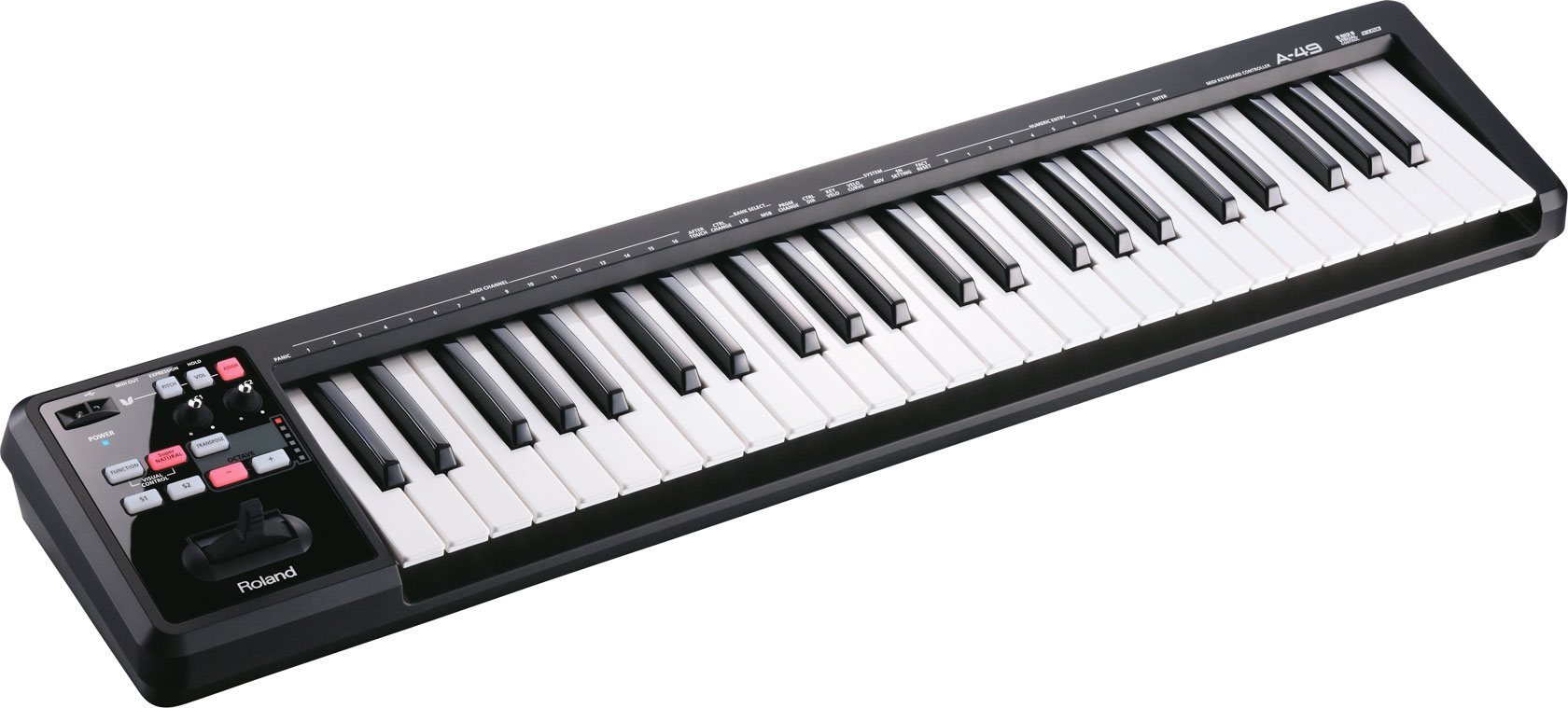
The A-49 is a 49-key MIDI keyboard from an earlier Roland generation. The manufacturer's US page still identifies it as a MIDI Keyboard Controller and lists black and pearl-white finishes, while Roland's product announcement dates the design to 2012. That combination matters: the model remains documented by its maker, but its age makes exact host support, software registration and the condition of a specific seller's unit worth checking. This assessment is based on Roland's product page, specification and English owner's manual; it is not a hands-on feel test.
Roland specifies 49 full-size, velocity-sensitive keys. Its copy describes a premium-grade keybed, but the specification does not name a weighted or synth-action mechanism. I would not translate the marketing description into a promise about resistance, repetition speed or whether a particular player will like it. The 49-note span covers more than a two-octave mini controller but leaves less room for wide two-handed parts than a 61- or 88-key bed. Octave and transpose buttons can move the playable range, yet they do not add simultaneous physical keys.
Hands-on controls without a pad bank
The panel is built around a combined pitch-bend/modulation lever, a D-BEAM hand controller, two assignable knobs and two assignable switches. Those are different kinds of control from the velocity- and pressure-sensitive pad banks found on some production keyboards: Roland's A-49 specification lists no pad bank. Its two pedal jacks add a hold switch and an expression pedal, but Roland lists the DP-series hold pedal and EV-5 expression pedal as separate options. The pedal jacks are helpful if your performance routine relies on foot control, not proof that a pedal is included with a used or new offer.
The SuperNATURAL button can be misunderstood. Roland describes the mode as a way to assign controls for compatible external SuperNATURAL sound modules. It does not turn the A-49 into a self-contained synthesizer. The documentation identifies MIDI messages and a computer connection, not an onboard sound engine or audio output. A software instrument or separate hardware module has to make the sound, and that sound needs its own speaker/headphone path.
Two connectors with a real setup cost
USB is Type-B, not USB-C. Roland lists the A-49 as powered by the computer through that port, and the English manual instructs the user to install Roland's USB driver before connecting it to a computer. That is a materially different starting point from a newer class-compliant board that simply appears as a USB MIDI device. Check the current driver download and your exact operating-system version before buying an older unit; the manual does not guarantee support for every present computer, hub or DAW.
For external hardware, the manual labels a separate MIDI OUT and shows the standard five-pin DIN connection to another device's MIDI IN. This gives the A-49 a direct route to a sound module without making USB audio claims. MIDI carries note and controller data, not the resulting sound. USB power remains part of the arrangement because the listed specification provides computer-supplied power and shows no DC input. In practical terms, plan the host/power cable and MIDI cable together, then confirm the receiving device can make and monitor audio.
The body is listed at 836 × 182 × 84 mm, or 32-15/16 × 7-3/16 × 3-5/16 inches, and 2.5 kg (5 lb 9 oz). Its modest mass makes it easier to lift than a full 88-key weighted controller, but 32-15/16 inches is still a substantial desk width. The case measurement excludes cable bend, hand space, a stand and any neighboring equipment. The finder uses the manufacturer's inch figure as a first screen only; a one-sixteenth-inch nominal margin under a 33-inch shelf is not a complete fit check.
What to check on an exact offer
Before ordering, confirm that the product is the Roland A-49 rather than a different A-series controller, and check whether the seller's pictured finish is black or pearl white. The US product page documents both colors, but this research found no finish-specific retail SKU or evidence of different controls, so the review treats color as a covered variant rather than a second functional model. If a particular color matters, compare the listing's own photos and model label instead of assuming the catalog image predicts the seller package.
Check the serial/model label, key and control condition, included USB cable, driver access, software-card status, pedal contents and return terms. Roland's page lists a USB cable and an Ableton Live Lite serial-number card in the product specification, but that old bundle language does not establish that a current seller's box is complete or that a software code remains unregistered. Verify the license with Roland and the seller. No current price, stock, warranty, retailer package or user rating is asserted here. The A-49's strengths are the full-size 49-note range, direct DIN output, D-BEAM and low listed mass; the trade-offs are its older driver-dependent USB-B workflow, lack of a sound engine, no USB-C and no pad bank.
Key specifications
Key details at a glance
| Keys | 49 |
|---|---|
| Width | 32.94 in |
| Pads | 0 |
| Velocity-sensitive pads | No |
| Pressure-sensitive pads | No |
| 5-pin MIDI Out | Yes |
| Computer connection | USB Type-B |
| USB bus-powered | Yes |
| Assignable pedal input | Yes |
| 5-pin MIDI In | No |
| Depth | 7.19 in |
| 5-pin MIDI outputs | 1 |
Use the exact model’s instructions for operating limits, supplied equipment and version differences.
Sources for this review
Sources for this assessment
Start with your setup, not a headline feature
Use the finder to combine key-count, connection, control and desk-fit requirements. Unverified specifications are never treated as a match.