
Your needs, this model
Does it fit your priorities?
Are the A-500PRO's pads actually pressure-sensitive?
Roland specifies eight Dynamic Pads, and the shared manual has a PAD AFTERTOUCH CURVE setting for how pressure on those pads maps to aftertouch data. That is separate from channel aftertouch on the 49 keys. The pad feature is documented, but the manual does not establish a particular feel or sensitivity by independent test.
Explore this need in the finder →Can I use USB software and a DIN sound module from one A-500PRO setup?
The manual's MIDI I/F mode routes computer USB MIDI to a sound module at MIDI OUT; the A-500PRO also lists physical MIDI IN. Select the needed interface mode and host ports before a session. The keyboard does not turn MIDI into audio: a receiving instrument and its own audio-monitoring route remain necessary.
Explore this need in the finder →How much desk space does the A-500PRO need?
Roland lists a 33-1/16-inch chassis width, 9-7/8-inch depth and 8 lb 7 oz mass. The width falls just over a 33-inch limit, and it excludes room for USB, DIN and pedal plugs, cable bends and hands. Measure the actual usable surface rather than treating the published dimension as a clearance envelope.
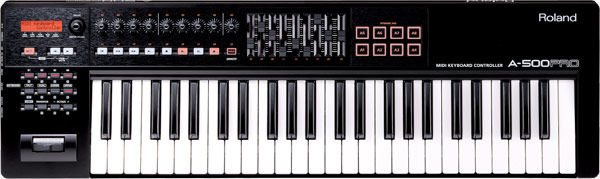
Explore this need in the finder →The A-500PRO is a discontinued 49-key controller in Roland's A-PRO family. It is aimed at a desk or stage rig where the keyboard is only one part of the surface: eight pads, assignable knobs and sliders, a display, pedals and a physical MIDI path all sit alongside the keys. This is an evidence-based assessment of Roland's US product specification and the shared English manual, not a report of personal use, testing or ownership.
What the 49-key configuration gives you
Roland specifies 49 velocity-sensitive keys with channel aftertouch. The product page describes the action as responsive but does not classify it as weighted, so the safe conclusion is about documented MIDI behavior rather than subjective feel. Forty-nine keys offer a useful middle range for lines and two-handed work, but they do not provide the span of a 61- or 88-key board. The A-500PRO's 33-1/16-inch body is only slightly wider than a strict 33-inch limit; plugs, cable bends and playing space make a true tight-fit installation a poor assumption.
The panel is the more unusual part. Roland lists eight Dynamic Pads, nine knobs, nine sliders, four buttons, transport controls, a two-line backlit LCD and a bender/modulation lever. The manual adds a pad-aftertouch curve that responds to pressure applied to the pads, separate from channel aftertouch on the keys. Those details make the A-500PRO a stronger match for a control-heavy workflow than its key count alone suggests.
Control maps matter as much as the control count
Roland describes the knobs, sliders, buttons and pads as assignable. In practice, a large panel does not automatically provide the right mapping for every instrument, DAW or plug-in. The A-PRO Editor and control-map system are part of the documented workflow; they may also be the least appealing part if the target computer is not supported by the available software. Check the precise driver and editor version for your host before relying on it. The current Roland US page lists A-PRO drivers for named Windows and macOS generations, but that is not proof of compatibility with every newer operating-system release.
The shared manual documents upper/lower keyboard parts and split/dual controls, so the A-500PRO can be configured for layered or divided performance. The available range remains 49 physical keys, and an arrangement does not expand that range. Its eight pads have their own pressure-response setting; they should not be confused with key aftertouch or treated as a guarantee of any particular pad feel.
USB, DIN and standalone operation
The controller offers USB computer MIDI and a separate MIDI IN/OUT pair. The manufacturer image shows a square USB Type-B port and full-size MIDI DIN sockets; USB bus power is supported. With the MIDI I/F switch in the interface mode, Roland's manual describes passing computer MIDI from USB through MIDI OUT to an external sound module and returning MIDI IN to the computer. Roland's support instructions describe using the alternate setting for direct keyboard-to-hardware control without a computer. That is a real distinction: whether the external instrument receives the keyboard directly or computer-routed messages depends on setup.
For a USB-hosted session, the connected computer powers the controller. For a hardware-only session without that host, Roland lists an optional AC adaptor. Neither arrangement makes the controller a sound source. The product specification documents a MIDI controller and MIDI I/O, not an internal synth or audio output. The connected computer or external module has to produce sound, and its own audio output must reach headphones, speakers or a mixer.
Compared with the A-500S and other sizes
The A-500S also has 49 keys, but it is a distinct, simpler model. Its documentation lists one rotary VALUE control, octave and program buttons, a three-character LED, one MIDI OUT and no pads or key aftertouch. It adds four-AA-battery power and 12 velocity curves. The A-500PRO is more capable as a control surface and has MIDI IN/OUT, but no manufacturer source here documents an AA-battery option. The A-300PRO has the same broad A-PRO control concept in a much narrower 32-key body; the A-800PRO has 61 keys and a longer chassis.
Used-model checks
Roland marks the A-500PRO discontinued, and neither its current product page nor this review establishes a live price, seller stock or condition. Verify that a listing is the A-500PRO rather than the A-500S, then inspect the 49 keys, pads, knobs, sliders, display, pedal jacks, USB and DIN connectors. Ask whether the included USB cable, AC adaptor, original software media and serial card are actually present; historical package documentation is not a promise about a used box or transferable licenses. Finally, confirm the present host supports the selected USB-driver or generic mode and control-map workflow. It is worth considering when the expressive control surface is a requirement, not merely because its product page counts many controls.
Key specifications
Key details at a glance
| Keys | 49 |
|---|---|
| Width | 33.06 in |
| Pads | 8 |
| Velocity-sensitive pads | Yes |
| Pressure-sensitive pads | Yes |
| 5-pin MIDI Out | Yes |
| Computer connection | USB Type-B |
| USB bus-powered | Yes |
| Assignable pedal input | Yes |
| Keyboard channel aftertouch | Yes |
| 5-pin MIDI In | Yes |
| Depth | 9.88 in |
| 5-pin MIDI outputs | 1 |
Use the exact model’s instructions for operating limits, supplied equipment and version differences.
Sources for this review
Sources for this assessment
- Roland US Owner's Manuals model directory
- Roland A-500PRO US product page and specifications
- Roland US A-500PRO Owner's Manual support record
- Roland A-300PRO/A-500PRO/A-800PRO English Owner's Manual
- Roland A-PRO standalone MIDI routing support article
- Roland A-500PRO rear-angle manufacturer product image

Start with your setup, not a headline feature
Use the finder to combine key-count, connection, control and desk-fit requirements. Unverified specifications are never treated as a match.