
Your needs, this model
Does it fit your priorities?
How is the A-500S different from the A-500PRO if both have 49 keys?
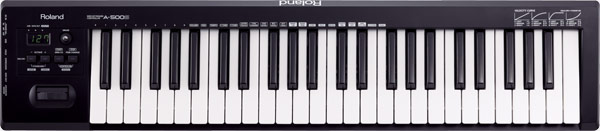
Roland specifies 49 velocity-sensitive keys on both, but the A-500S is the simpler surface: a VALUE knob, a few buttons, pitch/mod lever and three-character display, with one MIDI OUT. The A-500PRO adds channel aftertouch, eight pressure-responsive pads, nine knobs, nine sliders, a two-line LCD and MIDI IN/OUT. The A-500S instead documents 12 velocity curves, fixed-velocity mode and four-AA-battery power.
Explore this need in the finder →Can the A-500S run without a USB-connected computer?
Yes, Roland specifies four AA batteries or a separately sold 9 V AC adaptor as alternatives to USB bus power. The manual describes sending from the controller's MIDI OUT to an external MIDI sound module. Confirm that the used offer includes the battery cover, cable and any adaptor you need; the source listing does not make optional accessories part of every current seller package.
Explore this need in the finder →Should I count the old Production Plus Pack as a reason to choose it?
Treat it as a historical package description, not a live software entitlement. Roland's current page names SONAR 8.5 LE and three instruments, while the retrieved English manual package list names SONAR X1 LE. The manual also lists Windows XP standard-driver mode; the public driver list stops at older operating-system generations. Verify the exact serial/media, transfer rights and present host support separately.
Explore this need in the finder →The A-500S and A-500PRO are different 49-key controllers, despite the similar names. The A-500S is the simpler discontinued model: it gives you a velocity-sensitive keybed, a small set of controls, USB, one MIDI output and battery or optional AC power. This assessment is based on Roland's US product page and English owner's manual, not personal use or compatibility testing on a current computer.
A simple layout with useful velocity options
Roland specifies 49 full-size, velocity-sensitive keys, a pitch/modulation lever, VALUE knob, MIDI Channel and Program Change buttons, octave buttons and a three-character seven-segment display. The manual documents 12 velocity curves and a fixed-velocity mode. That can help when note entry needs a consistent velocity or when adjusting the response curve matters, but it is not aftertouch: the reviewed manual and product specifications do not document channel pressure on the keys.
It is also a much lighter control surface than the A-500PRO. The A-500S has no documented drum-pad bank, nine-knob section or nine faders. Someone who wants hands-on DAW controls should compare those panel differences directly rather than shopping by the shared 49-key count. The chassis is 32-13/16 inches wide, 7-1/4 inches deep and about 6 pounds. That is a useful published footprint, not the clearance needed for cables or a stand.
USB and a separate MIDI output
Roland documents USB computer MIDI and a separate MIDI OUT connector; its product image shows a square USB Type-B port and a full-size five-pin DIN output. The product page lists USB bus power, four alkaline AA cells or an optional AC adaptor. That combination supports different contexts: a computer can provide both USB connection and power, while batteries or the adaptor can power a direct hardware setup without a computer.
The physical MIDI output is for control messages to an external sound module, not an audio output from the A-500S. The manual describes selecting the A-500S MIDI OUT when routing to a connected external module. That module makes the sound and needs its own connection to speakers, headphones or a mixer. The A-500S also lacks documented MIDI IN, so it is not the same USB/DIN interface arrangement as the A-500PRO's MIDI IN/OUT pair.
Support age is a real buying factor
The A-500S is discontinued. Roland's public driver list covers older host generations, and the manual's standard USB-driver mode is specifically described for Windows XP. Those records do not verify operation with current Windows or macOS releases. A legacy controller may still suit a MIDI-hardware setup, but a new computer connection should be checked before buying. An adapter, host power, interface or driver cannot be assumed from the product name.
The software bundle deserves the same caution. Roland's current product page describes Production Plus Pack with SONAR 8.5 LE and three instruments, while the retrieved manual package list names SONAR X1 LE. Those are historical package descriptions, not proof that a used listing includes the discs or serial, that the license can transfer, or that the software can still install on a current computer. Consider the keyboard on the merits of its hardware controls and power options instead of assigning a value to a promised legacy bundle.
Comparison with the A-500PRO
For the same nominal key count, the A-500PRO is the more elaborate instrument: Roland lists key channel aftertouch, eight pressure-responsive pads, nine knobs, nine sliders, a two-line display and both MIDI IN and OUT. It is a little wider and does not document AA-battery power. The A-500S instead offers a smaller front panel, 12 velocity curves, fixed-velocity entry and battery operation. Neither is an automatic upgrade; they solve different control and power needs.
What to check before buying used
Ask the seller to confirm the exact A-500S model, not A-500PRO, and inspect all keys, the value knob, display, switches, octave buttons, pedal jacks, USB connector and MIDI OUT. Confirm which cable, adaptor and battery cover are included. The manual's approximate battery-life figure is manufacturer documentation and varies with conditions, not a promise about old cells. If a computer will be part of the setup, verify a compatible driver or standard-mode path on the exact host before the return window expires. The A-500S is a reasonable reference for a simple 49-key controller only when that legacy support and limited I/O are acceptable.
Key specifications
Key details at a glance
| Keys | 49 |
|---|---|
| Width | 32.81 in |
| Pads | 0 |
| Velocity-sensitive pads | No |
| Pressure-sensitive pads | No |
| 5-pin MIDI Out | Yes |
| Computer connection | USB Type-B |
| USB bus-powered | Yes |
| Assignable pedal input | Yes |
| 5-pin MIDI In | No |
| Depth | 7.25 in |
| 5-pin MIDI outputs | 1 |
Use the exact model’s instructions for operating limits, supplied equipment and version differences.
Sources for this review
Sources for this assessment

Start with your setup, not a headline feature
Use the finder to combine key-count, connection, control and desk-fit requirements. Unverified specifications are never treated as a match.